Advanced Information Management Enterprise Integration
Enterprise Information Management Frameworks
Structuring the Enterprise
Imagine trying to build a skyscraper without a blueprint. You might end up with staircases that lead to nowhere or electrical wiring that doesn't reach the top floors. A large organization, or enterprise, is just as complex as a skyscraper. Without a master plan, different departments can become disconnected, leading to wasted resources and conflicting goals.
Enterprise Architecture (EA) is the blueprint that aligns a company's business strategy with its technology infrastructure. It provides a holistic view of the entire organization.
To create this blueprint, organizations rely on established frameworks. These frameworks provide the structure and language needed to describe how all the pieces of the enterprise—from business processes to databases—fit together. They help ensure that every new project, every new piece of software, and every new hire moves the company in a unified direction.
The NIST Blueprint
One of the most foundational models is the NIST Enterprise Architecture Model. Developed by the National Institute of Standards and Technology, this model provides a high-level view of an organization's architecture. It's less of a step-by-step guide and more of a conceptual map, showing how different layers of the enterprise depend on one another.
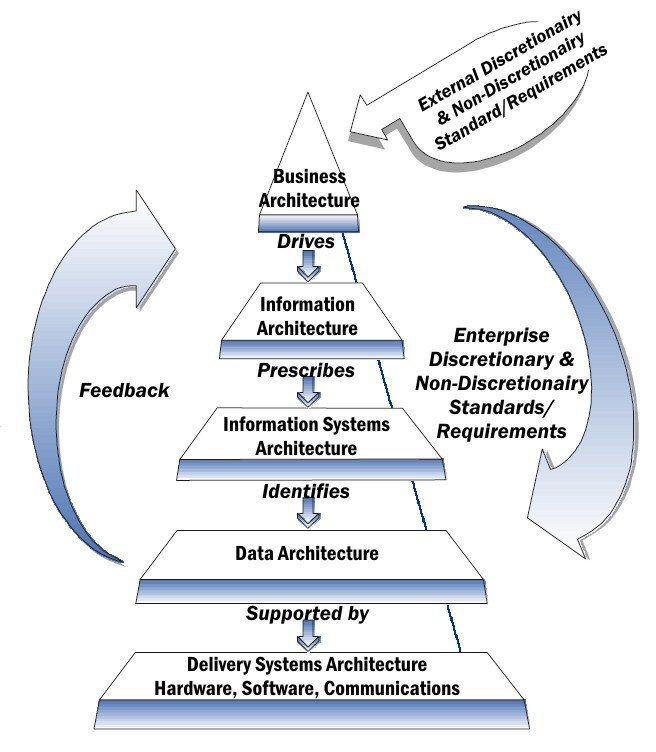
The model works from the top down. It starts with the Business Architecture, which defines the company's mission and strategy. This layer answers the question, "What are we trying to achieve?"
Flowing from that is the Information Architecture, which describes the data the organization needs to execute its business strategy. Finally, the Information Systems Architecture and Delivery Systems Architecture detail the applications and technology (like servers and networks) needed to manage that information and support the business. Everything is built on the foundation of the business goals.
The Four Domains of Architecture
Most enterprise architecture frameworks, including the NIST model, break down the enterprise into four key domains. Understanding these domains helps to organize the complexity of a large organization into manageable parts. Each domain represents a different layer of the enterprise, from the high-level business goals to the physical hardware that runs everything.
| Domain | Description | Key Questions |
|---|---|---|
| Business | The organization's strategy, governance, and key processes. | What is our mission? How do we create value? |
| Data | The structure of an organization's logical and physical data assets. | What information do we need? How is it stored and managed? |
| Applications | The software applications that support business functions. | What systems do we use? How do they interact? |
| Technology | The hardware, software, and network infrastructure. | What servers, networks, and operating systems do we need? |
These domains are not isolated. The Business domain dictates the needs of the Data and Applications domains, which in turn are supported by the Technology domain. A change in one domain, like a new business goal, will ripple through the others.
Information Framework
noun
A specific type of enterprise architecture framework that provides a standardized, industry-specific data model and business vocabulary.
While models like NIST provide a general structure, an Information Framework (IFW) gets more specific. It offers a pre-built map for an industry's data. For example, a bank using an IFW would have standard definitions for terms like "customer," "account," and "transaction." This ensures everyone in the organization is speaking the same language when it comes to data, which is crucial for consistency and clear communication.
By using these frameworks, an enterprise can create a clear and comprehensive plan. This plan guides decision-making and ensures that the organization's technology truly serves its business strategy.
Ready to test your knowledge? Let's see what you've learned about EIM frameworks.
What is the primary purpose of an enterprise architecture framework?
According to the NIST Enterprise Architecture Model, which layer defines the organization's mission and strategy?