Advanced Indian Polity and Constitutional Jurisprudence
Basic Structure Doctrine Evolution
The Amending Power Puzzle
The Indian Constitution gives Parliament the power to amend it under Article 368. But is this power absolute? Can Parliament rewrite any part of the Constitution it chooses, including the Fundamental Rights that protect citizens from the state?
This question sparked a decades-long tug-of-war between Parliament and the Judiciary. The first major test came in 1951 with the case of Shankari Prasad v. Union of India. The Supreme Court ruled that Parliament's power to amend the Constitution was unlimited. It could amend any provision, including Fundamental Rights. The court reasoned that an amendment was not an ordinary law and thus wasn't subject to the limitations that apply to regular legislation.
A Fundamental Shift
For over a decade, this interpretation held firm. Then, in 1967, the Supreme Court dramatically reversed its position in I.C. Golaknath v. State of Punjab. A bench of 11 judges declared that Fundamental Rights held a “transcendental and immutable” place in the Constitution. They could not be abridged or taken away by the amending procedure. The court effectively drew a line in the sand, stating that Parliament's power did not extend to these core rights.
This decision triggered a direct confrontation. In response, Parliament passed the 24th Amendment in 1971, which explicitly gave it the power to amend any part of the Constitution. It followed this with the 25th Amendment, which curtailed the right to property and sought to limit the scope of judicial review over certain laws.
The Kesavananda Bharati Resolution
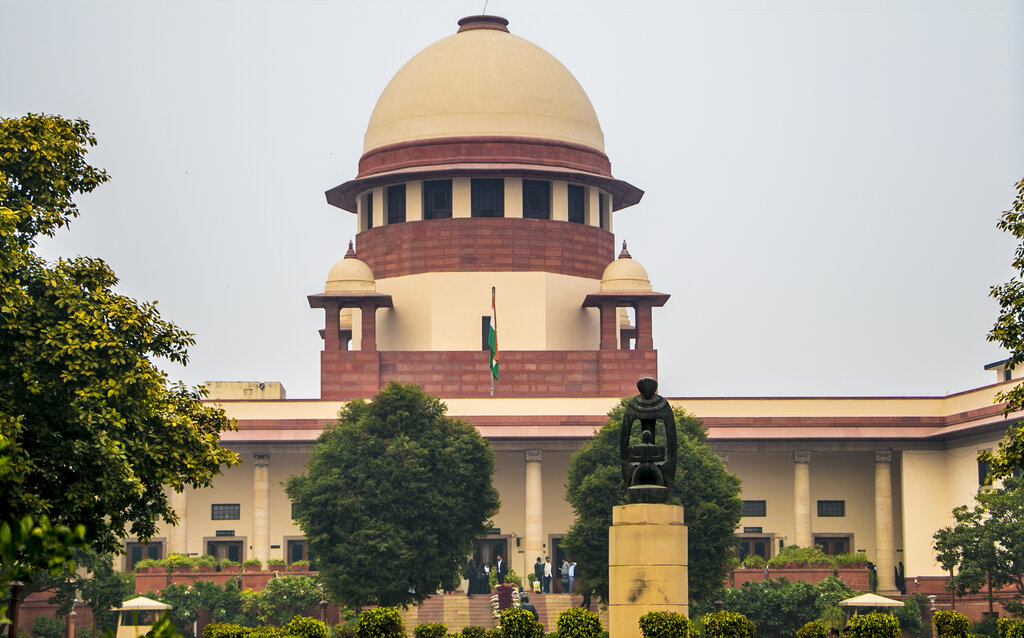
The constitutional crisis came to a head in the monumental case of Kesavananda Bharati v. State of Kerala in 1973. A 13-judge bench, the largest ever assembled in the Supreme Court, was tasked with settling the dispute once and for all. The verdict, delivered with a razor-thin 7:6 majority, was a masterclass in constitutional balancing.
The Court overturned its decision in Golaknath and affirmed Parliament's power to amend any part of the Constitution. However, it introduced a crucial limitation: Parliament could amend, but it could not alter or destroy the
basic structure
" of the Constitution. This meant that while the letter of the law could be changed, its soul could not.
The basic structure doctrine is an Indian judicial principle that the Constitution of India has certain basic features that cannot be altered or destroyed through amendments by the parliament.
Parliament pushed back again. The 42nd Amendment, passed in 1976, attempted to make parliamentary amendments completely immune from judicial scrutiny. It declared that there would be “no limitation whatever” on Parliament's amending power.
This led to the case in 1980. The Supreme Court struck down the parts of the 42nd Amendment that removed judicial review. The Court reasoned that the power of judicial review was itself a part of the Constitution's basic structure. It also emphasized that the harmony and balance between Fundamental Rights and Directive Principles was a core feature that could not be destroyed.
The Ninth Schedule Test
A final frontier for the doctrine was the of the Constitution. This schedule was created to protect certain laws, particularly those related to land reform, from being challenged in court for violating Fundamental Rights. Over the years, it became a sort of constitutional safe house for controversial legislation.
For decades, it was assumed that once a law was placed in the Ninth Schedule, it was immune from judicial review forever. This changed with the 2007 judgment in I.R. Coelho v. State of Tamil Nadu. The Court ruled that even laws placed in the Ninth Schedule are not exempt from scrutiny. Any law added to the schedule after the date of the Kesavananda Bharati judgment (April 24, 1973) could be struck down if it violated the basic structure of the Constitution. This ruling brought every single part of the Constitution under the protective umbrella of the basic structure doctrine.
Let's test your understanding of this constitutional journey.
What was the initial stance of the Supreme Court on Parliament's power to amend Fundamental Rights, as established in the 1951 Shankari Prasad v. Union of India case?
The Supreme Court's ruling in I.C. Golaknath v. State of Punjab (1967) stated that Fundamental Rights could not be abridged by Parliament.
Through this long series of judicial pronouncements, the Supreme Court carved out a space for constitutional flexibility while safeguarding its core identity.