Advanced Hydrocarbon Transformation and Functionalisation
Alkanes to Alkyl Halides
Activating the Unreactive
Alkanes are the bedrock of organic chemistry, but they're notoriously unreactive. Their C-C and C-H bonds are strong and non-polar, making them poor candidates for the ionic reactions that drive many syntheses. To use them as starting materials, we first need to install a functional group, a process called functionalisation. The most direct route is free-radical halogenation, which swaps a hydrogen atom for a halogen (like chlorine or bromine).
This transformation doesn't happen in a single step. It proceeds through a free-radical chain reaction, a self-propagating sequence of steps involving highly reactive species with unpaired electrons.
The Chain Reaction Mechanism
This mechanism unfolds in three distinct stages: initiation, propagation, and termination.
1. Initiation: The reaction is kick-started by creating the first radicals. UV light or heat provides the energy to split a diatomic halogen molecule homolytically, meaning each atom gets one electron from the bond, forming two halogen radicals.
2. Propagation: These steps form the product and regenerate the radical, allowing the chain to continue. There are two propagation steps that cycle repeatedly.
3. Termination: The chain reaction eventually stops when any two radicals in the mixture collide and combine, pairing their unpaired electrons to form a stable bond. This consumes the radicals without producing new ones.
Chlorine vs. Bromine
Not all halogens are created equal. Chlorine is highly reactive and not very selective. When reacting with an alkane that has different types of hydrogens (e.g., primary, secondary), chlorination produces a mixture of all possible isomers. For example, the free-radical chlorination of propane yields both 1-chloropropane and 2-chloropropane.
| Alkane | Product | Yield at 25°C |
|---|---|---|
| Propane | 1-Chloropropane | 45% |
| Propane | 2-Chloropropane | 55% |
Separating such a mixture can be difficult and costly, making this reaction less useful for targeted synthesis. Bromine, on the other hand, is much less reactive and far more selective. It will preferentially abstract the hydrogen that leads to the most stable alkyl radical.
This difference in selectivity is explained by the Hammond Postulate, which relates the structure of a transition state to the species it is closest to in energy. Hydrogen abstraction by a chlorine radical is highly exothermic, so the transition state is early and resembles the reactants. In contrast, hydrogen abstraction by a bromine radical is endothermic. Its transition state is late, product-like, and strongly reflects the stability of the resulting alkyl radical.
Because of this, bromination of propane almost exclusively yields 2-bromopropane. The reaction proceeds via the more stable secondary radical intermediate over the primary one. The order of is tertiary > secondary > primary. Therefore, bromine is the reagent of choice when you want to form the most substituted alkyl halide possible.
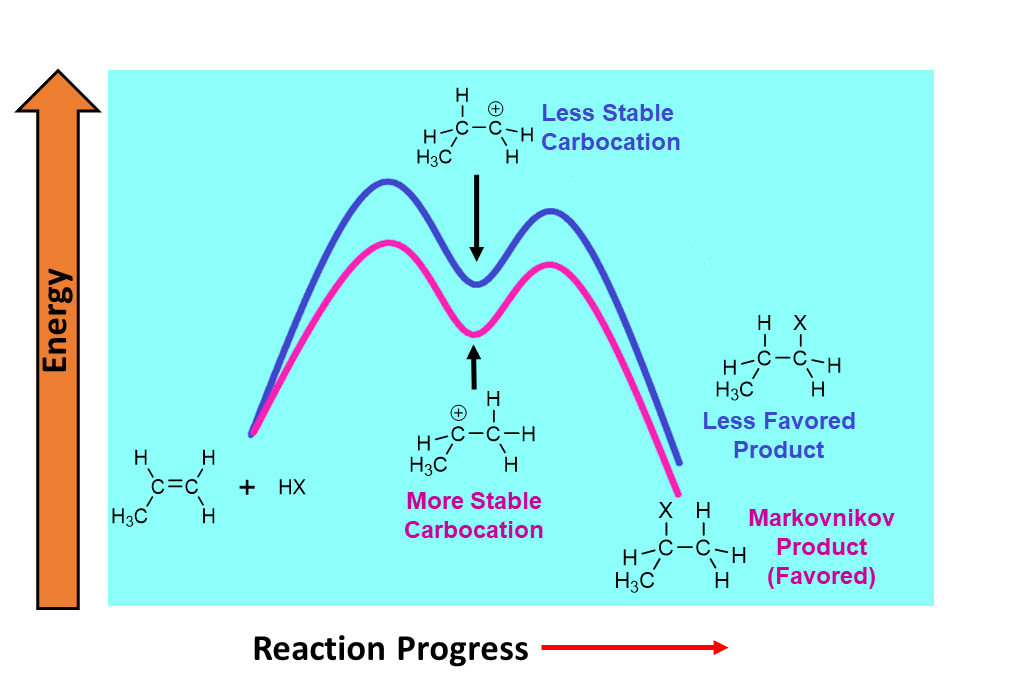
The Big Picture: Radicals and Carbocations prefer a greater degree of alkyl substitution.
Practical Synthesis
In practice, if a synthesis requires converting an alkane into a specific alkyl halide, free-radical bromination is often the best first step, provided there's a tertiary or secondary hydrogen available to be selectively replaced. For example, to synthesise 2-bromo-2-methylpropane, you would treat 2-methylpropane with Br₂ and UV light. The reaction would overwhelmingly favour abstraction of the lone tertiary hydrogen.
While chlorination can be useful in industrial settings where complex mixtures are either acceptable or easily separated, for targeted, lab-scale synthesis, the regioselectivity of bromine makes it a much more predictable and valuable tool. This initial functionalisation step opens the door to countless other transformations.
Why are alkanes generally considered unreactive?
What are the three stages of a free-radical chain reaction, in the correct order?
This conversion of a simple, unreactive alkane into a versatile alkyl halide is a foundational strategy in building more complex molecules.