Advanced Human Psychology Principles
Complex Cognitive Frameworks
The Two Minds Within
Our brains don't have a single, unified way of thinking. Instead, psychologists describe a dual-process model, where two distinct systems operate in parallel. Think of it as having a fast, intuitive autopilot and a slow, deliberate pilot who can take the controls when needed.
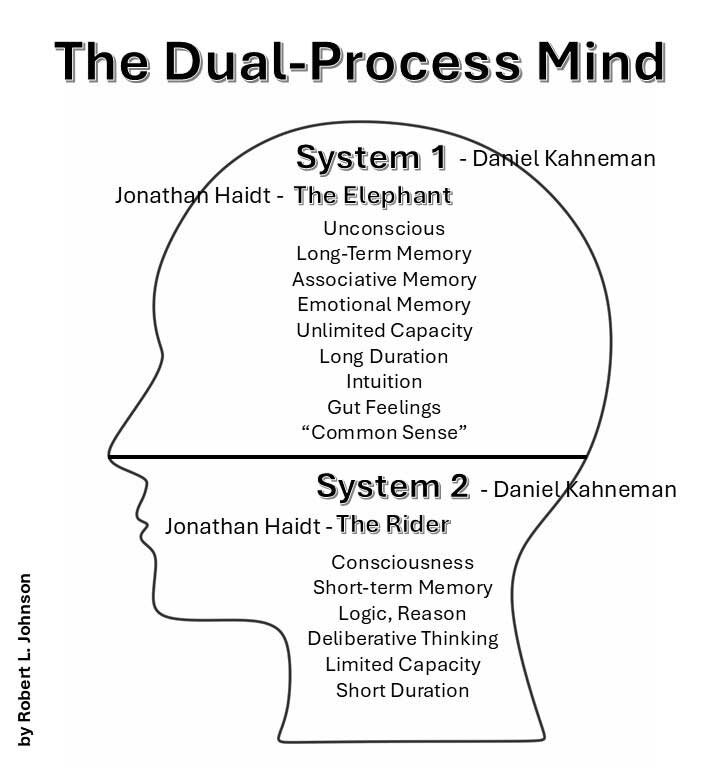
System 1 is the elephant. It's fast, automatic, and emotional. It operates effortlessly, handling everyday decisions like recognizing a friend's face or dodging a ball thrown at you. It relies on simple rules of thumb, called heuristics, to make quick judgments based on past experiences and associations. You don't consciously control it; it just happens.
System 2 is the rider. It's slow, analytical, and requires conscious effort. This is the system you engage when you solve a math problem, compare two different job offers, or learn a new skill. It's logical and deliberate, but it's also lazy. It tires easily and would rather let System 1 handle things whenever possible.
Why We Take Shortcuts
If System 2 is so logical, why don't we use it all the time? The simple answer is energy conservation. Deliberate thought is expensive. Our brains evolved to be efficient, and running System 2 constantly would be exhausting. This mental cost is known as , which is the total amount of mental effort being used in your working memory. When faced with too much information or too many decisions, we experience decision fatigue, and our brain defaults to the low-energy shortcuts of System 1.
Two main ideas explain why we rely on these heuristics. The Capacity-Based framework suggests our reliance on shortcuts is a matter of limited processing power. Like a computer with limited RAM, our brains can only handle so much active information at once. Heuristics are a necessary compromise. In contrast, the Expertise-Based framework argues that experts develop highly-tuned, accurate intuitions. A seasoned firefighter's gut feeling about a building's stability isn't a random guess; it's a System 1 response built from thousands of hours of experience. For them, the shortcut is often the right path.
This process works on basic neural principles. The Principle of Association means that System 1 links ideas together based on experience. Thinking of 'beach' might automatically bring 'sun' and 'sand' to mind. The Principle of Compatibility describes our tendency to favor information that fits with our existing beliefs. This makes processing easier but also opens the door to biases.
When Shortcuts Go Wrong
While heuristics are efficient, their uncritical use in high-stakes environments can lead to systematic errors in judgment, known as cognitive biases. These aren't just random mistakes; they are predictable patterns of deviation from rational thought.
One of the most common is bias. This is our tendency to rely too heavily on the first piece of information offered (the 'anchor') when making decisions. In a salary negotiation, the first number put on the table, whether high or low, sets a powerful anchor that influences all subsequent counteroffers. Real estate agents often leverage this by showing a client an overpriced house first, making subsequent, more reasonably priced houses seem like a bargain.
Another powerful bias is the Availability Heuristic. We tend to overestimate the likelihood of events that are more easily recalled in our memory. Because vivid, dramatic, or recent events are more memorable, we assume they are more common.
A loan officer who recently processed a default on a restaurant loan might become overly cautious and reject similar, perfectly viable applications, overestimating the risk because the recent failure is so fresh in their mind. Similarly, news coverage of a plane crash can make people feel that flying is more dangerous than driving, even though statistics show the opposite. The dramatic story is more 'available' to our minds than the boring data.
Belief bias is a direct result of the compatibility principle. It’s our tendency to judge the strength of arguments based on the plausibility of their conclusion, rather than how strongly they support that conclusion. If an argument's conclusion fits with what we already believe, we are more likely to accept the argument as valid, even if its logic is flawed. This makes it difficult to evaluate opposing viewpoints fairly, as our System 1 brain is already telling us the conclusion is 'wrong' before we've even engaged System 2 to analyze the reasoning.
Which of the following best describes the primary function of System 1 thinking?
A real estate agent shows a client an absurdly overpriced house first before showing them more reasonably priced options. The client then perceives the subsequent houses as great deals, even if they are still slightly overvalued. This strategy primarily leverages which cognitive bias?
Understanding these cognitive frameworks is the first step toward better decision-making. By recognizing the pull of our automatic, intuitive brain, we can learn when to pause and deliberately engage our slower, more analytical mind, especially when the stakes are high.