Advanced Human Physiology and Systemic Coordination
Circulatory Fluid Dynamics
The Physics of Blood Flow
Your circulatory system is much more than a simple network of tubes. It's a highly sophisticated hydraulic system governed by the principles of fluid dynamics, a field known as hemodynamics when applied to blood. At its core, the relationship is straightforward: the amount of blood that flows through a vessel is directly proportional to the pressure difference driving it and inversely proportional to the resistance it encounters.
Blood Flow () = Pressure Gradient () / Resistance ()
This seems simple enough, but the 'Resistance' variable hides a lot of complexity. The most critical factor determining resistance in a blood vessel is its radius. A French physician and physicist, Jean Léonard Marie Poiseuille, studied fluid flow through narrow tubes and derived an equation that perfectly captures this relationship.
Notice the radius () is raised to the fourth power. This is the crucial takeaway. It means that even a tiny change in the diameter of a blood vessel has an enormous effect on its resistance to flow. If you halve the radius of an artery, you don't just double the resistance—you increase it by a factor of 16 ().
This principle is the foundation of how your body regulates blood flow. By constricting (vasoconstriction) or relaxing (vasodilation) the muscular walls of your arterioles, your body can precisely control where blood goes and how much gets there.
Exchange at the Capillaries
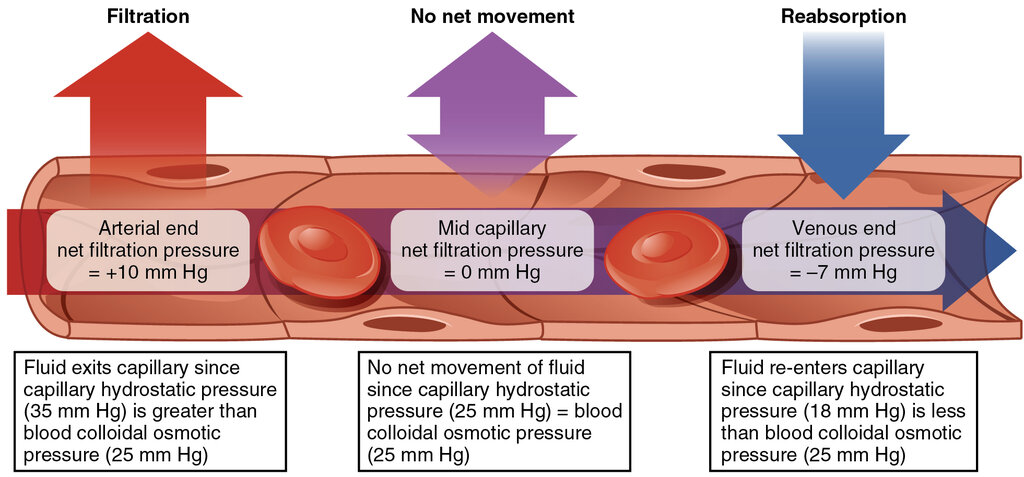
Once blood reaches the vast network of capillaries, its primary job isn't just to flow, but to exchange substances with the surrounding tissues. This is where oxygen and nutrients leave the blood, and carbon dioxide and waste products enter it. This delicate ballet is orchestrated by a balance of two opposing pressures, collectively known as Starling forces .
-
Hydrostatic Pressure: This is the physical pressure of the blood against the capillary walls, generated by the heart's pumping. It acts as a pushing force, trying to move fluid out of the capillary and into the surrounding interstitial space.
-
Oncotic Pressure (or Colloid Osmotic Pressure): This is an osmotic pressure generated by large proteins (mainly albumin) that are too big to easily pass through the capillary wall. These proteins create a pulling force, drawing fluid into the capillary from the interstitial space.
At the arterial end of a capillary, hydrostatic pressure is high, overpowering oncotic pressure. This results in net filtration, where fluid, oxygen, and nutrients are pushed out into the tissues. As blood moves along the capillary, pressure drops. By the venous end, hydrostatic pressure is lower than the oncotic pressure, resulting in net reabsorption, where fluid and waste products are pulled back into the bloodstream.
Any excess fluid left in the interstitial space is collected by the lymphatic system and returned to circulation. When this balance is disturbed, for example by high blood pressure (increased hydrostatic pressure) or liver disease (decreased plasma proteins and oncotic pressure), fluid can accumulate in the tissues, causing oedema.
Meeting Local Demands
Your body doesn't send the same amount of blood everywhere all the time. An actively contracting muscle needs far more oxygen than a resting one. This redirection of blood flow is managed locally, without needing direct instructions from the brain, through a process called autoregulation.
When a tissue's metabolic activity increases, it produces waste products like carbon dioxide, adenosine, and lactic acid. These substances act as local vasodilators, causing the arterioles feeding the tissue to relax and widen. This reduces resistance and increases blood flow, delivering more oxygen to meet the demand. This is called metabolic autoregulation.
Another clever mechanism is the myogenic response. The smooth muscle in arteriole walls has a unique property: it contracts when stretched. If blood pressure suddenly increases, the vessel wall stretches, triggering a contraction. This vasoconstriction increases resistance and prevents a surge in blood flow, protecting the delicate capillaries downstream. Conversely, a drop in pressure causes the muscle to relax, increasing flow.
Changes in resistance are the primary means by which blood flow is regulated within organs because control mechanisms in the body maintain arterial and venous blood pressures within a narrow range.
These local controls ensure that cardiac output is distributed efficiently according to the real-time needs of different tissues.
System-Wide Pressure Control
While local mechanisms handle tissue-specific needs, the body needs a way to manage overall blood pressure. This is crucial for ensuring adequate blood flow to vital organs like the brain. The primary rapid-response system for this is the baroreceptor reflex.
Located in the walls of the aorta and carotid arteries, baroreceptors are stretch-sensitive nerve endings that constantly monitor blood pressure. If pressure rises, the artery walls stretch more, increasing the firing rate of these nerves. This signal travels to the brainstem, which responds by:
- Increasing parasympathetic (calming) signals to the heart, slowing it down.
- Decreasing sympathetic (fight-or-flight) signals to the heart and blood vessels, reducing heart contractility and causing vasodilation.
The combined effect is a decrease in both cardiac output and Systemic Vascular Resistance (SVR), the total resistance of all the blood vessels in the body. This quickly brings blood pressure back down. If pressure drops, the opposite occurs: baroreceptor firing decreases, and the sympathetic system kicks in to raise heart rate and constrict blood vessels, restoring pressure.
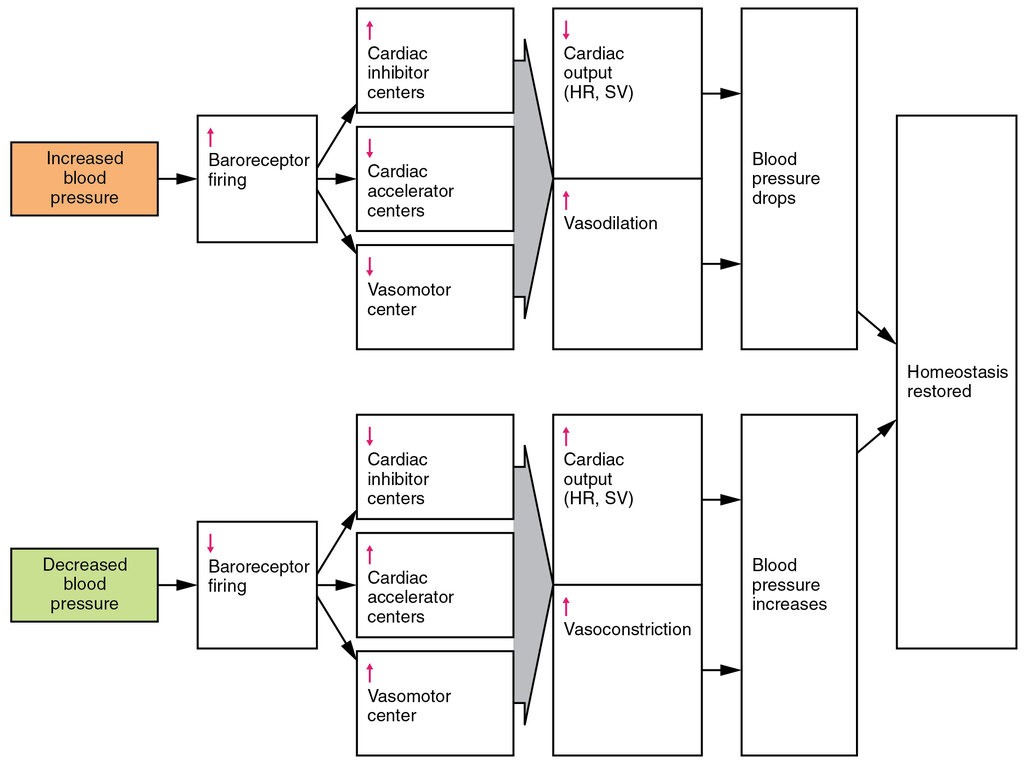
This reflex maintains our Mean Arterial Pressure (MAP) within a narrow, safe range, protecting us from the effects of sudden postural changes, like standing up too quickly.
Time to test your understanding of these fluid dynamic principles.
If a small artery constricts and its radius is reduced by half, what is the resulting increase in its resistance to blood flow?
At the arterial end of a capillary bed, the physical pressure of the blood pushing fluid outwards is typically stronger than the osmotic pressure pulling fluid inwards. What is this phenomenon called?
Understanding these principles of pressure, flow, and resistance moves us beyond simple anatomy. It reveals the circulatory system as a dynamic, responsive network that constantly adjusts to maintain the delicate balance required for life.