Advanced Human Memory Systems
Synaptic Plasticity Mechanics
The Brain's Malleable Wiring
The foundation of learning and memory isn't abstract. It's a physical process of rewiring that happens at a microscopic level. Your brain contains billions of neurons, and the connections between them, called synapses, are not fixed. They can strengthen or weaken based on their activity. This ability to change is known as synaptic plasticity. It’s the mechanism that allows us to adapt, learn new skills, and form lasting memories. The core principle, often simplified as "neurons that fire together, wire together," was proposed by Donald Hebb in 1949 and is a cornerstone of neuroscience.
Synaptic plasticity refers to the ability of synapses to strengthen or weaken over time, which is essential for learning and memory formation
Strengthening Connections: LTP
When a synapse is frequently used, it can become stronger for an extended period. This process is called Long-Term Potentiation (LTP). Imagine you're learning a new phone number. Repeating it over and over is like sending a high-frequency signal across a specific set of synapses. This repeated stimulation kicks off a precise molecular cascade that fortifies the connection.
It begins when the presynaptic neuron releases the neurotransmitter glutamate into the synaptic cleft. On the postsynaptic membrane, glutamate binds to two critical types of receptors: AMPA and NMDA. AMPA receptors are the first to act, opening to allow sodium ions () to flow in. This causes a small, temporary depolarization of the postsynaptic neuron.
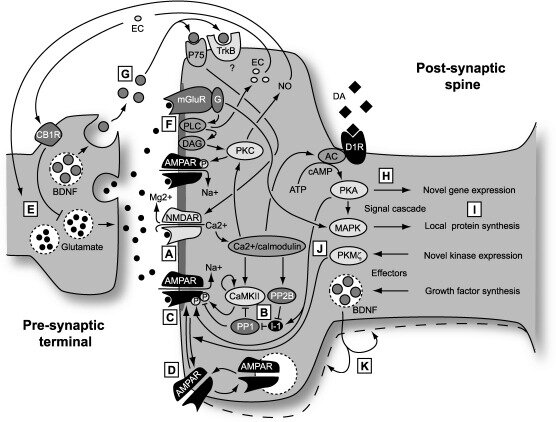
The is the real star of LTP. Under normal conditions, it's blocked by a magnesium ion (), like a cork in a bottle. Even if glutamate binds to it, nothing happens. However, if the presynaptic neuron fires rapidly and repeatedly, the cumulative influx of sodium through the AMPA receptors causes a strong enough depolarization to expel the magnesium ion. This unblocks the NMDA receptor. Now, when glutamate binds, the channel opens and allows a flood of calcium ions () into the postsynaptic cell. This calcium influx is the trigger for LTP.
The surge of intracellular calcium activates a host of enzymes, most notably CaMKII (Calcium/calmodulin-dependent protein kinase II). Activated CaMKII sets off a chain reaction with two major effects. First, it phosphorylates existing AMPA receptors, making them more responsive to glutamate. It's like turning up the volume on the receiver. Second, and more importantly for long-lasting change, it triggers the insertion of new AMPA receptors into the postsynaptic membrane from an intracellular reserve pool.
With more AMPA receptors, the same amount of glutamate released from the presynaptic neuron will now cause a much larger response in the postsynaptic neuron. The connection is potentiated, or strengthened. This physical change can last for hours, days, or even longer, forming the biological basis of a memory.
Rules of Engagement
LTP doesn't happen randomly. It follows specific rules that allow for the creation of complex, organized neural circuits.
Cooperativity: A single, weak stimulus is usually not enough to induce LTP. It takes the cooperative action of several presynaptic neurons firing at once, or one neuron firing at a very high frequency, to depolarize the postsynaptic membrane sufficiently to unblock the NMDA receptors. It's a team effort.
Associativity: This property is crucial for associative learning, like when the sound of a bell becomes associated with food. If a weak pathway is activated at the same time as a strong pathway on the same neuron, both pathways can be strengthened. The strong input provides the necessary depolarization to unblock the NMDA receptors at the synapses of the weak input, allowing LTP to occur there as well. The weak input essentially 'piggybacks' on the strong one.
Input Specificity: LTP is confined only to the synapses that are actively stimulated. If a neuron receives inputs from a thousand different presynaptic cells, only the synapses that meet the criteria for cooperativity and associativity will be strengthened. Inactive synapses on the same neuron will remain unchanged. This precision prevents the entire neuron from becoming indiscriminately excitable and allows for the refined storage of information.
This specificity, however, raises a question: if the strengthening process involves creating new proteins, how does the neuron ensure those proteins only go to the correct, active synapse and not to neighboring inactive ones? This is explained by the synaptic tagging and capture hypothesis..
Weakening and Forgetting
Just as connections can be strengthened, they can also be weakened. This process, called Long-Term Depression (LTD), is not simply the reversal of LTP but an active mechanism in its own right. It is often induced by slow, prolonged, low-frequency stimulation.
Like LTP, LTD is triggered by a rise in postsynaptic calcium, but the dynamics are different. A small, slow rise in calcium activates a different set of enzymes, primarily protein phosphatases. These enzymes do the opposite of kinases like CaMKII: they dephosphorylate AMPA receptors, making them less responsive, and trigger their removal from the synaptic membrane. Fewer AMPA receptors mean the synapse is weaker. LTD is just as important as LTP, providing a mechanism to clear old memories, refine motor skills, and prevent neural circuits from becoming over-saturated and unstable.
LTP and LTD work in concert, allowing the brain to encode new information while also pruning away irrelevant connections, ensuring our neural networks remain efficient and adaptive.
Time to see what you've learned about how our brains build memories at the cellular level.
What is the fundamental principle that describes how learning and memory are physically formed in the brain?
In the process of Long-Term Potentiation (LTP), what is the direct role of the NMDA receptor?