Advanced Human Genetics Principles
Non-Mendelian Inheritance
Beyond Dominant and Recessive
Genetics often starts with Gregor Mendel's peas, where one allele is clearly dominant over another. A tall plant allele and a short plant allele don't create a medium-height plant; the tall allele wins out. This is called complete dominance. But the living world is far more complex than that. Many traits don't follow this simple dominant-recessive pattern. Let's explore the nuances of how genes are actually expressed.
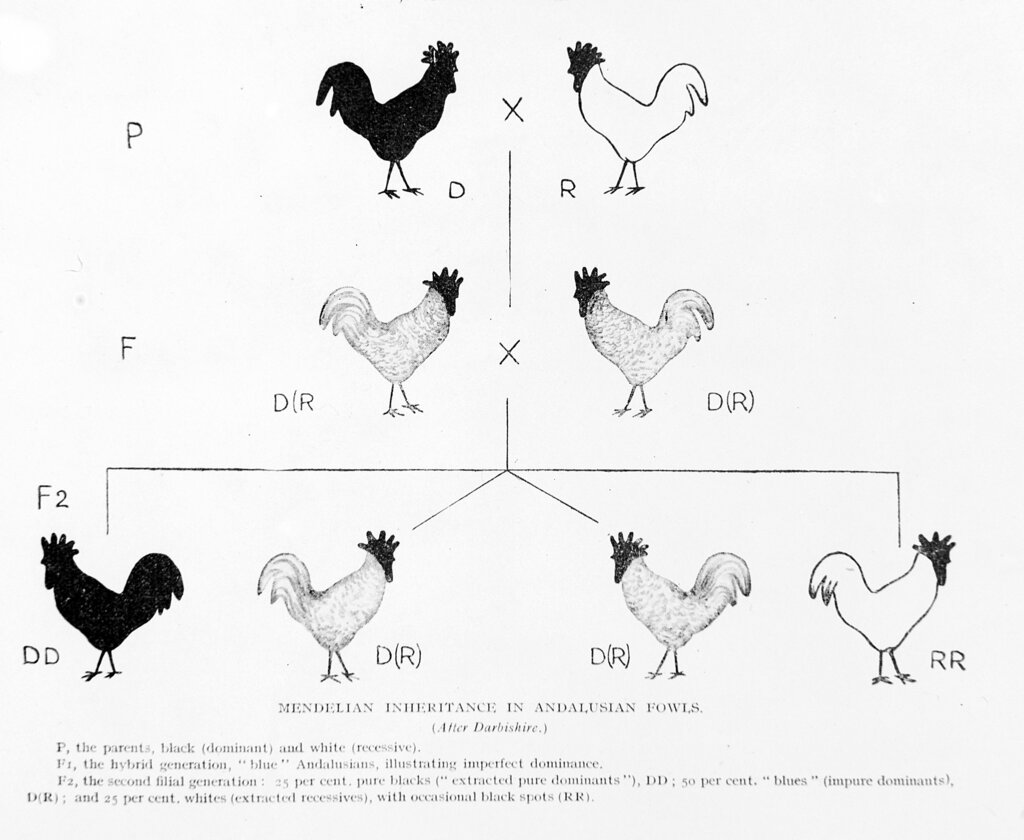
First, consider incomplete dominance. In this pattern, the heterozygous phenotype is a blend of the two homozygous phenotypes. It’s like mixing paint. A classic example is the snapdragon flower. A plant with two alleles for red flowers (RR) will be red. A plant with two alleles for white flowers (rr) will be white. But a plant with one of each (Rr) won't be red; it will be pink, an intermediate color. Neither allele completely masks the other.
Shared Expression
Codominance is another departure from Mendel's simple rules. Instead of blending, both alleles are fully and separately expressed in the phenotype. The most famous example of this is the ABO blood group system in humans. This system also introduces another concept: multiple alleles. While an individual can only have two alleles for a gene, more than two can exist within a population.
For blood type, there are three main alleles: , , and . The and alleles are codominant with each other, and both are completely dominant over the recessive allele. This leads to four possible phenotypes (blood types).
| Genotype(s) | Phenotype (Blood Type) |
|---|---|
| or | Type A |
| or | Type B |
| Type AB | |
| Type O |
If you have the genotype , your red blood cells have both A-type and B-type antigens on their surface. Neither allele is diluted or blended; they are both equally expressed. This is the essence of codominance.
One Gene, Many Effects
Sometimes, a single gene can influence multiple, often seemingly unrelated, phenotypic traits. This phenomenon is called pleiotropy (from the Greek words for "more" and "turn"). Instead of a one-to-one relationship between a gene and a trait, one gene can have a ripple effect, causing a cascade of different outcomes in an organism.
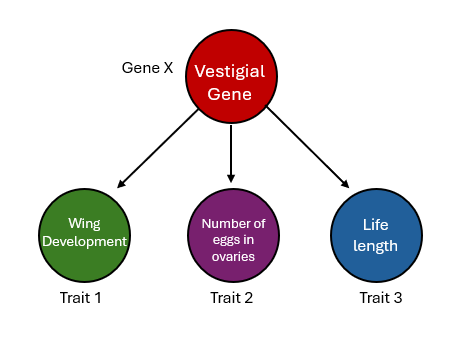
A classic human example is Marfan syndrome, a disorder affecting the body's connective tissue. It's caused by a mutation in a single gene (FBN1), but it produces a wide range of symptoms. People with Marfan syndrome are often unusually tall, have long limbs and fingers, and can have serious heart and eye problems. All these different effects stem from that one faulty gene impacting connective tissue throughout the body.
Gene Teamwork
Genes don't operate in a vacuum. Often, one gene can interfere with or modify the expression of another gene. This interaction is called epistasis. It's like a genetic override switch. Dominance is an interaction between alleles of the same gene, but epistasis is an interaction between different genes.
In epistasis, the gene that does the masking is called the epistatic gene; the gene whose effect is masked is the hypostatic gene.
Coat color in Labrador retrievers provides a clear example. One gene (the B gene) determines the pigment color: the dominant allele (B) produces black pigment, while the recessive allele (b) produces brown pigment. A separate gene (the E gene) controls whether the pigment is deposited in the fur. The dominant allele (E) allows pigment deposition, but the recessive homozygous genotype (ee) blocks it entirely, resulting in a yellow coat regardless of what the B gene says. The E gene is epistatic to the B gene.
Finally, we have polygenic inheritance, where a single trait is influenced by the additive effects of multiple genes. Unlike the traits Mendel studied, which were discrete (like purple or white flowers), polygenic traits show continuous variation across a spectrum. Human height, skin color, and eye color are all examples. There isn't just a "tall" and "short" gene; dozens or even hundreds of genes contribute small effects that, together, determine a person's height. This results in the familiar bell-curve distribution of traits in a population.
These non-Mendelian patterns show that genetics is a rich and complex field. While Mendel's laws provided the foundation, understanding phenomena like codominance, pleiotropy, and polygenic inheritance is key to grasping how genotypes truly create the diverse phenotypes we see in the world.