Advanced Human Anatomy Systems
Vascular System
The Body's Highway System
Your circulatory system is a vast network of tubes, much like a complex highway system. These tubes, called blood vessels, transport blood to every part of your body. Just as roads vary from multi-lane freeways to small neighborhood streets, blood vessels come in three main types, each with a specific job: arteries, veins, and capillaries.
The human vascular system comprises three distinct types of blood vessels—arteries, veins, and capillaries—each with specialized structures and functions that work together to sustain life.
Think of arteries as the major highways leading out of a city—the heart. They carry oxygen-rich blood away from the heart to the rest of the body. Capillaries are the small local streets that branch off the highways, delivering oxygen and nutrients directly to the houses—your cells. Veins are the highways leading back to the city, carrying oxygen-poor blood and waste products back to the heart.
Arteries: The Pressure Pipelines
Arteries are built to withstand pressure. Every time your heart beats, it pushes a powerful surge of blood into these vessels. To handle this force, arteries have thick, muscular, and elastic walls. The elasticity allows them to expand with each pulse and then snap back, which helps push the blood forward.
The largest artery in your body is the aorta, which connects directly to the heart's left ventricle. From the aorta, smaller arteries branch out, reaching every region of the body. The one major exception to the "oxygen-rich" rule is the pulmonary artery, which carries oxygen-poor blood from the heart to the lungs to get re-oxygenated.
As arteries branch further and further from the heart, they become smaller and are called arterioles. These arterioles act as gatekeepers, controlling which capillary beds receive blood.
Capillaries: The Exchange Zones
This is where the real work of the circulatory system happens. Capillaries are the smallest blood vessels, so narrow that red blood cells have to pass through in single file. Their walls are incredibly thin—just a single layer of cells. This delicate structure is perfect for their function: the exchange of substances between the blood and the body's tissues. This process is called microcirculation.
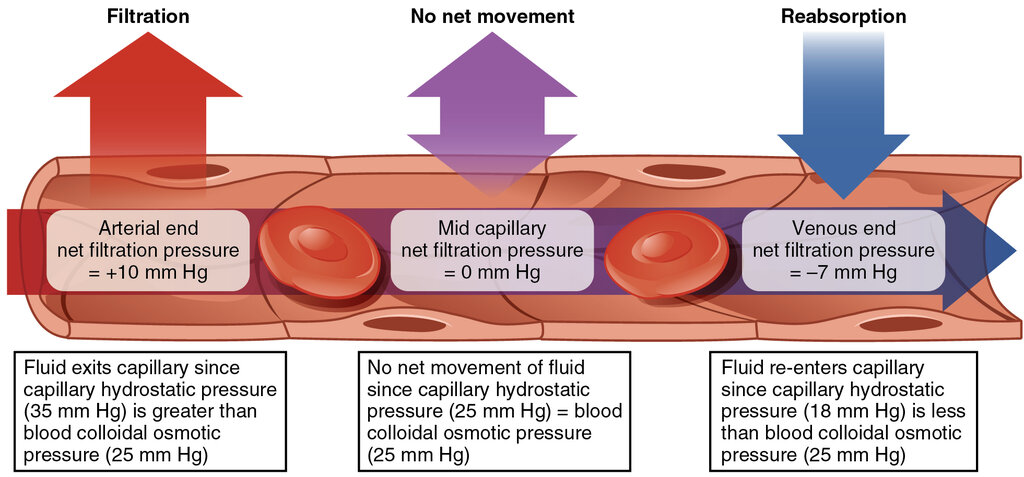
At the arterial end of a capillary, blood pressure (hydrostatic pressure) is higher than the pressure of the fluid surrounding the cells. This pressure difference pushes oxygen, water, and nutrients out of the capillary and into the tissues. As blood moves along the capillary, the pressure drops. Near the venous end, the osmotic pressure—a force driven by proteins in the blood that pulls fluid in—becomes greater than the blood pressure. This causes carbon dioxide and other waste products to be drawn from the tissues back into the bloodstream.
Essentially, capillaries act like a finely-tuned irrigation and drainage system, constantly refreshing the fluid that bathes every cell.
Veins: The Low-Pressure Return
After the exchange in the capillaries is complete, the now oxygen-poor blood enters the smallest veins, called venules. These merge to form larger veins, which eventually carry the blood back to the heart.
By the time blood reaches the veins, the pressure from the heart's pump has greatly diminished. To compensate for this low pressure and to fight gravity, especially in your limbs, veins have a secret weapon: valves. These are tiny flaps of tissue that allow blood to flow toward the heart but snap shut to prevent it from flowing backward.
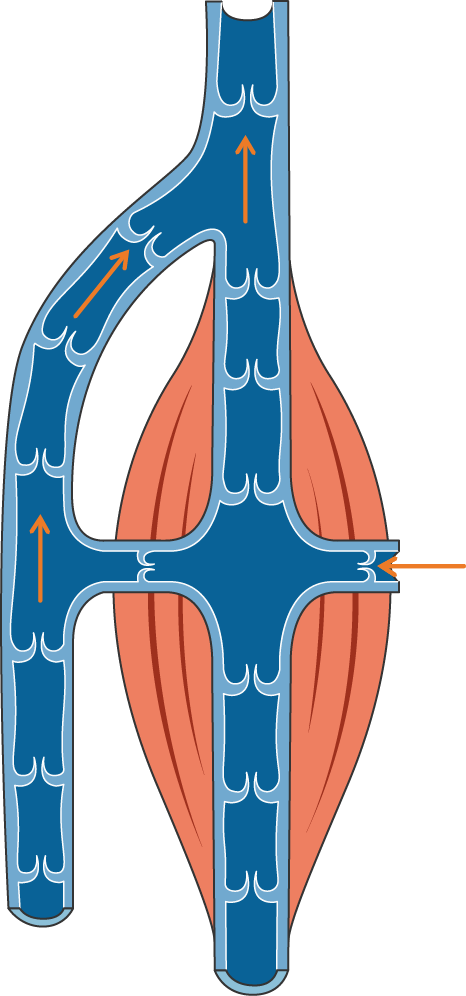
The contraction of your skeletal muscles also plays a crucial role. When you walk or move, your muscles squeeze the veins, pushing the blood along its path. This is why staying active is so important for good circulation.
Regulating Flow and Pressure
Your body is an expert at directing blood where it's needed most. When you're exercising, your muscles need more oxygen. When you're eating, your digestive system requires more blood. This regulation is achieved by changing the diameter of your blood vessels.
Vasoconstriction is the narrowing of blood vessels, which increases blood pressure and restricts blood flow. Vasodilation is the widening of blood vessels, which lowers blood pressure and increases blood flow.
The smooth muscle in the walls of arteries and arterioles contracts or relaxes to make these adjustments, ensuring that all your tissues receive the right amount of blood at the right time. This constant fine-tuning maintains a stable blood pressure and allows your body to respond to changing demands.
Ready to test your knowledge of the body's vascular network?
What is the primary role of arteries in the circulatory system?
The walls of capillaries are extremely thin, often just a single cell thick. What is the main advantage of this structure?
Together, arteries, veins, and capillaries form an incredibly efficient and adaptable system that is vital for sustaining every cell in your body.