Advanced Hepatic Physiology and Clinical Correlation
Advanced Metabolic Regulation
The Liver as Metabolic Mission Control
The liver acts as the body's central metabolic processor. It's not just a passive storage unit; it's a dynamic hub that actively manages the flow of nutrients—glucose, fats, and amino acids—to meet the body's ever-changing energy demands. Think of it as a sophisticated biochemical command center, constantly monitoring blood nutrient levels and orchestrating metabolic pathways to maintain systemic balance.
This intricate regulation ensures that your brain has a steady supply of glucose, your muscles have fuel for activity, and excess energy is properly stored or repackaged for later use. The liver achieves this by toggling between different metabolic programs, primarily dictated by the hormones insulin and glucagon.
Orchestrating Blood Glucose
When you haven't eaten for a while, your blood glucose levels begin to drop. The liver springs into action with two main strategies: breaking down its stored glucose (glycogenolysis) and creating new glucose from scratch (gluconeogenesis).
Glycogenolysis
noun
The metabolic process of breaking down stored glycogen into glucose-1-phosphate and then glucose-6-phosphate, which is then converted to free glucose in the liver and released into the bloodstream.
Glycogenolysis is controlled by the enzyme glycogen phosphorylase. This enzyme is activated by another key player, phosphorylase kinase, in response to hormonal signals like glucagon. It works by cleaving glucose units off the glycogen chain, preparing them for release into the blood.
When glycogen stores run low, the liver shifts to gluconeogenesis. This pathway synthesizes glucose from non-carbohydrate sources like lactate (from muscles), amino acids (from protein breakdown), and glycerol (from fat breakdown). The key regulatory enzymes that act as control points are Pyruvate Carboxylase and PEPCK (Phosphoenolpyruvate carboxykinase). Glucagon stimulates these enzymes, while insulin strongly inhibits them.
By controlling these two pathways, the liver ensures the brain and other essential tissues receive a constant supply of glucose, even during prolonged fasting.
Fat Metabolism and Ketone Production
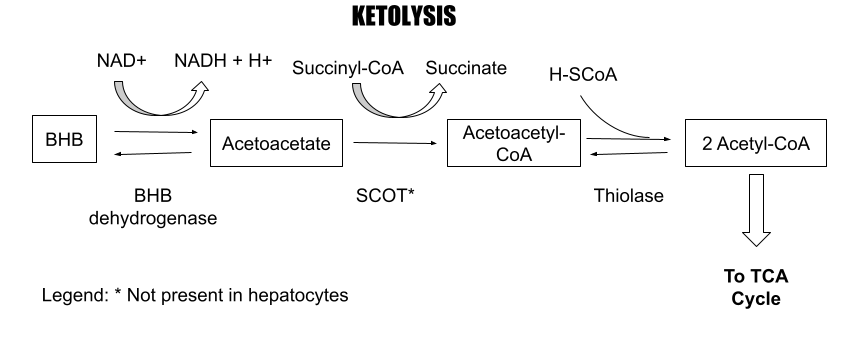
During extended periods of fasting or on a very low-carbohydrate diet, the liver switches to another critical function: converting fatty acids into ketone bodies. This process is called ketogenesis.
First, fatty acids are transported into the liver's mitochondria and broken down through beta-oxidation into acetyl-CoA. Normally, acetyl-CoA would enter the Krebs cycle. However, when glucose is scarce, a key Krebs cycle intermediate (oxaloacetate) is diverted to gluconeogenesis. This causes acetyl-CoA to build up. The liver then redirects this excess acetyl-CoA into the ketogenesis pathway. The primary control point is the enzyme HMG-CoA synthase, which commits acetyl-CoA to forming ketones.
These ketone bodies—acetoacetate and β-hydroxybutyrate—are then released into the bloodstream and can be used as an alternative fuel source by the brain, heart, and skeletal muscle, sparing what little glucose is available.
Packaging and Exporting Fats
In the fed state, when there is an excess of carbohydrates and calories, the liver takes up glucose and fatty acids and converts them into triglycerides for storage. But since the liver has limited storage capacity, it must export these triglycerides to other tissues, primarily adipose (fat) tissue.
To do this, it packages the triglycerides, along with cholesterol and specific proteins, into particles called . These VLDL particles are assembled in the endoplasmic reticulum and Golgi apparatus of liver cells before being secreted into the bloodstream.
The rate of VLDL synthesis and secretion is tightly regulated. High levels of insulin (in the fed state) promote the process, while glucagon (in the fasted state) suppresses it. Disruptions in this pathway, such as the liver producing too many VLDLs, can lead to high levels of triglycerides in the blood and contribute to metabolic diseases.
Which statement best describes the liver's primary role in metabolism based on the provided text?
When blood glucose is low and glycogen stores are depleted, the liver synthesizes new glucose from non-carbohydrate sources. What is this process called?
The liver's ability to seamlessly integrate these diverse pathways is fundamental to metabolic health. Its precise regulation ensures that the body has the right fuel, at the right time, no matter the circumstance.