Advanced Handstand Mastery
Shoulder Mechanics
Active Shoulders: Your Foundation
To hold a stable handstand, think less about balancing and more about building a strong, rigid structure. The foundation of this structure is active shoulders. Instead of letting your chest sink toward the floor and your shoulders sag into their sockets, you must actively push the floor away. Imagine trying to create as much space as possible between your ears and your shoulders.
This constant upward push engages the muscles around your shoulder girdle, transforming your arms and torso into a solid, connected unit. A passive shoulder is a wobbly shoulder. An active shoulder is the key to creating a stable platform for the rest of your body to stack upon.
Keeping your shoulders active throughout the handstand will prevent you from collapsing, which is one of the main reasons for failed attempts.
Your Shoulder Blades in Action
Two specific movements of your shoulder blades, or scapulae, are crucial for achieving that active push: elevation and protraction.
Elevation is the act of shrugging your shoulders up toward your ears. This engages your upper trapezius muscles and helps create the vertical line needed for a handstand.
Protraction is the movement of your shoulder blades wrapping around your ribcage, as if you were reaching forward for something just out of reach. In a handstand, this action stabilizes the shoulder joint and prevents your chest from collapsing. Combining these two motions creates a powerful, stable base.
Opening the Shoulders
A straight handstand line requires 'open' shoulders. This refers to achieving a full 180-degree angle between your arms and your torso. If your shoulders are tight, your body will have to bend somewhere else, usually in the lower back, to find balance. This banana-back shape is unstable and inefficient.
To help open the shoulders, focus on humeral external rotation This means slightly rotating your upper arm bones (humerus) outward, so the pits of your elbows face more forward. This small adjustment positions the shoulder joint in its most stable and open configuration, making it easier to stack your joints and hold a straight line.
The muscles primarily responsible for elevating your shoulder blades are the , particularly the upper portion. These large, diamond-shaped muscles run from the base of your skull down to your mid-back and out to your shoulders. When you actively shrug in a handstand, you're firing up your 'traps' to provide crucial stability and prevent the shoulders from collapsing under your body's weight.
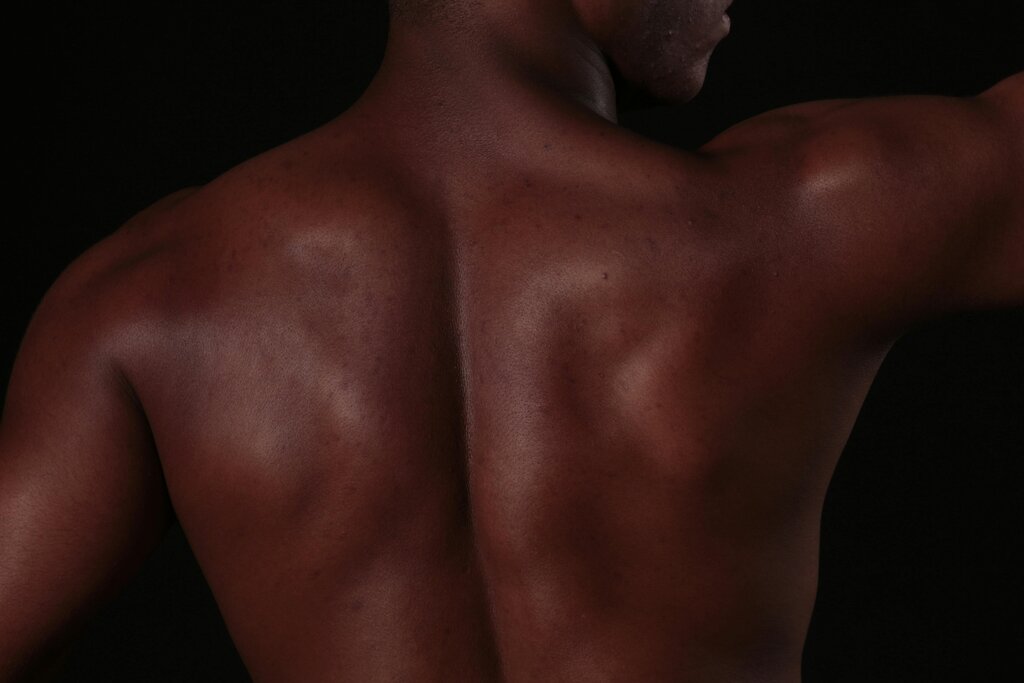
Now that we've broken down the key mechanics of the shoulder, let's review before putting it all together.
Ready to check your understanding?
What is the foundational principle for achieving a stable handstand, shifting focus away from just balancing?
Which two movements of the shoulder blades (scapulae) are essential for creating a stable base in a handstand?
Mastering these shoulder mechanics transforms your handstand from a shaky balance act into a display of structural strength. It's the difference between flopping over and holding a solid, controlled line.