Advanced Guitar Mastery
Advanced Chord Voicings
Beyond the Seventh Chord
You're already familiar with triads and seventh chords, the foundational blocks of harmony. But what happens when we keep stacking notes? We get extended chords, which add new layers of color, tension, and sophistication to our music.
Think of a basic seventh chord as a four-story building. Extended chords add a fifth, sixth, or even a seventh story. These new notes are called extensions, and they are the 9th, 11th, and 13th. Just like with seventh chords, we find these notes by continuing to stack thirds on top of our root note, using the notes of the scale.
Playing all the notes of a 13th chord at once can sound dense and muddy. In practice, musicians choose specific notes from the chord to create a desired sound, an arrangement known as a voicing. The most important notes for defining the chord's quality are usually the 3rd, the 7th, and the highest extension. The root and 5th are often omitted, especially when playing with a bass player who typically covers the root note.
Altered Chords
While extended chords add notes from the scale, altered chords change them. These chords create a strong sense of tension that feels satisfying when it resolves. Alterations are almost always applied to dominant 7th chords because their job is to build tension and lead back to the tonic chord.
Common alterations involve sharpening or flattening the 5th and 9th. This gives us four main possibilities:
- Flat nine (♭9): The 9th is lowered by a half step.
- Sharp nine (♯9): The 9th is raised by a half step.
- Flat five (♭5): The 5th is lowered by a half step.
- Sharp five (♯5): The 5th is raised by a half step.
A single dominant chord can have multiple alterations. For example, a G7(♭9, ♯5) chord contains the notes G, B, D♯ (the ♯5), F, and A♭ (the ♭9). This creates a very dissonant sound that pulls strongly toward a C major chord.
Altered chords are a cornerstone of jazz harmony, used to create sophisticated melodic lines and powerful resolutions.
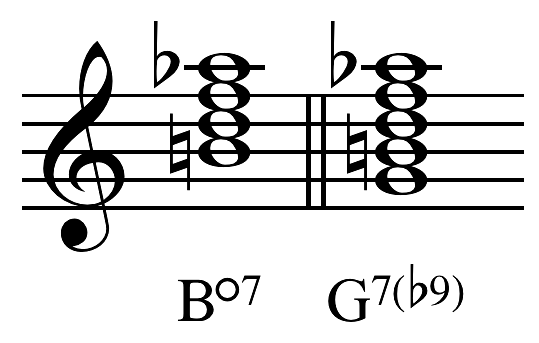
How do you know when to use an altered chord? Your ear is the best guide. Try replacing a standard dominant 7th chord in a progression with an altered version. For example, in a standard ii-V-I progression in C major (Dm7 – G7 – Cmaj7), try playing a G7(♭9) instead of the regular G7. Notice how the altered note adds a new flavor and a stronger pull toward the C major resolution.
Experimenting with these advanced voicings will open up a new world of harmonic possibilities, allowing you to add complexity and emotional depth to your music.
Ready to test your knowledge?
How are the extensions (9ths, 11ths, and 13ths) of a chord determined?
In a practical setting, like playing in a band with a bass player, which notes of an extended chord are most often omitted from a voicing?
Mastering these chords is all about practice and listening. Keep experimenting to discover how they can transform your sound.