Advanced Graviton Theory and Quantum Gravity
Graviton Field Quantization
From Curved Spacetime to a Particle
General relativity paints a picture of gravity as the curvature of spacetime. Massive objects warp the fabric of the universe, and other objects follow these curves. But quantum mechanics has a different view. It describes forces as an exchange of particles. For electromagnetism, it's the photon. For gravity, the hypothetical particle is the graviton.
How do we connect these two ideas? We can start by looking at gravity in a situation where it's very weak, like the gravitational waves rippling out from a distant collision of black holes. In this 'weak-field limit,' we can treat the curvature of spacetime as a tiny perturbation on top of a flat background. Think of it as small waves on the surface of a calm lake. This simplification is called linearized general relativity.
This disturbance, , behaves like a field that spreads through space. Quantum field theory tells us that every field, when quantized, has a corresponding particle. The quantum of the gravitational field is the graviton. By linearizing gravity, we isolate the part of it that we can try to quantize using our standard tools.
Describing a Spin-2 Particle
Particles in quantum mechanics have an intrinsic property called spin. Photons, which carry the electromagnetic force, are spin-1 particles. Gravitons are predicted to be spin-2. This isn't an arbitrary choice. The spin of a force-carrying particle is related to the nature of the force it mediates. Electromagnetism is carried by a vector field, which corresponds to a spin-1 particle. Gravity, as described by general relativity, is a tensor field, which requires a spin-2 particle to carry the interaction.
The mathematical framework for describing a spin-2 particle is known as the Fierz-Pauli formalism. It was originally developed to describe a massive particle with spin-2. It lays out a series of conditions, or constraints, that a field must satisfy to behave correctly.
A key goal of these constraints is to ensure the theory doesn't have 'ghosts'—unphysical states with negative energy that would make the whole model unstable and nonsensical.
For the graviton, we are interested in a massless spin-2 particle. Taking the Fierz-Pauli theory and setting the mass to zero reveals a problem: the theory doesn't smoothly transition to describe a massless particle. However, it was later shown that this massless limit works if the field couples to a conserved source, which for gravity is the stress-energy tensor. This result connects the abstract theory of spin-2 fields directly back to Einstein's general relativity.
A Theory Full of Holes
When we apply the standard techniques of quantum field theory to our linearized model of gravity, we run into a serious problem: the theory is non-renormalizable. In quantum theories like QED (quantum electrodynamics), calculations of particle interactions often produce infinite results. The process of 'renormalization' is a set of techniques for taming these infinities, absorbing them into a redefinition of physical quantities like mass and charge to get sensible, finite predictions that match experiments with incredible accuracy.
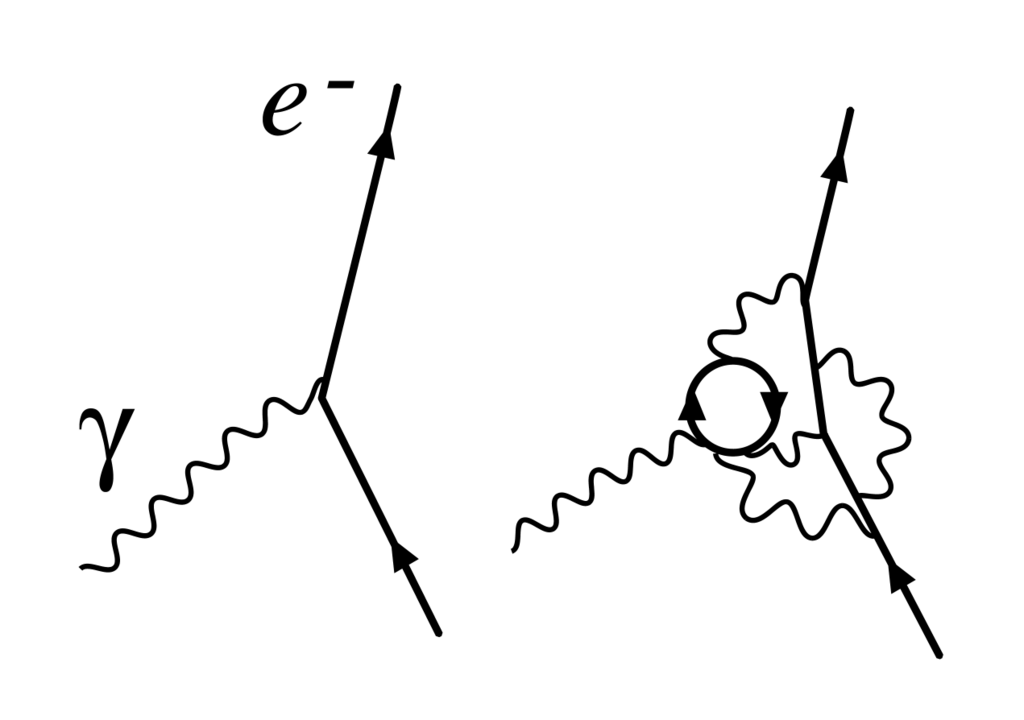
When we try this with gravity, the procedure fails. The infinities that appear are far more severe. At each level of precision, new and different kinds of infinities pop up. We would need an infinite number of corrections to cancel them all out, which renders the theory useless for making predictions, especially at very high energies like those found inside a black hole or at the Big Bang.
This is the central challenge of quantum gravity. The simple picture of gravitons as quantized ripples on spacetime breaks down. It suggests that our approach of simply quantizing the gravitational field is missing a fundamental piece of the puzzle. It's not just a matter of mathematical tweaks; it likely requires a completely new understanding of spacetime itself at the smallest scales.
The ongoing challenge in modern physics is reconciling quantum mechanics with general relativity into a unified theory of quantum gravity.
This is why theories like string theory and loop quantum gravity exist. They are not just attempts to quantize gravity, but radical reimaginings of reality that might avoid the pitfalls of non-renormalizability from the start.
General relativity and quantum mechanics offer different descriptions of gravity. What is the fundamental difference between them?
What is the primary obstacle encountered when trying to combine general relativity and quantum field theory, leading to theories like string theory?
While quantizing gravity remains one of the biggest open problems in physics, the concept of the graviton provides a crucial bridge between the worlds of the very large and the very small.