Advanced Graph Algorithms and Network Analysis
Advanced Graph Representations
How to Store a Graph
A graph is just a concept, a set of vertices and the edges that connect them. To make it useful in a computer program, we need a concrete way to store that information in memory. The way we represent a graph has a huge impact on our code's efficiency. How fast can we check if two nodes are connected? How much memory will it take to store a social network with billions of connections? Choosing the right data structure is the first critical step in solving any graph problem.
We'll explore the most common strategies, each with its own set of trade-offs. The two heavyweights are the adjacency matrix and the adjacency list.
The Adjacency Matrix
An adjacency matrix is a straightforward, grid-based approach. Imagine a square table where the rows and columns are both labeled with the graph's vertices. To mark an edge between two vertices, say from vertex i to vertex j, you simply put a 1 in the cell at matrix[i][j]. If there's no edge, you put a 0. For weighted graphs, you can store the edge's weight instead of a 1.
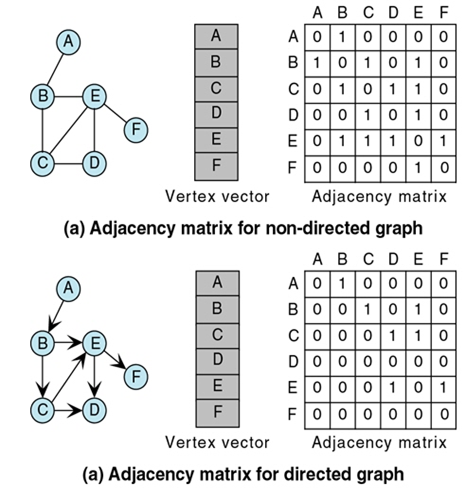
The biggest advantage of this method is speed. Checking for an edge between any two vertices is incredibly fast, an operation that takes constant time, or . You just look up the coordinates in the matrix.
However, this speed comes at a steep cost in memory. The matrix requires space, where is the number of vertices. This is fine for small graphs, but it becomes a major problem for sparse graphs — graphs with many vertices but relatively few edges. Most real-world networks, like social networks or road systems, are sparse. Storing them as an adjacency matrix means wasting most of your memory on zeros.
The Adjacency List
An adjacency list offers a more memory-friendly alternative. Instead of a big matrix, you use an array (or a hash map) where each position or key corresponds to a vertex. The value stored at that position is a list of all the vertices it's connected to — its neighbors.
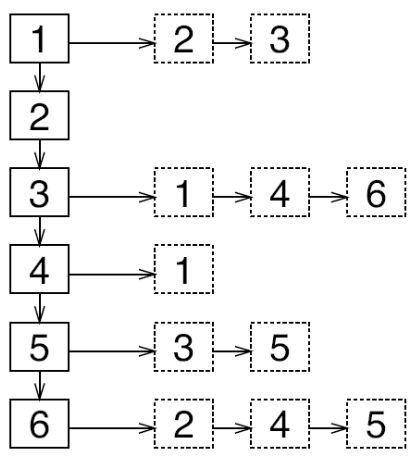
This structure shines for sparse graphs. Its space complexity is , where is the number of vertices and is the number of edges. You only store the connections that actually exist. This is a massive memory saving for graphs that aren't densely packed with connections.
The trade-off is that checking for a specific edge is slower. To see if an edge exists from vertex u to v, you have to go to u's list and iterate through it to see if v is present. This takes time proportional to the number of neighbors u has. However, iterating through all of a vertex's neighbors is very efficient, which is a common operation in many graph algorithms.
Other Representations
While matrices and lists are the most common, a few other structures are useful in specific scenarios.
Edge List
noun
An edge list is the simplest representation: it's just a list of all the edges in the graph. Each edge is typically represented as a pair of vertices, like (u, v).
This structure is not efficient for finding a vertex's neighbors. You'd have to scan the entire list. However, it's perfect for algorithms that need to iterate over all edges without regard to their source vertex. for finding a minimum spanning tree is a prime example; it works by sorting all edges by weight.
Another, less common structure is the incidence matrix. Here, rows represent vertices and columns represent edges. The cell matrix[v][e] contains a 1 if vertex v is an endpoint of edge e, and 0 otherwise. This structure explicitly maps vertices to edges, which can be useful in network flow and other specialized problems, but it's generally less efficient for common graph traversals.
| Representation | Space Complexity | Check Edge (u, v) | Find All Neighbors of u |
|---|---|---|---|
| Adjacency Matrix | |||
| Adjacency List | |||
| Edge List | |||
| Incidence Matrix |
Choosing the right representation is a foundational skill. It's a balance between memory usage and the performance of the specific operations your algorithm needs most. For most real-world problems involving large, an adjacency list is the go-to choice.
What is the primary disadvantage of using an adjacency matrix to represent a large, sparse graph?
You are designing a system to model a national road network. The system needs to efficiently find all cities directly connected to a given city. Which graph representation is most suitable for this task in terms of both memory and performance?
Understanding these trade-offs is key to building efficient graph-based systems.