Advanced Global Travel Optimization
GDS Logic Fundamentals
Beyond the Search Box
Forget standard flight search engines. Their purpose is to sell you a simple A-to-B ticket at the highest possible price. Our work begins where their capabilities end: inside the Global Distribution Systems (GDS). While dozens of systems exist, the travel world runs on three giants: Amadeus, Sabre, and Travelport. Functionally, they are massive, archaic databases that manage airline inventory, schedules, and fares. For our purposes, they are the command line interface to air travel, allowing us to manipulate ticketing logic in ways consumer-facing tools prohibit.
Understanding their architecture is key. A GDS doesn't just hold data; it executes complex rules. When you request a flight, the system isn't just checking for empty seats. It's evaluating fare rules, connection viability, and, most critically, airline-imposed sales strategies. The most significant of these is married segment logic.
Breaking the Marriage
Airlines use married segment logic to control inventory on a journey basis, not a flight-by-flight basis. A London-to-Sydney itinerary via Singapore (LHR-SIN-SYD) is treated as a single product. The airline might not offer a seat in a cheap fare bucket on the LHR-SIN leg by itself, even if it's available as part of the complete LHR-SYD journey. They do this to protect higher-yield fares on popular individual segments. The GDS enforces this, showing no availability for the standalone segment.
Bypassing this requires forcing the GDS to evaluate the segments independently. This often involves constructing a journey that 'tricks' the system. For instance, you might search for an availability from LHR to a distant, unpopular destination that forces a connection in Singapore. Once the desired LHR-SIN segment is secured in the PNR, the subsequent segment can sometimes be dropped or modified. Success depends on the GDS, the airline, and the specific fare rules.
The key is to make the system see the flights as individual components, not a pre-packaged product. This often means building the PNR manually, segment by segment.
// Sabre command to check availability for LHR-JFK on Feb 10th
110FEB LHRJFK

// A more advanced command to find availability in specific fare classes (e.g., J, I)
110FEB LHRJFK/ABA/CJ,I

// Manually selling a segment from an availability display (line 3)
03Y1
The Fare Bucket Hierarchy
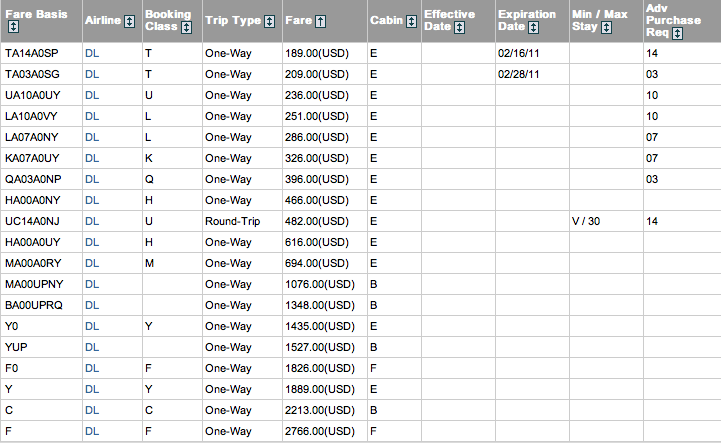
Every seat on a plane is categorized into a fare bucket, represented by a single letter. These are not just about which cabin you're in. They dictate the price, rules, upgrade eligibility, and mileage accrual. While the public sees Economy, Business, and First, the GDS sees a complex hierarchy of over a dozen classes.
| Cabin | Fare Class | Typical Meaning |
|---|---|---|
| First | F, A | F is full-fare, A is discounted. |
| Business | J, C, D | J is full-fare. C and D are discounted. |
| Business | I, R, Z | Deeply discounted or award/upgrade inventory. |
| Premium Econ | W, P | W is full-fare, P is discounted. |
| Full-Fare Econ | Y, B | Full-fare, flexible, often upgradeable. |
| Economy | H, M, K | Standard economy fares with varying restrictions. |
| Discount Econ | L, T, V, Q | Heavily discounted with strict rules. |
| Deep Discount | N, S, G, O | Lowest fares, often ineligible for miles/upgrades. |
Knowing this hierarchy is crucial. An agent might tell you there are no business class award seats, but they are only checking the 'I' bucket. A deeper search might reveal availability in the 'R' or 'Z' bucket, which may be accessible through a different loyalty programme or a specific partner. This is also where you find ghost availability—when a cached result shows a seat that the airline's live inventory system has already sold or re-allocated. Direct GDS queries minimise this by hitting the airline's system more directly.
Agreements and Records
Complex itineraries involving multiple airlines are possible because of interline agreements. These are the back-end contracts that allow one airline to issue tickets that include flights on another. The rules for these agreements are codified in a series of IATA Resolutions that function as the legal framework for global ticketing. For example, Resolution 787 governs the standards for interline e-ticketing. Understanding these allows you to construct itineraries that would seem impossible, like combining a low-cost carrier with a legacy airline on a single ticket, provided the right agreements are in place.
All of this culminates in the construction of the Passenger Name Record, or PNR. A PNR is more than a booking confirmation; it is a live command record in the GDS. It contains mandatory elements like the name, itinerary, and contact info, but also a wealth of optional data: seat assignments, meal requests, frequent flyer numbers, and ticketing deadlines. Skilled agents can add specific OSI (Other Service Information) or SSR (Special Service Request) messages to the PNR to communicate with the airline, flagging a passenger for upgrades or noting a connection that needs to be protected. This is the ultimate canvas for the travel hacker.
Time to test your understanding of GDS logic.
What is the primary function of a Global Distribution System (GDS) like Amadeus or Sabre in the context of advanced travel hacking?
An airline shows no availability for a cheap fare on a direct London to Singapore flight, but that same cheap fare is available when booking a London to Sydney journey that connects in Singapore. This is an example of:
With this foundational knowledge of GDS logic, you're prepared to move beyond simply finding flights and begin actively constructing and manipulating them.