Advanced Geometry Explorations
Manifolds
Locally Flat, Globally Curved
Imagine an ant walking on the surface of a giant orange. From the ant's perspective, its world is flat. It can move forward, backward, left, or right on a two-dimensional plane. The ant isn't aware of the orange's overall curvature. It's only if the ant travels a very long distance that it might notice something strange, like returning to its starting point without ever turning around.
This is the core idea behind a manifold. A manifold is a space that, when you zoom in close enough on any point, looks like familiar Euclidean space. For our ant, its world locally looks like a flat 2D plane (). But the orange as a whole is a sphere, which is a curved, finite space.
This “locally Euclidean” property is what makes manifolds so powerful. They allow mathematicians and physicists to apply the tools of calculus, which were developed for flat spaces, to describe and analyze curved spaces like the surface of the Earth or even spacetime itself.
A manifold is more formally defined as a topological space where every point has a neighborhood that is homeomorphic to an open subset of Euclidean space. Let's break that down.
homeomorphic
adjective
In topology, two spaces are homeomorphic if one can be continuously stretched, bent, or deformed into the other without cutting or gluing. A coffee mug and a donut are famously homeomorphic.
So, for any point on a manifold, you can find a small patch around it that can be smoothly mapped to a flat piece of Euclidean space. The dimension of that Euclidean space gives the dimension of the manifold.
A 1-manifold is locally like a line (). A 2-manifold is locally like a plane (). An n-manifold is locally like n-dimensional Euclidean space ().
Examples of Manifolds
You're already familiar with several manifolds, even if you didn't know the term. They appear in many different dimensions.
| Dimension | Manifold Example | Description |
|---|---|---|
| 1-Manifold | Circle () | A closed loop. Zoom in on any point, and it looks like a small segment of a straight line. |
| 1-Manifold | Line () | The simplest example. Any segment of a line is just a line. |
| 2-Manifold | Sphere () | The surface of a ball. Locally, it's a flat plane (think of maps of the Earth). |
| 2-Manifold | Torus () | The surface of a donut. It's also locally flat everywhere. |
| 3-Manifold | 3-Sphere () | Harder to visualize, but it's a key object in topology. It's the set of points equidistant from a center in 4D space. |
Not every shape is a manifold. A key requirement is that the space must be "locally Euclidean" everywhere. Consider the shape of two circles joined at a single point, like the figure eight.
Almost every point on the figure eight has a neighborhood that looks like a line segment. But what about the point where the two circles meet? No matter how much you zoom in on that intersection point, it will always look like two lines crossing. It never looks like a single, straight line (). Since it fails the test at that one point, the figure eight is not a manifold.
Why Manifolds Matter
The concept of manifolds is a profound bridge between geometry, topology, and analysis. It generalizes the idea of curves and surfaces to any number of dimensions, giving us a framework to study complex shapes and spaces.
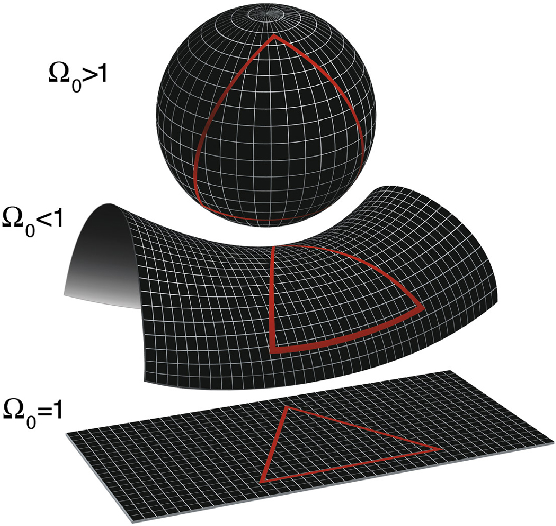
In physics, manifolds are essential. Albert Einstein's theory of general relativity models the universe as a 4-dimensional manifold called spacetime. Mass and energy curve this manifold, and the 'straight lines' that objects follow through this curved spacetime are what we perceive as gravity.
In robotics and computer graphics, the set of all possible positions and orientations of an object forms a manifold. For a rigid body in 3D space, this is a 6-dimensional manifold. Understanding this 'configuration space' is crucial for planning motion and avoiding obstacles.
From modeling the shape of the universe to designing the movements of a robot arm, manifolds provide a powerful mathematical language for describing the world around us. They allow us to use the familiar rules of flat-space calculus in a vast range of curved and complex settings.
Let's check your understanding of these fundamental ideas.
What is the defining characteristic of a manifold?
The analogy of an ant on an orange is used to illustrate which concept?
By providing a way to handle curved spaces that locally behave like flat ones, manifolds form the foundation for much of modern geometry and its applications.