Advanced Geometry and Applications of the Cube
Geometric Calculation Optimization
From Sides to Space
You already know a cube has six square faces, twelve edges, and eight vertices. But how do we translate those simple properties into practical measures of space and material? It starts with a single measurement: the length of one side, which we'll call .
The total area covering the outside of the cube—its surface area—is simply the sum of the areas of its six identical faces. Since each face is a square with an area of , or , the total surface area is six times that amount.
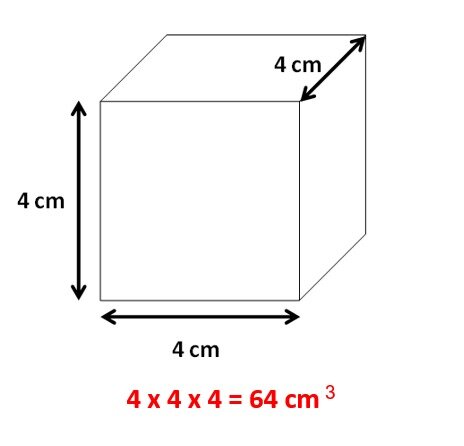
Volume measures the total space inside the cube. To find it, we multiply its length, width, and height. In a cube, all three dimensions are identical, so we just multiply by itself three times.
The Ratio That Shapes Everything
In design and engineering, the relationship between the surface area and the volume is critical. This surface-area-to-volume ratio () tells us how much
'skin' an object has compared to its internal capacity. For a cube, this ratio is $6s^2 / s^3$, which simplifies to $6/s$. This simple fraction has huge implications.
As a cube gets larger (as $s$ increases), its volume grows much faster than its surface area. A tiny cube has a lot of surface area for its small volume, while a massive cube has a relatively small surface area for its enormous volume. This principle governs everything from how quickly an ice cube melts to why large buildings are more energy-efficient to heat.
| Side Length (s) | Surface Area (6s²) | Volume (s³) | SA/V Ratio (6/s) |
|---|---|---|---|
| 1 cm | 6 cm² | 1 cm³ | 6.0 |
| 2 cm | 24 cm² | 8 cm³ | 3.0 |
| 5 cm | 150 cm² | 125 cm³ | 1.2 |
| 10 cm | 600 cm² | 1,000 cm³ | 0.6 |
Cubic Growth
Let's explore how scaling affects a cube's properties. Imagine you have a cube and decide to double its side length from to . What happens to its surface area and volume?
The new surface area becomes . It quadruples.
The new volume becomes . It increases eightfold.
This is the square-cube law in action. When you scale an object up, its surface area increases by the square of the scaling factor (in this case, ), while its volume increases by the cube of that factor (). This non-linear growth is a fundamental concept in fields like structural engineering, where doubling the size of a support column increases its strength (related to area) by four times but its weight (related to volume) by eight times.
Packing and Efficiency
How efficiently can you fill a larger space with smaller units? This is a core problem in logistics and material science. Let's say you have a large warehouse that is a perfect cube with a side length of 10 meters, and you need to fill it with smaller cubic boxes, each with a side length of 50 centimeters (0.5 meters).
First, find the volume of the warehouse and a single box.
- Warehouse Volume:
- Box Volume:
To find how many boxes fit, you divide the total volume by the volume of a single unit.
The result is 8,000 boxes. This type of calculation, known as determining packing efficiency, is vital for optimizing storage and minimizing wasted space. For cubes filling a larger cube, the efficiency is 100% as there are no gaps. However, when packing other shapes like spheres, empty space is unavoidable.
If a cube has a side length of , which formula represents its total surface area?
You have a cube with a side length of 4 meters. What is its volume?
These principles of scaling and efficiency are the building blocks for analyzing more complex geometric forms in architecture, engineering, and beyond.