Advanced Geological Principles and Rock Mechanics
Magmatic Petrology Foundations
The Chemistry of Cooling Magma
Igneous rocks are more than just cooled lava; they are frozen records of complex chemical journeys. The final composition of an igneous rock is dictated by three key factors: pressure (P), temperature (T), and the initial composition of the melt (X). As a magma body cools and ascends through the crust, these variables change, forcing a predictable yet intricate sequence of mineral crystallization.
Think of magma not as a uniform substance, but as a hot, molten soup of elements. As it cools, certain elements will combine to form stable mineral crystals, effectively removing themselves from the liquid. The order in which these minerals form, and how they interact with the remaining melt, is the core of magmatic petrology.
Beyond Bowen's Reaction Series
You're likely familiar with Bowen's Reaction Series, which neatly lays out the crystallization sequence from mafic (olivine, pyroxene) to silicic (quartz, feldspar) minerals. While it's a brilliant framework, real-world magma systems rarely behave so simply. Two key processes, fractional crystallization and magma mixing, introduce significant variations.
Fractional crystallization is the process where early-formed crystals are separated from the parent magma, preventing them from reacting with the remaining melt.
Imagine a magma chamber slowly cooling. The first crystals to form will be high-temperature, iron- and magnesium-rich minerals like olivine. Being denser than the surrounding melt, these crystals can sink and accumulate at the bottom of the chamber. This physical separation is crucial. By removing these mafic components, the remaining liquid becomes progressively enriched in silica, aluminum, sodium, and potassium. A single parent basaltic magma can thus give rise to a whole suite of rocks, from gabbro to andesite and eventually to granite, simply by fractionating its crystals along the way.
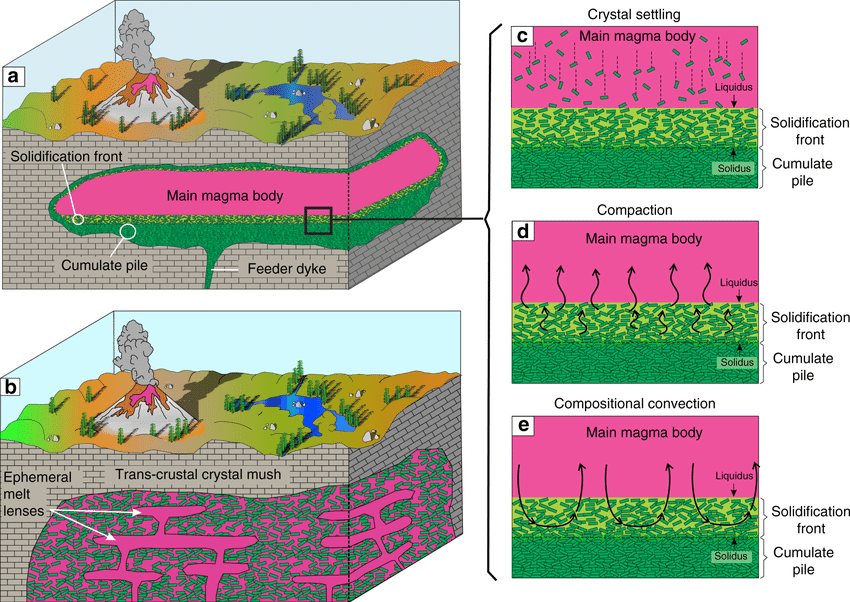
The plot thickens when one magma body intrudes into another. This is called magma mixing. A hot, mafic magma rising from the mantle might inject into a cooler, more evolved silicic magma chamber in the crust. This event can cause rapid changes in temperature and composition, disrupting the orderly crystallization sequence. Evidence for this process is often visible in the rocks themselves, such as of basaltic magma suspended in a lighter-colored granite, or complex zoning patterns within individual mineral crystals.
Reading a Phase Diagram
To move beyond conceptual models and quantify these processes, geologists use phase diagrams. These are maps that show which mineral phases are stable under specific conditions of temperature and composition. For simplicity, let's look at a binary system, which involves just two components. A classic example is the Diopside (CaMgSi₂O₆) - Anorthite (CaAl₂Si₂O₈) system, which models the crystallization of basalt.
The upper V-shaped line is the —above this temperature, everything is molten. The horizontal line at the bottom is the solidus—below this temperature, everything is solid rock. Let's trace the cooling of a melt with 70% Anorthite:
- Above 1445°C: The system is entirely liquid.
- At 1445°C (Point A): The melt hits the liquidus line. The first solid crystals of Anorthite begin to form.
- Between 1445°C and 1274°C: As the temperature drops, more Anorthite crystallizes. This removes Anorthite from the melt, causing the liquid's composition to shift leftward, down along the liquidus curve towards the eutectic point.
- At 1274°C (Point B): The melt composition reaches the where the remaining liquid crystallizes as a mixture of both Diopside and Anorthite simultaneously. The system is now completely solid.
This diagram allows us to predict the mineral assemblage and crystallization history for any starting composition in this system.
Chemical Suites
When geologists analyze a suite of related igneous rocks from a single volcano or region, they often see coherent chemical trends. These trends are the result of the magmatic processes we've discussed. Plotting the concentration of various elements (like SiO₂ vs. MgO) for a suite of rocks often reveals clear lines or curves, known as liquid lines of descent. These lines trace the chemical evolution of the magma as it underwent fractional crystallization.
| Magma Series | Key Characteristics | Tectonic Setting |
|---|---|---|
| Tholeiitic | Iron enrichment during early crystallization. | Mid-ocean ridges, ocean islands |
| Calc-Alkaline | No significant iron enrichment; rich in Al₂O₃ and CaO. | Subduction zones (e.g., Andes) |
| Alkaline | Rich in sodium (Na₂O) and potassium (K₂O). | Continental rifts, ocean islands |
By classifying rocks into these series, we can infer the chemical starting point of the parent magma and the tectonic environment in which it formed and evolved. A calc-alkaline suite, for example, points strongly to a history involving the subduction of an oceanic plate, where water played a key role in melting the mantle wedge.
What are the three primary factors that dictate the final composition of an igneous rock?
During fractional crystallization, if early-forming, dense, mafic minerals like olivine sink to the bottom of a magma chamber, how does the remaining liquid magma change?
Understanding these chemical principles allows geologists to read the story of a rock—deciphering its origin deep within the Earth and the dynamic journey it took to the surface.