Advanced Function Analysis and Precalculus Mastery
Complex Function Transformations
Transforming Functions
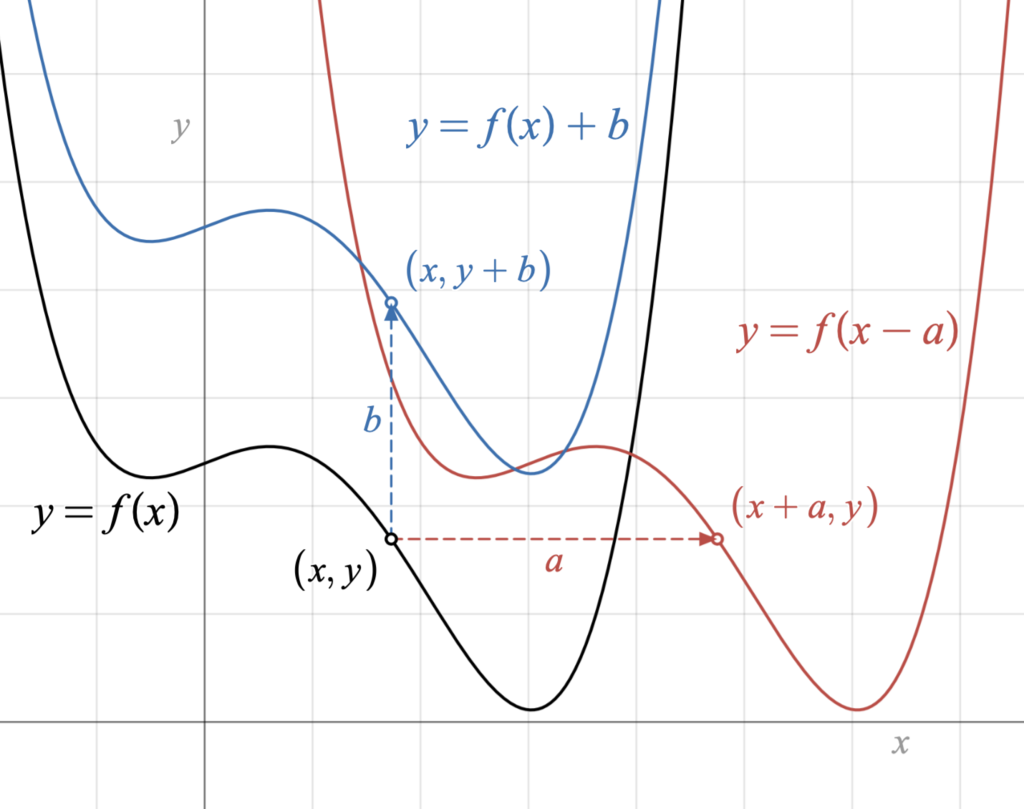
Any function can be altered, or transformed, by applying a series of mathematical operations. These transformations shift, stretch, compress, or reflect the function's graph. Understanding them allows us to predict the behavior of complex functions based on the properties of their simpler, parent functions.
All transformations can be described by a single, unified equation that builds upon a base function, .
This framework is powerful because it works for any function, from a simple parabola like to a more complex rational function like . Let's break down what each of these parameters does.
| Parameter | Transformation Type | Effect on Graph of |
|---|---|---|
| Vertical Shift | Moves graph up (if ) or down (if ). | |
| Horizontal Shift | Moves graph right (if ) or left (if ). | |
| Vertical Stretch/Compress | Stretches vertically (if $ | |
| Horizontal Stretch/Compress | Compresses horizontally (if $ | |
| sign of | Vertical Reflection | Reflects across the x-axis if is negative. |
| sign of | Horizontal Reflection | Reflects across the y-axis if is negative. |
Order of Operations
When a function involves multiple transformations, the order matters. Just like with arithmetic, we follow a specific sequence. For the form , the correct order is:
- Horizontal shifts (parameter )
- Horizontal stretches, compressions, and reflections (parameter )
- Vertical stretches, compressions, and reflections (parameter )
- Vertical shifts (parameter )
Think of it as working from the inside out. Anything happening inside the parentheses with affects the horizontal axis first. Anything outside the parentheses affects the vertical axis next.
A good way to remember the order: Horizontal shifts, then Stretches and Reflections, then Vertical shifts. (H-SR-V)
Let's apply this to a parent function . We want to graph . First, we need to rewrite it in our standard form to isolate the horizontal shift, . We factor out the coefficient of inside the square root.
Now, we can apply the transformations in order:
- Horizontal shift (): Shift the graph of one unit to the right.
- Horizontal reflection (): Reflect the result across the y-axis.
- Vertical stretch and reflection (): Stretch the result vertically by a factor of 2, then reflect it across the x-axis.
- Vertical shift (): Shift the final result up by 3 units.
The domain and range of the parent function, , are . After all transformations, the domain of is and the range is . Each transformation systematically altered these intervals.
Function Symmetry
Symmetry is a key property that helps simplify functions. It describes how a function's graph behaves with respect to the axes. The two primary types of symmetry are even and odd.
A function is considered an if its graph is symmetric with respect to the y-axis. Algebraically, this means that for every in the function's domain, . A classic example is , where . Another is .
A function is an odd function if its graph has rotational symmetry about the origin. This means if you rotate the graph 180 degrees, it looks the same. The algebraic test is for every in the domain. Examples include and .
Most functions are neither even nor odd. For example, is not symmetric about the y-axis or the origin. However, knowing if a function has symmetry can be a powerful shortcut, especially in calculus when evaluating certain definite integrals.
Let's test the function for symmetry. We evaluate :
Since , the function is an despite being a ratio of odd-powered terms. This kind of analysis reveals deep structural properties of functions that aren't obvious from just looking at the equation.
Getting students to group the transformations gets them carefully examining the equations for similarities and differences and encourages them to look for some structure in something unfamiliar.
Ready to test your knowledge?
In the general transformation equation , what transformation is controlled by the parameter 'c'?
When applying multiple transformations to a function in the form , what is the correct sequence of operations?
Mastering these transformations provides a powerful toolkit for understanding and manipulating any function you encounter.