Advanced Freediving Science and Performance
Breath-Hold Physiology
Your Underwater Superpowers
Holding your breath and diving deep triggers a remarkable set of automatic responses in your body known as the Mammalian Dive Reflex (MDR). This isn't something you learn; it's a physiological inheritance shared by all mammals, from seals and dolphins to us. The reflex is most prominent when your face is submerged in cool water, activating a cascade of changes designed to do one thing: conserve oxygen.
The entire process is orchestrated by your autonomic nervous system, the same system that manages your heartbeat and digestion without you having to think about it. Three core responses work together to extend your time underwater safely.
The first and most immediate response is bradycardia. Your heart rate begins to slow down, sometimes by as much as 50%. A slower heart pumps less frequently, which means the heart muscle itself consumes less oxygen. It also reduces the speed at which oxygenated blood circulates through the body, helping to ration the supply you took with you on your last breath.
bradycardia
noun
A slower-than-normal heart rate, typically defined as fewer than 60 beats per minute in adults.
Next, your body initiates peripheral vasoconstriction. The blood vessels in your extremities—your arms, legs, fingers, and toes—narrow significantly. This process doesn't cut off blood flow entirely but dramatically reduces it, shunting oxygen-rich blood away from the muscles in your limbs and redirecting it to where it's needed most: your brain and heart. Your limbs can tolerate low oxygen levels for short periods, but your vital organs cannot.
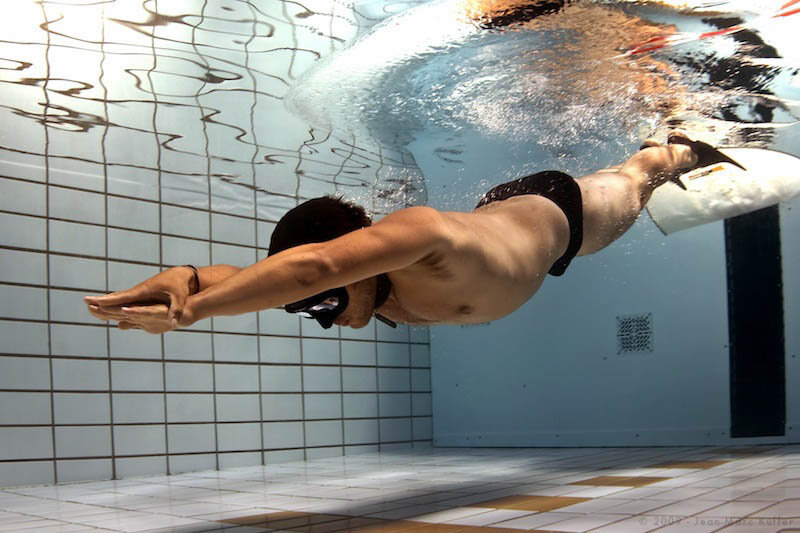
Finally, as you descend deeper and the surrounding water pressure increases, the blood shift phenomenon kicks in. To prevent your chest cavity and lungs from collapsing under the immense pressure, blood plasma floods the capillaries in your lungs. This fluid fills the space, making the chest cavity essentially incompressible and protecting your delicate lung tissue from damage. It’s a natural, elegant solution to one of the biggest dangers of deep diving.
The Dangers of Cheating the System
It might seem tempting to try and trick your body into a longer breath-hold. One common but dangerous technique is hyperventilation—taking a series of rapid, deep breaths before a dive. While it feels like you're “super-oxygenating” your blood, you're actually doing something very different and very risky.
Your urge to breathe isn't primarily triggered by low oxygen (), but by high levels of carbon dioxide () in your blood. Hyperventilation artificially purges from your system.
Hyperventilation before breath-holding intensifies the risk by reducing circulating CO2, which suppresses the urge to breathe and prompts individuals to hold their breath longer than safe.
With abnormally low levels, your body's alarm system is effectively silenced. You won't feel the urgent need to surface for air, even as your oxygen levels drop to a critical point. This can lead to a sudden loss of consciousness known as a hypoxic blackout, or shallow water blackout, because it often occurs in the last 10-15 feet of ascent when the partial pressure of oxygen in the lungs drops sharply.
This blackout is insidious because it comes without warning. The diver feels fine one moment and is unconscious the next.
The golden rule is to never hyperventilate. Your body's signals are there to protect you, not to be bypassed.
Understanding these powerful physiological responses is the first step toward safe and effective breath-hold diving. Respecting them is even more important.
Ready to test your knowledge? Let's see what you've learned about your body's amazing underwater abilities.
What is the primary purpose of the Mammalian Dive Reflex (MDR)?
Which component of the MDR involves redirecting blood from the limbs to the vital organs like the brain and heart?
By understanding how your body naturally adapts to being underwater—and the risks of trying to manipulate those systems—you can approach breath-hold diving with both confidence and caution.