Advanced Foundations of Product Management
Advanced Product Discovery
From Phase to Mindset
You already know the basics of talking to users and creating personas. The real challenge isn't just doing discovery, but embedding it into your team's DNA. Advanced product discovery isn't a one-off phase you complete before building. It's a continuous, parallel process of reducing risk and ensuring you're always working on the right problems. This ongoing work is driven by a small, cross-functional team.
At the heart of this approach is the [{
}]—a product manager, a designer, and a lead engineer. This group collaborates daily to make decisions, balancing customer value, usability, and technical feasibility in real time.
Dual Track Agile
To make discovery continuous, high-performing teams use a model called Dual Track Agile. Instead of a linear process where discovery stops and development begins, two tracks run in parallel: Discovery and Delivery.
- The Discovery Track is for learning and de-risking. The Product Trio lives here, conducting research, running experiments, and validating ideas.
- The Delivery Track is for building and shipping. The engineering team takes validated ideas from the discovery track and turns them into high-quality, production-ready code.
The two tracks constantly inform each other. The discovery track feeds the delivery track with well-vetted opportunities, while the delivery track provides insights on technical constraints and possibilities.
The discovery track is fueled by two types of research. Generative research helps you explore and understand a problem space. It uncovers latent needs and pain points your customers may not even be able to articulate. In contrast, evaluative research helps you validate a specific solution idea, like testing a prototype to see if it's usable.
A simple way to think about it: Generative research asks, "What is the problem?" Evaluative research asks, "Does our proposed solution fix the problem?"
Mapping Your Path
How do you connect broad business goals to the specific problems your users face? The (OST) is a visual framework designed for just that. It helps teams think clearly about how they might reach a desired outcome.
An OST has four main levels:
- Outcome: The measurable business goal you want to achieve (e.g., "Increase weekly active users by 10% in Q3").
- Opportunities: These are the customer needs, pain points, or desires that you've discovered through research. If you solve them, you'll drive your outcome (e.g., "Users find it hard to discover new content").
- Solutions: These are specific product ideas or features that target an opportunity. You should brainstorm multiple solutions for each opportunity.
- Experiments: These are small, fast tests you run to see if a solution is a good idea before you commit to building it.
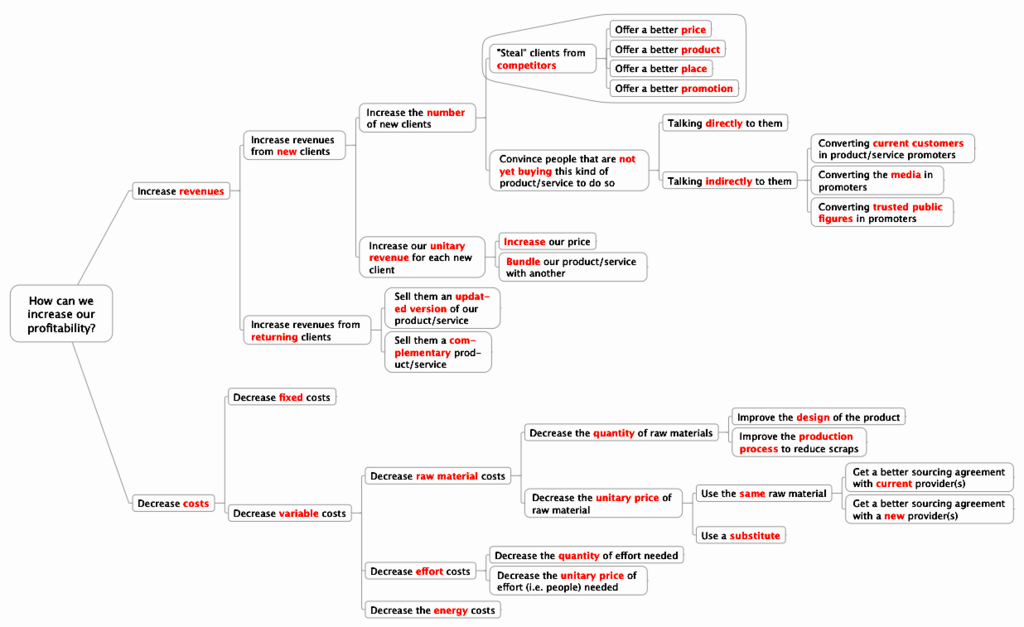
By mapping your work this way, you ensure every feature you consider is directly tied to a customer problem, which in turn is tied to a critical business outcome.
Tackling the Riskiest Assumptions
Every new idea is built on a pile of assumptions. We assume customers want our solution, that they'll be willing to pay for it, and that we can technically build it. The biggest risk in product development is building something based on a faulty assumption. To avoid this, we use assumption mapping.
First, brainstorm all the assumptions underlying your proposed solution. Then, plot them on a matrix. The Y-axis represents how important the assumption is to your success. The X-axis represents how certain you are that the assumption is true.
Your most critical task is to focus on the top-left quadrant: high importance, low certainty. These are your riskiest, "leap-of-faith" assumptions. Your experiments should be designed to gather evidence and move these assumptions to the right on the chart, turning them from guesses into known facts.
By systematically identifying and testing your riskiest assumptions, you replace guesswork with evidence. This is the essence of modern product discovery: learning as quickly and cheaply as possible to ensure that what you deliver actually matters to your customers and your business.
In the Dual Track Agile model, what is the primary purpose of the 'Discovery Track'?
A product team is using an Opportunity Solution Tree. They have identified that 'users struggle to organize their saved items' as a key problem to solve. What level of the tree does this represent?