Advanced Foundations of Music Theory and Structure
Advanced Chromatic Harmony
Color Outside the Lines
So far, we've treated keys like self-contained universes. The seven notes of a major or minor scale generate seven predictable chords. This is diatonic harmony, and it's the foundation of most Western music. But it's also just the beginning.
Chromatic harmony is about purposefully using notes from outside the key to create richer textures and stronger emotional pulls. Think of it as adding new colors to your sonic palette. These outside notes aren't random; they follow specific patterns to create tension that demands resolution, guiding the listener's ear in powerful ways.
Creating Temporary Tonics
The strongest relationship in tonal music is the dominant (V) resolving to the tonic (I). That G7 chord pulling back to a C major is the sound of coming home. What if we could apply that same powerful pull to other chords in the key?
This is the job of the secondary dominant chord. It's a dominant seventh chord built on a note that is a perfect fifth above a non-tonic chord, making that non-tonic chord feel like a temporary home base. For instance, in C major, the dominant chord is G (V). The supertonic chord is D minor (ii). If we want to make that D minor feel more important, we can precede it with its own dominant, which would be A7. We'd call this chord "V7 of ii," written as V7/ii.
This technique, called tonicization, creates a chain of compelling resolutions within a single key.
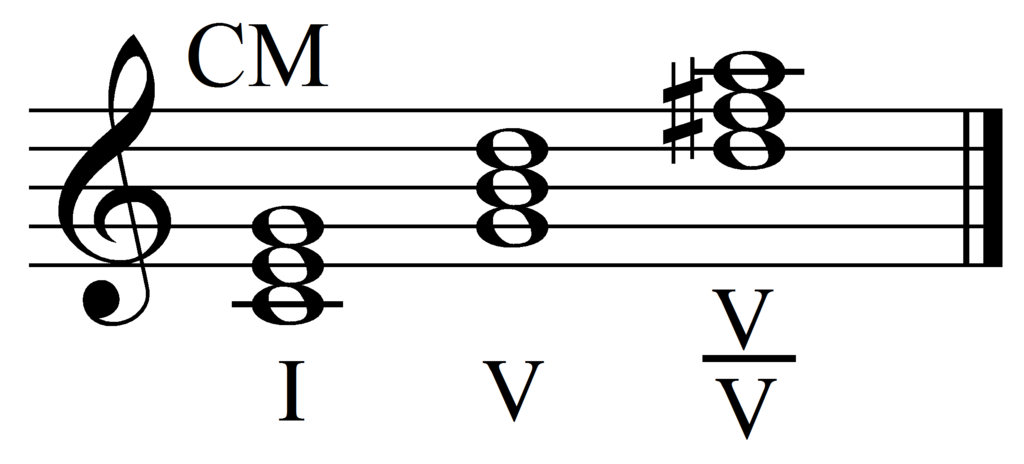
A close cousin to the secondary dominant is the secondary leading-tone chord. Just as the diatonic vii° chord pulls strongly to the tonic, a secondary leading-tone chord (like vii°/V) pulls to the dominant. It functions just like a secondary dominant but offers a different, more biting harmonic flavor due to its diminished quality.
Harmonic Borrowing
Another way to introduce chromaticism is through modal mixture, also known as borrowing chords. This involves taking a chord from a parallel key. The parallel key shares the same tonic but has a different mode, like C major and C minor.
Composers in a major key often borrow chords from the parallel minor to add a touch of melancholy or drama. One of the most common borrowed chords is the minor subdominant (iv). In C major, the diatonic subdominant is F major (F-A-C). Borrowing from C minor gives us an F minor chord (F-A♭-C). That single A♭, a note not found in C major, can dramatically shift the emotional tone of a progression.
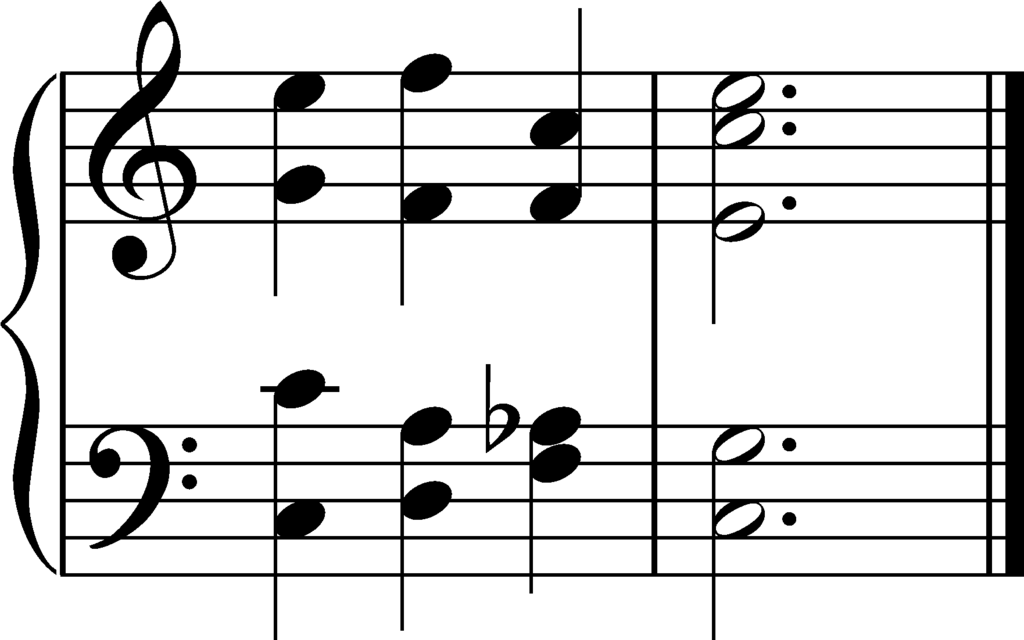
You can borrow any chord, but the subdominant and submediant chords are particularly popular for their rich, expressive sound. This technique is all over popular music, from The Beatles to modern film scores, because it's a simple way to make a standard progression feel fresh and emotionally complex.
Chords with an Agenda
Some chromatic chords are specialists, designed for one primary purpose: to create intense tension that resolves in a specific, satisfying way. These are called predominant chords, as they lead strongly to the dominant.
The Neapolitan chord is one such specialist. It's a major chord built on the lowered second scale degree (♭II) and almost always appears in first inversion, giving it the name "Neapolitan sixth" (N6). In C minor, the second scale degree is D. Lowering it gives us D♭. A major chord on D♭ is D♭-F-A♭. The powerful, yearning sound of the N6 chord pulls irresistibly toward the dominant (V).
Then there are the augmented sixth chords. These chords are defined by the interval of an augmented sixth between the bass note (typically the lowered sixth scale degree, ♭6) and a raised fourth scale degree (♯4). This interval is highly unstable and wants to resolve outward by half step to an octave on the dominant.
The defining interval of an augmented sixth chord (e.g., A♭ to F♯ in C minor) creates a powerful dissonance that expands outward to resolve to the dominant (G).
There are three main types, named after countries for historical reasons that are not entirely clear.
| Type | Notes in C minor (♭6, 1, ♯4) | Extra Note |
|---|---|---|
| Italian (It⁺⁶) | A♭, C, F♯ | None |
| French (Fr⁺⁴₃) | A♭, C, F♯ | D (scale degree 2) |
| German (Ger⁺⁶₅) | A♭, C, F♯ | E♭ (scale degree ♭3) |
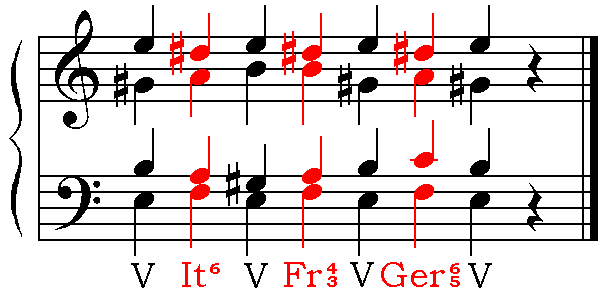
Each version has a slightly different color, but their function is identical: build maximum tension before giving way to the dominant chord. The German sixth is particularly interesting because it's enharmonically equivalent to a dominant seventh chord (A♭7 in this case), which can be used to pivot to a new key.
Changing Keys with Finesse
All of these chromatic chords can be used not just to add color, but to smoothly modulate to a new key. The key is finding a —a chord that is diatonic in the original key but also exists in the destination key, sometimes as a chromatic chord.
Imagine you're in C major and want to modulate to A minor. The C major chord (I in C) is also the III chord in A minor. That's a simple diatonic pivot. But for more distant keys, chromatic pivots are essential.
A German augmented sixth chord in C major (A♭-C-E♭-F♯) resolves to G7. But if we respell the A♭ as G♯, the chord becomes an A7 chord in third inversion with a lowered fifth (G♯-C-E♭-F♯). This sounds very much like a dominant function chord in D minor. By using this single, chromatically complex chord, a composer can cleverly bridge two seemingly unrelated keys.
Mastering these chromatic tools transforms your understanding of harmony. You move from following the rules of a single key to bending them, creating a musical narrative that is more dynamic, expressive, and unpredictable.
Time to test your knowledge on these new harmonic colors.
What is the primary function of a secondary dominant chord, such as V7/V?
In the key of D major, the diatonic subdominant chord is G major. If a composer 'borrows' the subdominant from the parallel minor (D minor), what chord would they use?
Chromatic harmony opens up a world of expressive possibilities. By understanding how to create temporary tonal centers, borrow from parallel worlds, and use specialized chords to build tension, you can guide the listener on a much richer journey.