Advanced Foundations of Human Nutrition
Macronutrient Metabolic Pathways
From Meal to Molecule
After a meal, your body enters the absorptive, or fed, state. It’s flush with incoming nutrients, and the primary goal is to use what it needs and store the rest. Insulin levels rise, signaling cells to take up glucose from the blood. This is an anabolic phase, focused on building and storing.
Several hours later, you transition into the postabsorptive, or fasted, state. With no new fuel coming in, the body shifts to catabolism. It begins breaking down stored energy—first glycogen, then fat—to maintain blood glucose levels and power your cells. This dynamic switch between using and storing energy is known as metabolic flexibility. A healthy metabolism can pivot seamlessly between burning carbohydrates and fats based on their availability.
The Sugar Story
How your body responds to carbohydrates isn't just about the type of sugar, but how much arrives and how quickly. The glycemic index (GI) ranks foods based on how fast they raise blood glucose. But the glycemic load (GL) gives a more complete picture by factoring in the amount of carbohydrate in a serving. A food can have a high GI but a low GL if you eat a small portion, resulting in a modest blood sugar response.
This response is managed by insulin. When blood glucose rises, the pancreas releases insulin, which acts like a key. It binds to receptors on muscle and adipose (fat) cells, causing GLUT4 transporters to move to the cell surface and usher glucose inside. This is insulin-dependent uptake. Other tissues, like the liver and brain, have transporters (e.g., GLUT2) that don't require insulin, ensuring they have constant access to glucose.
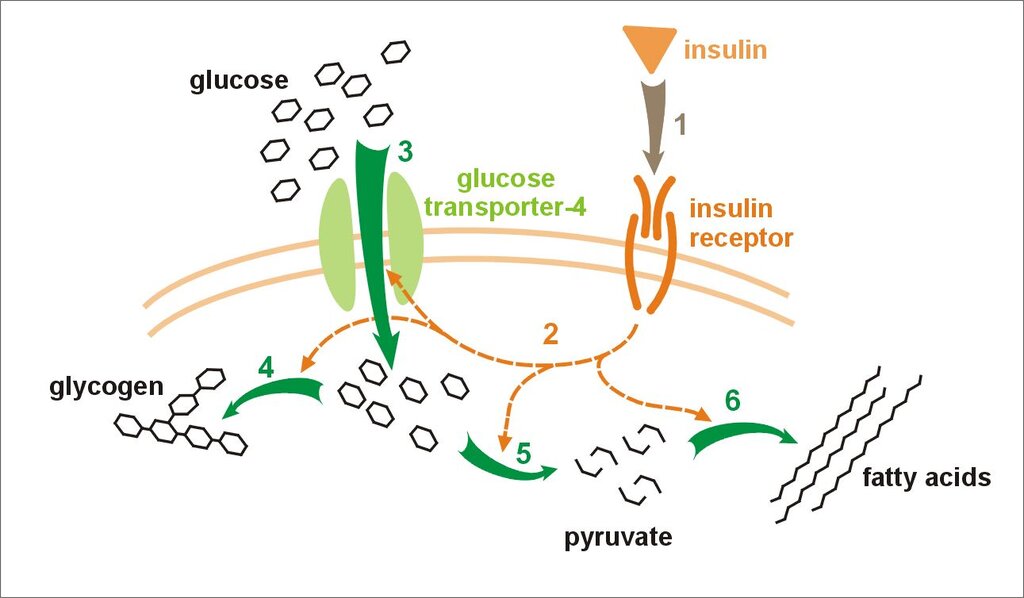
Inside the cell, glucose is either used immediately for energy via glycolysis or stored as glycogen. The direction is tightly regulated. In the fed state, high insulin levels promote glycolysis, the breakdown of glucose into pyruvate. This pyruvate then enters the to generate ATP. When fasting, low insulin and high glucagon levels flip the switch. The liver activates gluconeogenesis, a pathway that creates new glucose from non-carbohydrate sources like lactate and amino acids to maintain blood sugar.
In the fed state, your body favors glycolysis to burn sugar. In the fasted state, it shifts to gluconeogenesis to make sugar.
Fats as Fuel
When insulin levels drop during fasting, your body turns to its largest energy reserve: adipose tissue. The hormone glucagon signals fat cells to begin lipolysis, the breakdown of triglycerides into glycerol and free fatty acids.
These fatty acids are released into the bloodstream, where they travel to tissues like the heart, skeletal muscle, and liver. But before they can be used for energy, they must enter the mitochondria, the cell's powerhouses. Since long-chain fatty acids can't cross the inner mitochondrial membrane on their own, they rely on a transport system called the carnitine shuttle to get inside.
Once inside the mitochondria, fatty acids undergo beta-oxidation. This process systematically cleaves the long fatty acid chains into two-carbon units of acetyl-CoA. This acetyl-CoA then enters the same TCA cycle that pyruvate from glucose does, generating a large amount of ATP.
The Protein Pivot
Unlike carbohydrates and fats, the body doesn't have a dedicated storage depot for protein. Amino acids are primarily used for building tissues, enzymes, and hormones. However, during prolonged fasting or when protein intake far exceeds the body's needs for synthesis, amino acids can be diverted for energy.
To be used as fuel, an amino acid must first undergo deamination—the removal of its nitrogen-containing amino group (). This process primarily occurs in the liver. The toxic ammonia () that's produced is quickly converted into urea, a less harmful substance, through the urea cycle and then excreted by the kidneys.
The remaining carbon skeleton, called a keto-acid, can enter metabolic pathways at various points. Some keto-acids can be converted into pyruvate or acetyl-CoA, while others can enter the TCA cycle directly. Those that can be converted to pyruvate can also be used by the liver for gluconeogenesis, providing a vital source of glucose when carbohydrate stores are depleted.
The Master Switch
How does a cell know when to burn energy and when to store it? A key player in this decision is AMP-activated protein kinase, or . Think of it as the cell's fuel gauge. When cellular energy is low, the ratio of AMP (adenosine monophosphate) to ATP (adenosine triphosphate) rises. This high AMP:ATP ratio activates AMPK.
Once activated, AMPK acts like a master metabolic regulator. It shifts the cell from an anabolic (energy-consuming) state to a catabolic (energy-producing) one. It stimulates pathways that generate ATP, such as glucose uptake and fatty acid oxidation. At the same time, it puts the brakes on energy-expensive processes like the synthesis of glycogen, fatty acids, and proteins.
This single enzyme integrates signals about the energy status of the cell and coordinates a response that keeps the cell alive and functioning. Its central role in managing energy makes it a crucial factor in metabolic health and a target for therapies aimed at treating metabolic disorders like type 2 diabetes.
Understanding these interconnected pathways reveals how elegantly the body manages its fuel sources, pivoting between carbohydrates, fats, and proteins to maintain energy homeostasis.
During the absorptive (fed) state, which process is dominant in the body?
What is the primary role of the carnitine shuttle in fat metabolism?