Advanced Football Tactics and Strategy
Modern Formation Structures
From Lines to Triangles
A formation isn't just a set of numbers like 4-4-2 or 4-3-3. It's a team's blueprint for controlling space. Think of it less as a list of fixed positions and more as a starting grid that defines relationships between players, both with and without the ball. The classic 4-4-2 is the bedrock of many defensive systems.
The 4-4-2 creates two solid, flat banks of four players. This structure is famously difficult to break down, providing excellent defensive cover across the width of the pitch.
Its strength is its structural rigidity. The two lines of four move in unison, maintaining short distances between players. This compact shape makes it hard for opponents to find pockets of space between the lines of defence and midfield. However, this rigidity can also be a weakness. With only two central midfielders, a team playing 4-4-2 can be outnumbered and overwhelmed by teams that pack the middle of the park. The lines are strong horizontally, but the vertical connections between attack and midfield can sometimes feel stretched.
The Midfield Battle
The 4-3-3 formation offers a direct solution to the midfield problem. By deploying three central midfielders, a team can immediately establish numerical superiority in the most critical area of the pitch. This isn't just about having an extra body; it's about geometry. The three midfielders naturally form passing triangles, creating multiple, simple passing options for the player on the ball at all times. This makes it easier to keep possession under pressure.
Structure defines how players position themselves during possession.
This structure, popularized by the Dutch teams of the 1970s under the guidance of , is designed for fluid ball movement and proactive control of the game. Instead of two flat lines, the 4-3-3 creates staggered layers. This staggering improves a team's by ensuring players are positioned at different depths and widths, covering more territory effectively. The formation encourages players to find space between the opposition's lines, not just in front of them.
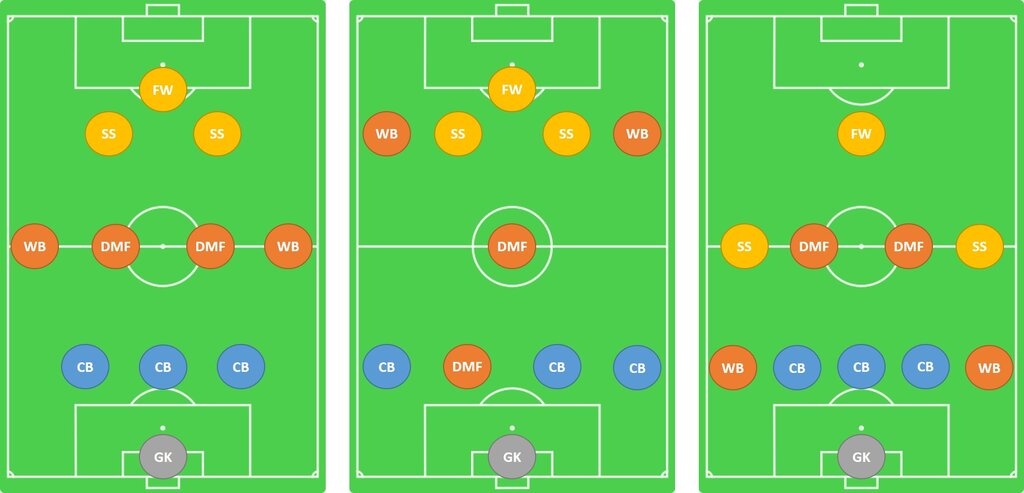
The diagram above shows the difference clearly. The 4-4-2 provides strong, simple horizontal passing lanes. The 4-3-3, however, creates diagonal passing options that are crucial for breaking through an opponent's defensive lines. It allows a team to move the ball forward and sideways with equal ease, making their attack less predictable.
Fluidity vs Rigidity
Ultimately, the choice between these formations comes down to philosophy. The 4-4-2 prioritises defensive solidity and is often used by teams that are happy to absorb pressure and attack quickly on the counter. It relies on discipline and collective movement.
The 4-3-3 is built for proactive, possession-based football. It demands technically skilled players who are comfortable on the ball and intelligent in their movement. While it can seem more attacking, a well-drilled 4-3-3 can also be a formidable defensive shape, using its midfield three to press high up the pitch and win the ball back quickly.
In modern football, these formations are rarely static. A team might defend in a 4-4-2 shape but transition into a 4-3-3 when they have the ball. The numbers are just the starting point; the real magic lies in the fluid movement and understanding between the players on the pitch.
Let's check your understanding of these tactical structures.
What is the primary defensive strength of the classic 4-4-2 formation?
A team manager wants to implement a proactive, possession-based style of football. Which formation provides a better structural starting point for this philosophy?
Understanding these basic structures is key to appreciating the tactical chess match that unfolds in every high-level game.