Advanced Fluid Milk Microbiology for Dairy Technology
Raw Milk Spoilage Dynamics
The Cold-Loving Saboteurs
When raw milk is cooled, its native microflora, primarily mesophilic lactic acid bacteria, are largely inhibited. This creates an opening for a different class of microorganisms: , which thrive in cold environments. Genera like Pseudomonas, Acinetobacter, and Alcaligenes are common culprits, often originating from environmental sources like water, soil, and milking equipment. Pseudomonas fluorescens is particularly problematic due to its rapid growth at refrigeration temperatures (below 7°C) and its potent metabolic activity.
These organisms are not just passive inhabitants. They actively metabolise milk components for growth, even at 4°C. The real issue, however, isn't the bacteria themselves, which are mostly eliminated during pasteurisation. The problem is the biochemical baggage they leave behind.
Enzymes That Survive the Heat
As psychrotrophic bacteria multiply in raw milk, they secrete extracellular enzymes into the surrounding medium. The two most significant types are proteases and lipases. These enzymes are remarkably heat-stable, capable of withstanding standard High-Temperature, Short-Time (HTST) pasteurisation at 72°C for 15 seconds. Some can even survive Ultra-High Temperature (UHT) treatments.
This means that even after the bacteria are killed, their destructive enzymes remain active in the pasteurised milk, continuing to degrade proteins and fats throughout its shelf life.
Proteolysis, the breakdown of proteins, primarily targets κ-casein and β-casein. This weakens the structure of casein micelles, leading to coagulation, gelation, and the development of bitter flavours from the resulting peptides. Lipolysis is the hydrolysis of triglycerides into free fatty acids. This process releases short-chain fatty acids like butyric acid, causing distinct rancid, soapy, or unclean off-flavours in the milk.
The Slime in the Tank
Psychrotrophic bacteria are adept at forming biofilms on the surfaces of dairy equipment, especially in hard-to-clean areas of bulk tanks, pipes, and gaskets. A is a structured community of bacterial cells enclosed in a self-produced matrix of extracellular polymeric substances (EPS). This slimy layer protects the bacteria from cleaning agents and sanitisers, creating a persistent reservoir of contamination. As milk flows over these surfaces, cells and enzymes from the biofilm are continuously shed into the milk, inoculating batch after batch.
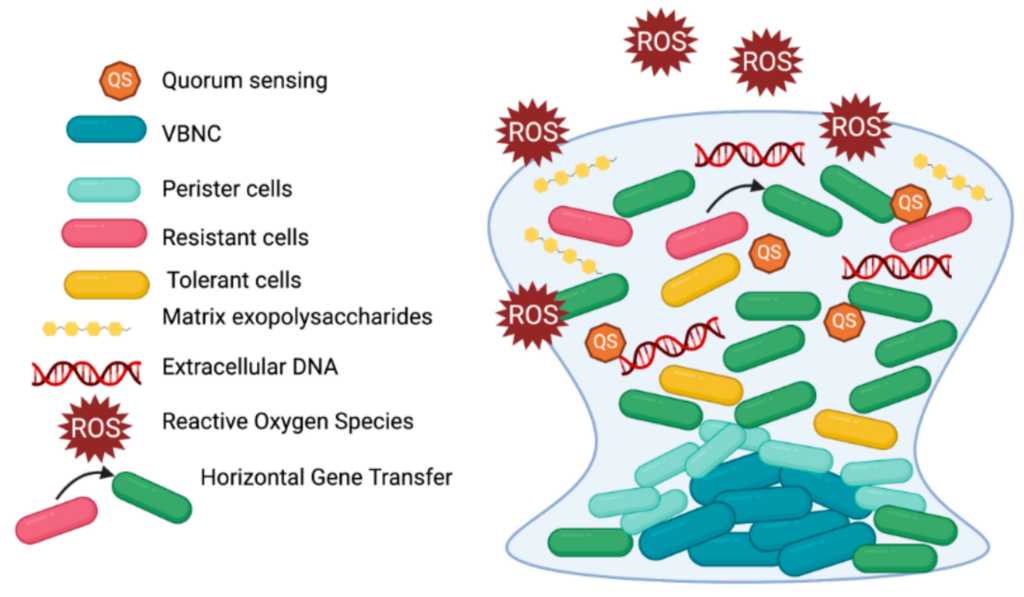
Effective cleaning-in-place (CIP) protocols, involving proper turbulence, temperature, and chemical concentrations, are essential to disrupt and remove these biofilms. Failure to do so leads to consistently high psychrotroph counts in raw milk, compromising the quality of the final product regardless of pasteurisation efficiency.
Microbial Succession
The microbial population in raw milk is not static; it undergoes a process of succession during cold storage. Initially, the milk may contain a diverse flora. However, the refrigerated conditions act as a strong selective pressure. Gram-positive bacteria, which often dominate in fresh raw milk, are poor competitors at low temperatures. In contrast, Gram-negative psychrotrophs like Pseudomonas are perfectly adapted. They rapidly outgrow other microorganisms and come to dominate the population, often within 48 to 72 hours of storage. This shift is what drives the spoilage process, as the population becomes concentrated with potent enzyme producers.
| Storage Time | Dominant Microflora | Key Spoilage Activity |
|---|---|---|
| 0-24 hours | Mixed (Lactococcus, Micrococcus, etc.) | Minimal enzymatic activity |
| 24-72 hours | Pseudomonas and other psychrotrophs begin to dominate | Production of heat-stable proteases and lipases begins |
| >72 hours | Overwhelmingly Pseudomonas | High concentration of active enzymes causing protein and fat degradation |
It's time for a quick check on these concepts.
Let's see what you've learned.
What is the primary reason psychrotrophic bacteria are a major concern for the quality of pasteurised milk?
The breakdown of triglycerides into free fatty acids, which causes rancid and soapy off-flavours in milk, is a process known as __________.
Understanding these dynamics is key to managing raw milk quality. By controlling the growth of psychrotrophs before pasteurisation, the dairy industry can significantly extend the shelf life and preserve the sensory quality of fluid milk products.