Advanced Feline Anatomical Systems
Skeletal Locomotion Dynamics
Designed for the Hunt
A cat's skeleton is a masterpiece of functional design, optimized for the explosive movements of a predator. Unlike skeletons built for heavy loads or endurance, the feline frame prioritizes flexibility, speed, and stealth. Every element, from the shoulders to the tail, contributes to its remarkable athleticism.
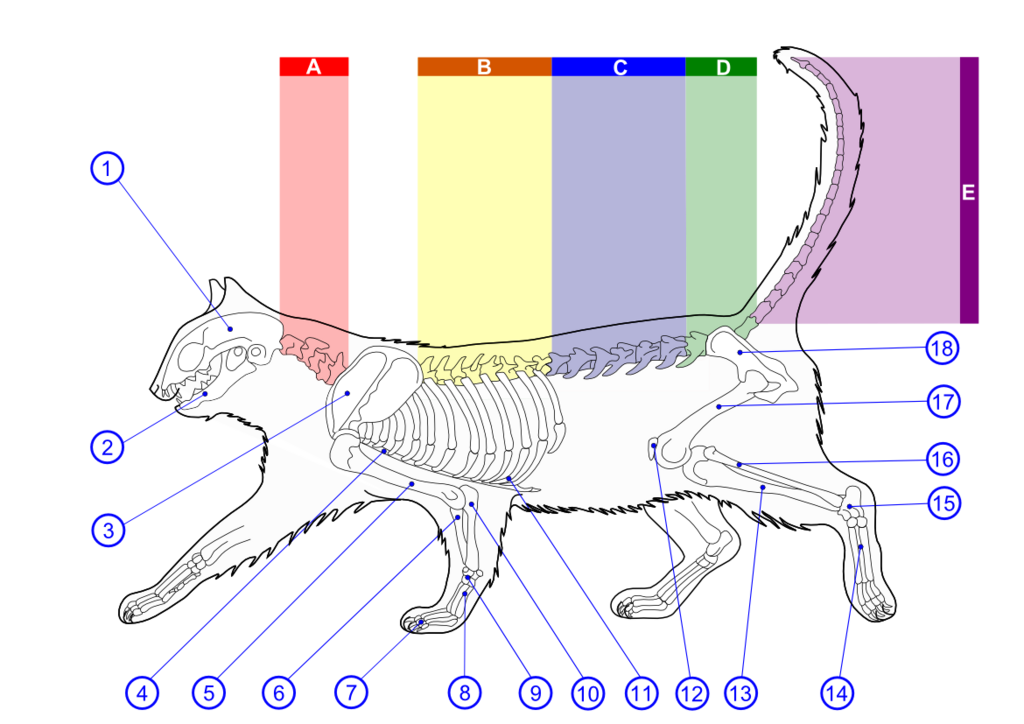
One key adaptation is the feline shoulder assembly. In humans, the collarbone (clavicle) forms a rigid connection between the shoulder blade and the sternum. Cats, however, possess only a tiny, vestigial clavicle embedded in muscle, with no bony attachment to the rest of the skeleton. This “floating” shoulder allows the scapulae to move with much greater freedom. When a cat runs, this decoupling extends its stride length, as the forelimbs can reach further forward and pull the body through a longer arc. This unique arrangement is also why a cat can often squeeze its body through any opening its head can fit through.
The Spine as a Spring
The most dramatic source of a cat's power comes from its vertebral column. The spine is incredibly flexible, with more vertebrae than a human's and highly elastic cushioning discs between them. This structure allows a cat to coil and uncoil its body like a spring, storing and releasing massive amounts of kinetic energy.
The 30 exceptionally flexible vertebrae in the spine enable felines to stretch out, compress, arch the back, and rotate, bend, and twist the front half of the body independently from the back half.
During a full-speed gallop, a cat will extend its spine to its maximum length, then flex it dramatically, bringing its hind legs far under its body. This flexion compresses the spine, loading it with potential energy. As the spine extends again for the next stride, this energy is released, catapulting the animal forward. This spinal flexion and extension cycle is a primary driver of a cat's incredible acceleration and top speed, a mechanism far more pronounced than in canids like dogs.
The pelvic girdle is robustly fused to the sacral vertebrae, creating a solid platform for the powerful hind limbs. This architecture is crucial for transferring the immense force generated by the leg muscles into forward motion for sprinting and upward thrust for jumping. The structure is also designed to absorb the significant shock of landing from heights, dissipating [{
The Vulnerable Stifle
While powerful, the feline musculoskeletal system has points of vulnerability. The [{
The CCL prevents the tibia from sliding forward relative to the femur. Due to the angle of the feline stifle joint, this ligament is under constant tension. Sudden twisting motions, hyperextension, or simply the cumulative stress over years can lead to a partial or complete rupture of the CCL. This is one of the most common orthopedic injuries in cats, causing pain, lameness, and instability that often requires surgical intervention to restore proper joint function. Understanding this biomechanical weak point is critical in veterinary medicine for diagnosing and treating hind limb lameness.
Now, let's test your understanding of these dynamic skeletal features.
What is the primary function of a cat's flexible spine during a full-speed gallop?
A cat's ability to squeeze through tight spaces is primarily due to its vestigial clavicle.
The feline skeleton is a remarkable example of evolutionary adaptation, where each component contributes to the animal's role as an agile and powerful predator.