Advanced Eukaryotic Cell Organelle Dynamics
Vesicular Non-Vesicular Transport
The Machinery of Vesicular Transport
Material exchange between organelles is not a random process of diffusion. It's a highly regulated logistics network. Vesicular transport relies on protein coats that select cargo and physically deform the donor membrane into a bud. The three canonical coat protein complexes—COPI, COPII, and clathrin—dictate the direction and nature of this traffic.
COPII-coated vesicles mediate anterograde transport, moving cargo from the endoplasmic reticulum (ER) forward to the Golgi apparatus. This process is initiated by the small GTPase Sar1, which, upon activation to its GTP-bound state, inserts an amphipathic helix into the ER membrane, beginning the curvature. Conversely, COPI vesicles manage retrograde transport, recycling materials from the Golgi back to the ER and within the Golgi cisternae. Clathrin, assisted by adaptor proteins, handles vesicle formation from the trans-Golgi network and the plasma membrane for endocytosis.
Regulation and Targeting
The lifecycle of a vesicle is tightly controlled by small GTPases. The Sar1/Arf families regulate coat assembly and disassembly, acting as molecular switches. Once a vesicle is formed and uncoated, Rab GTPases on the vesicle surface recruit tethering factors on the target membrane, mediating initial recognition. This tethering brings the vesicle close enough for the fusion machinery to engage.
Fusion is driven by the , a marvel of biomechanical engineering. Vesicle-associated SNAREs (v-SNAREs) on the vesicle pair with target-membrane SNAREs (t-SNAREs), forming a tight, four-helix bundle. The formation of this trans-SNARE complex pulls the two membranes into proximity, overcoming the energy barrier for lipid bilayer fusion. Following fusion, the now-inactive cis-SNARE complex is disassembled by the ATPase NSF and its cofactor SNAP, recycling the components for another round. This cycle ensures both specificity and efficiency in membrane traffic.
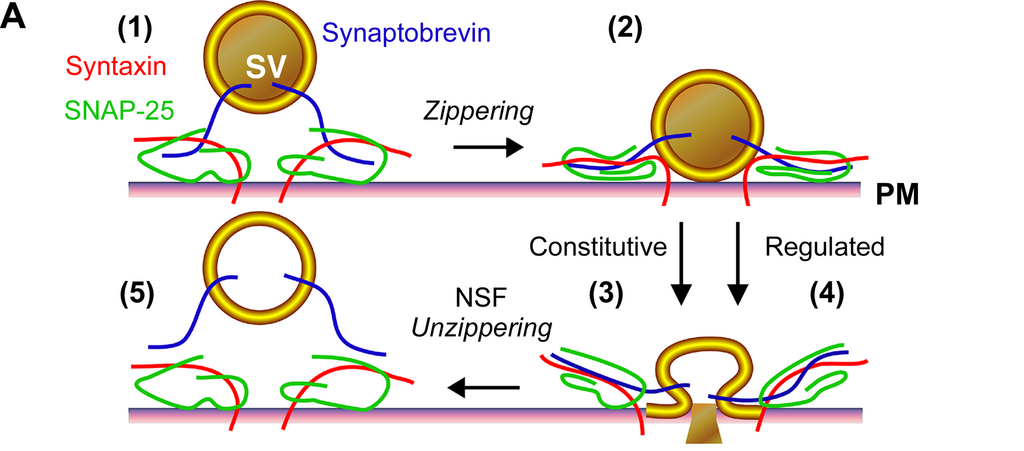
Generating the initial bud requires deforming the lipid bilayer, a process governed by proteins containing specific membrane curvature-sensing modules. Chief among these are proteins with BAR domains, which are banana-shaped dimers that bind to and stabilize curved membranes. Some BAR domains can also induce curvature themselves, actively participating in vesicle formation. This interplay between sensing and generating curvature is essential for sculpting the dynamic membranes of the endomembrane system.
Beyond the Vesicle
Not all intercellular communication requires vesicles. At membrane contact sites (MCS), organelles are held in close apposition (10-30 nm), allowing for the direct, non-vesicular transfer of lipids and small molecules like calcium. These sites are dynamic hubs of metabolic regulation, distinct from the bulk cargo delivery of vesicles.
Non-vesicular transport is faster and more energy-efficient for small molecules, avoiding the overhead of vesicle budding, transport, and fusion.
Lipid transfer is a key function of MCS. Since lipids are hydrophobic, they cannot diffuse through the aqueous cytoplasm. Instead, lipid transfer proteins (LTPs) shuttle them across the gap. A prime example involves (OSBPs) and their relatives, which often work at ER-Golgi or ER-plasma membrane contact sites. They typically exchange one lipid for another, such as phosphatidylinositol-4-phosphate (PI(4)P) for cholesterol, coupling the transport to a lipid gradient and ensuring directionality.
Finally, the positioning of organelles, which is critical for both vesicular and non-vesicular transport, is managed by molecular motors. Kinesins and dyneins are ATP-powered motors that walk along microtubule tracks, dragging organelles with them. Kinesins generally move towards the plus-end of microtubules (cell periphery), while dyneins move towards the minus-end (cell center). This dynamic positioning ensures that organelles are in the right place at the right time for efficient material exchange.
A vesicle traveling from the Golgi apparatus back to the endoplasmic reticulum (ER) would most likely be coated with which protein complex?
What is the primary function of the trans-SNARE complex in vesicular transport?