Advanced Epoxy Furniture Crafting
Material Science Strategy
Deep Pours vs. Coating Resins
Not all epoxies are created equal. The resin you use for a thin, protective coat on a tabletop is fundamentally different from one designed for a 4-inch deep river table. The key distinction lies in viscosity and curing speed, which are engineered to manage heat.
All epoxy cures through an exothermic reaction, meaning it generates heat as the resin and hardener molecules link together. For a thin coating, a fast cure time and higher viscosity are fine. The heat dissipates quickly because of the large surface area and low volume. But if you used that same resin for a deep pour, you’d have a disaster on your hands. The large mass would trap heat, causing it to build up rapidly. This can lead to yellowing, excessive shrinkage, and even dangerous thermal cracking.
Deep-pour resins are formulated with a much lower viscosity and a slower cure time. This allows bubbles to escape and, most importantly, slows the exothermic reaction to prevent overheating.
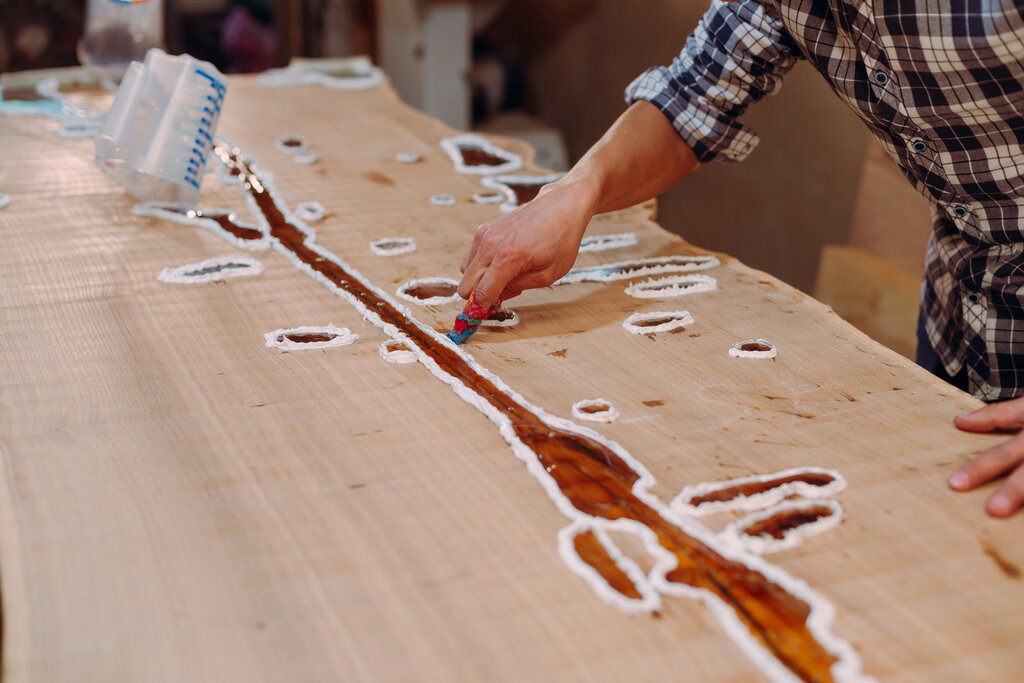
Think of it like cooking. A thin pancake cooks quickly on a hot griddle. But if you tried to cook a thick loaf of bread at that same temperature, the outside would burn before the inside was even warm. Deep-pour epoxies are like a low-and-slow oven, ensuring a controlled, even cure throughout the entire volume. Brands like Black Forest and Ecopoxy have developed specific formulations for pours of varying depths, from 2-inch to over 4-inch single layers.
Managing Exothermic Heat
The single most critical factor in a successful deep pour is managing the exothermic peak temperature. This is the maximum temperature the epoxy reaches during its cure. If this peak gets too high, the resin will fail. The total amount of heat generated is directly related to the total mass of the pour.
To predict and control this, you need to calculate the thermal mass. While complex fluid dynamics are at play, a simplified approach gives you a solid estimate. First, calculate the volume of your pour in cubic inches.
Next, you need the density of the specific epoxy you're using, which is usually found on the product's technical data sheet (TDS). Most epoxies have a density around 0.04 lbs per cubic inch. Multiply the volume by the density to find the total mass.
A larger mass means more potential heat. If your calculation shows a very large mass, you must take steps to mitigate heat. This might involve pouring in multiple, thinner layers, using cooling fans directed at the surface, or working in a colder environment. A cooler ambient temperature slows the reaction, extending the pot life and giving the heat more time to dissipate.
To increase the pot life of a cup of mixed epoxy, spread it over a larger surface area, work in a cooler environment, or mix multiple, smaller batches as you go.
Brand-Specific Trade-Offs
When selecting a professional-grade epoxy, you're balancing cost, clarity, viscosity, and cure time. There's no single "best" brand; the right choice depends on the project's specific demands.
-
West System: Known for its reliability and strength, West System epoxies are often higher in viscosity. They are fantastic for structural applications and coating but less ideal for ultra-deep, single pours. Their faster cure times require more careful management of pot life, especially in warmer shops.
-
Black Forest Deep Pour: This brand specializes in deep-pour applications. Their resins have an extremely low viscosity, which is excellent for degassing—allowing bubbles to rise and pop easily. However, this watery consistency means you need a perfectly sealed mold, as it will find and exploit even the tiniest leak.
-
Ecopoxy: Ecopoxy offers a range of products, including their popular FlowCast, which balances a low viscosity with a reasonable cure time. It's often favored for its clarity and use of bio-based content, but it can be more sensitive to temperature and humidity fluctuations during the cure.
| Brand | Best For | Key Trait | Main Consideration |
|---|---|---|---|
| West System | Structural, Coating | High Strength | Higher Viscosity, Faster Cure |
| Black Forest | Very Deep Pours | Ultra-Low Viscosity | Requires Perfect Mold Sealing |
| Ecopoxy | River Tables, Art | Bio-Based, Clear | Sensitive to Environment |
For complex assemblies, like a multi-piece river table or a large encapsulation, extending the open-time is vital. This is where environmental controls become your primary tool. Dropping your workshop temperature by just 10°F can significantly slow the reaction, giving you more time to pour and manipulate the resin before it begins to set. Some professionals even use chilled tables to draw heat away from the bottom of the mold, further controlling the cure profile.
The final consideration is degassing. A low-viscosity resin will naturally release most bubbles. But for a crystal-clear finish, especially with thicker resins, a vacuum chamber is indispensable. Pulling a vacuum on the mixed epoxy before pouring removes nearly all dissolved air, preventing bubbles from forming deep within the cure.
Now, let's test your understanding of these advanced concepts.
Why is it a bad idea to use a standard coating epoxy for a very deep pour, like a 4-inch river table?
What is the single most critical factor to manage for a successful deep epoxy pour?
Selecting the right epoxy and managing its cure is more science than art. By understanding the trade-offs between brands and mastering control over thermal mass, you can execute ambitious projects with precision and confidence.