Advanced Emotional Regulation Strategies
Neurobiology of Regulation
The Brain's Emotional Tug-of-War
Your brain is constantly managing a delicate balancing act between immediate emotional reactions and thoughtful responses. This process involves two key players: the amygdala, your brain's rapid-fire threat detector, and the prefrontal cortex (PFC), the centre of rational thought and planning. Their interaction is best understood through two distinct pathways: bottom-up and top-down processing.
Bottom-up processing is your brain's automatic, instinctual response. When you encounter a sudden, surprising stimulus, like a loud bang, your sensory organs send a signal straight to the amygdala. The amygdala, acting like a hypersensitive smoke alarm, immediately triggers a physiological stress response without waiting for any higher-level analysis. Your heart races, your muscles tense, and you're ready for action before you even consciously register what happened. This is a survival mechanism, designed for speed over accuracy.
Top-down processing is the counterbalance. After the amygdala sounds the alarm, the signal also travels to your prefrontal cortex. The PFC acts like the building manager who hears the alarm and goes to investigate. It assesses the situation using logic, context, and past experiences. It might determine the loud bang was just a car backfiring, not a threat. The PFC then sends an inhibitory signal back to the amygdala, essentially telling it to stand down. This dampens the stress response and allows you to return to a calm state. Effective emotional regulation is the skill of strengthening this top-down pathway.
Your Body's On-Off Switch
This dialogue between your brain's emotional and rational centres directly influences your Autonomic Nervous System (ANS), which controls your body's involuntary functions like heart rate and breathing. The ANS has two main branches that work in opposition.
| Branch | Function | Nickname |
|---|---|---|
| Sympathetic | Prepares the body for intense physical activity. | "Fight or Flight" |
| Parasympathetic | Relaxes the body and slows high-energy functions. | "Rest and Digest" |
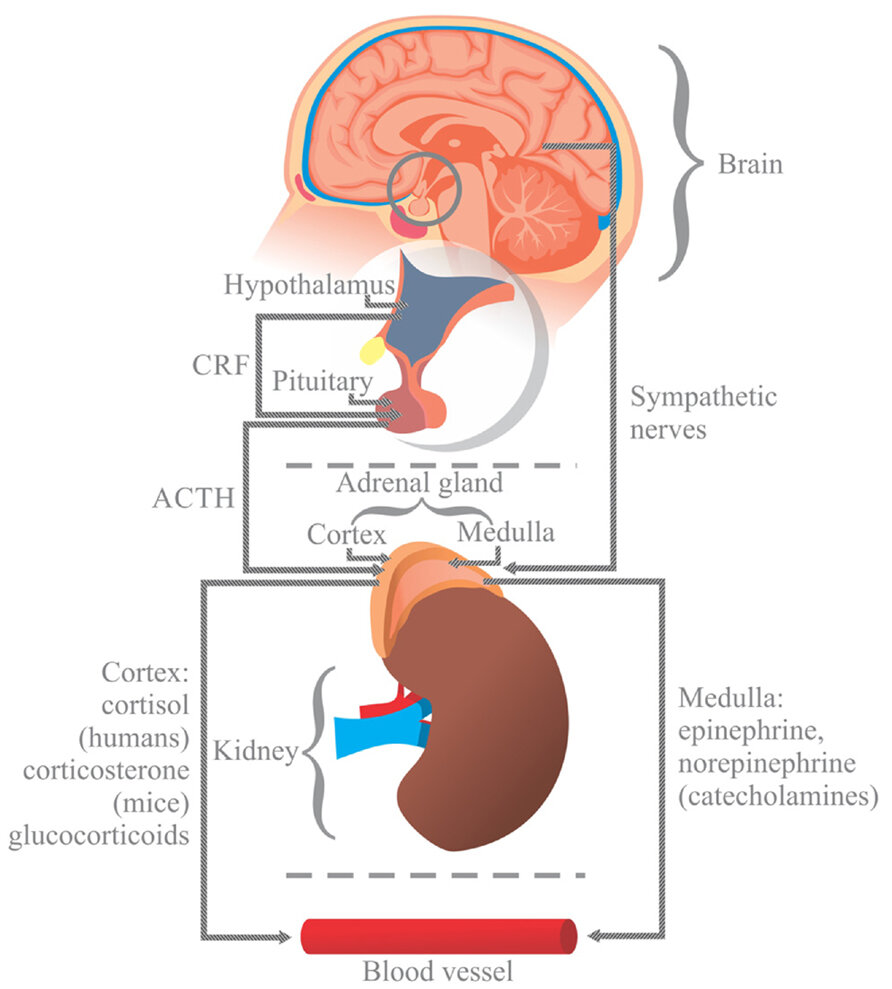
When your amygdala is in charge (bottom-up), it activates the sympathetic nervous system. Adrenaline courses through your body, your heart pounds, and your breathing becomes shallow. This is your body preparing to face a perceived threat.
To counteract this, the prefrontal cortex engages the parasympathetic nervous system, primarily through the vagus nerve . This extensive nerve wanders from the brainstem to many of the body's major organs, including the heart and lungs. When activated, it sends signals to slow your heart rate, deepen your breathing, and promote a sense of calm. Techniques like deep, slow breathing directly stimulate the vagus nerve, giving you a physical tool to help your PFC regain control.
The Chemical Messengers
Underpinning these neural signals are neurotransmitters, the chemical messengers that allow neurons to communicate. In the context of regulation, two are particularly important: glutamate and GABA. Think of them as the nervous system's accelerator and brakes.
Glutamate is the primary excitatory neurotransmitter. It increases the likelihood that a neuron will fire, essentially turning up the volume on neural communication. During a stress response, glutamate helps transmit the urgent signals from the amygdala throughout the brain.
GABA (gamma-aminobutyric acid) is the main inhibitory neurotransmitter. It does the opposite, decreasing a neuron's activity and acting as a brake. Your prefrontal cortex uses GABA to quiet the amygdala and dampen the stress response. The balance between glutamate and GABA is critical for maintaining a stable emotional state.
Rewiring Your Brain
The good news is that these regulatory pathways aren't fixed. Every time you successfully manage an emotional impulse using a top-down strategy—like taking a deep breath instead of snapping back, or reframing a negative thought—you are actively strengthening the neural connections between your prefrontal cortex and your amygdala. This principle is called .
Think of it like building a muscle. The first few times you try to regulate a strong emotion, it feels difficult and requires immense effort. The 'pathway' for top-down control is weak. But with consistent practice, that pathway becomes more robust and efficient. The communication between your PFC and amygdala gets faster and stronger, making self-regulation feel more automatic over time. You are literally reshaping your brain to be more resilient and less reactive.
In the context of emotional regulation, which of the following best describes the initial, automatic response to a sudden stimulus, known as bottom-up processing?
Top-down processing allows the prefrontal cortex to send an inhibitory signal to the amygdala, dampening the stress response.