Advanced Emergency Medical Response Strategies
Advanced Patient Assessment
Beyond the Checklist
You've mastered the basics of patient assessment. The SAMPLE history and OPQRST mnemonics are second nature. Now it's time to move beyond the checklist and develop a deeper diagnostic mindset. Advanced assessment isn't about a new set of steps; it's about refining your approach to see the whole clinical picture, especially when the patient's condition is complex or deteriorating.
This is where you transition from a data collector to a clinical detective. You learn to probe deeper, connect seemingly unrelated pieces of information, and recognize subtle clues that point toward a critical diagnosis. It’s about building a differential diagnosis in your head from the moment you meet the patient and using every piece of new information to narrow down the possibilities.
Nuanced History Taking
A comprehensive history is your most powerful diagnostic tool. When a patient can't give you a clear story, you need strategies to fill in the gaps. For a patient with an altered mental status, don't just rely on family or bystanders. Look for medical alert bracelets, check their wallet for an emergency contact card, or scan their phone’s medical ID. The patient's environment is also full of clues. Are there empty pill bottles? Is the home neat or in disarray? These details build the story.
When questioning, avoid leading questions. Instead of asking, "Are you having chest pain?" try, "Tell me what you're feeling in your chest." For sensitive topics like substance use or potential abuse, establish trust first. Use a calm, non-judgmental tone. Phrases like, "I need to ask some personal questions to make sure we give you the best care," can help.
Consider a patient with shortness of breath. Basic questioning asks about onset and duration. Advanced questioning explores positional changes (orthopnea), nighttime awakenings (paroxysmal nocturnal dyspnea), and associated swelling in the feet, painting a clearer picture of potential heart failure.
The Focused Physical Exam
Your physical exam should be guided by the patient's chief complaint and your initial findings. It's about knowing which specific assessments will yield the most valuable information. For example, in a patient with abdominal pain, you're not just palpating for tenderness. You're assessing for guarding, rebound tenderness, and rigidity. You might perform specific maneuvers like checking for Murphy's sign (for gallbladder inflammation) or Rovsing's sign (for appendicitis).
Recognizing subtle signs is crucial. A patient with a severe headache and stiff neck requires an immediate assessment for meningitis (nuchal rigidity). In a trauma patient, you might notice Beck's triad—muffled heart sounds, jugular venous distention, and hypotension—which points to cardiac tamponade. These aren't obvious findings; they require a deliberate and skilled examination.
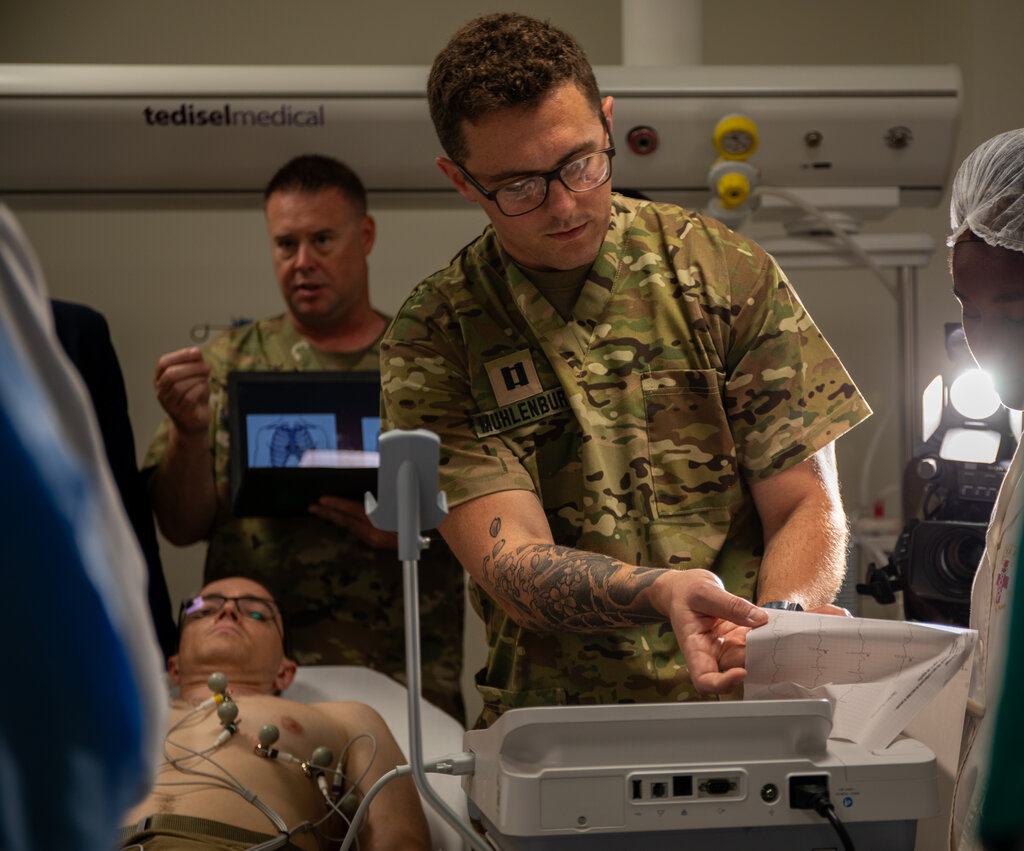
Integrating data from monitoring equipment is another layer. A pulse oximeter reading of 95% might seem normal, but what if the patient is on high-flow oxygen? That seemingly good number could be masking severe respiratory distress. You need to interpret data within the context of the entire clinical situation.
Capnography, which measures end-tidal CO₂, is an incredibly powerful tool. A sudden drop to zero in an intubated patient indicates a displaced tube. In a patient with shortness of breath, a low reading could suggest hyperventilation, while a high reading might point to COPD or respiratory failure.
| Diagnostic Tool | Common Use | Advanced Insight |
|---|---|---|
| EKG | Identify heart attack | Detect electrolyte imbalances (e.g., peaked T-waves in hyperkalemia) or signs of a pulmonary embolism (S1Q3T3 pattern). |
| Glucometer | Check blood sugar | Rule out hypoglycemia as a cause for altered mental status, even in non-diabetic patients. |
| Capnography | Confirm ET tube placement | Assess CPR quality (low ETCO₂ indicates poor compressions) and monitor for return of spontaneous circulation (a sudden spike in ETCO₂). |
| Ultrasound (POCUS) | Visualize organs | Quickly perform a FAST exam in trauma to find internal bleeding, or check for cardiac activity in cardiac arrest. |
Advanced assessment is a dynamic process of weaving together the patient's story, your physical findings, and diagnostic data. It’s a skill that grows with experience, turning every patient encounter into a learning opportunity.
You are assessing a patient with an altered mental status who is unable to provide a medical history. Which of the following is the LEAST effective action to take?
A patient with a severe headache and a stiff neck (nuchal rigidity) should be considered at high risk for what condition?