Advanced Electron Configuration and Atomic Orbitals
Quantum Mechanical Foundations
Beyond Fixed Orbits
In earlier models of the atom, electrons were pictured whizzing around the nucleus like planets in a solar system. This picture is simple, but it's not quite right. The quantum mechanical model paints a more complex and fascinating reality. Instead of neat, predictable paths, electrons exist in regions of probability called orbitals. We can't say exactly where an electron is at any given moment, but we can describe the space where it's most likely to be found.
This shift in thinking comes from two core ideas of quantum mechanics. The first is wave-particle duality, the concept that particles like electrons can behave both as particles and as waves. The second is the Heisenberg Uncertainty Principle, which states that it's impossible to know both the exact position and the exact momentum of a particle simultaneously. The more precisely you know one, the less precisely you know the other. This uncertainty isn't due to faulty equipment; it's a fundamental property of the universe. Because of this, we have to talk about electrons in terms of probability clouds, or orbitals, not fixed orbits.
An orbital isn't a path. It's a three-dimensional region around the nucleus that indicates the probable location of an electron.
An Electron's Address
To describe the location and energy of an electron in an atom, we use a set of four quantum numbers. Think of them as an electron's unique address. No two electrons in the same atom can have the exact same set of four quantum numbers. This rule is known as the Pauli Exclusion Principle.
| Quantum Number | Symbol | Describes | Possible Values |
|---|---|---|---|
| Principal | Energy level & size | Integers (1, 2, 3, ...) | |
| Angular Momentum | Orbital shape | 0 to | |
| Magnetic | Orbital orientation | to (including 0) | |
| Spin | Electron spin | +1/2 or -1/2 |
Orbital Shapes and Energy
Let's break down what these numbers tell us about the orbitals themselves.
Principal Quantum Number
noun
Designated by the symbol , this number indicates the main energy level or shell of an electron. It's the most general part of the electron's address.
The value of must be a positive integer (1, 2, 3, and so on). A higher value of means the electron is in a higher energy level, is on average farther from the nucleus, and its orbital is larger.
Higher = Higher energy & Larger orbital size
Next, the Angular Momentum Quantum Number () defines the shape of the orbital. Its value depends on ; it can be any integer from 0 up to . Instead of using the numbers, chemists often use letters to denote the orbital shape:
| Value of | Orbital Letter | Shape |
|---|---|---|
| 0 | s | Spherical |
| 1 | p | Dumbbell |
| 2 | d | Complex (cloverleaf, etc.) |
| 3 | f | Very complex |
So, for the first energy level (), can only be 0. This means the first shell only has an s orbital (a 1s orbital). For the second energy level (), can be 0 or 1. This means the second shell has both an s orbital (2s) and p orbitals (2p).
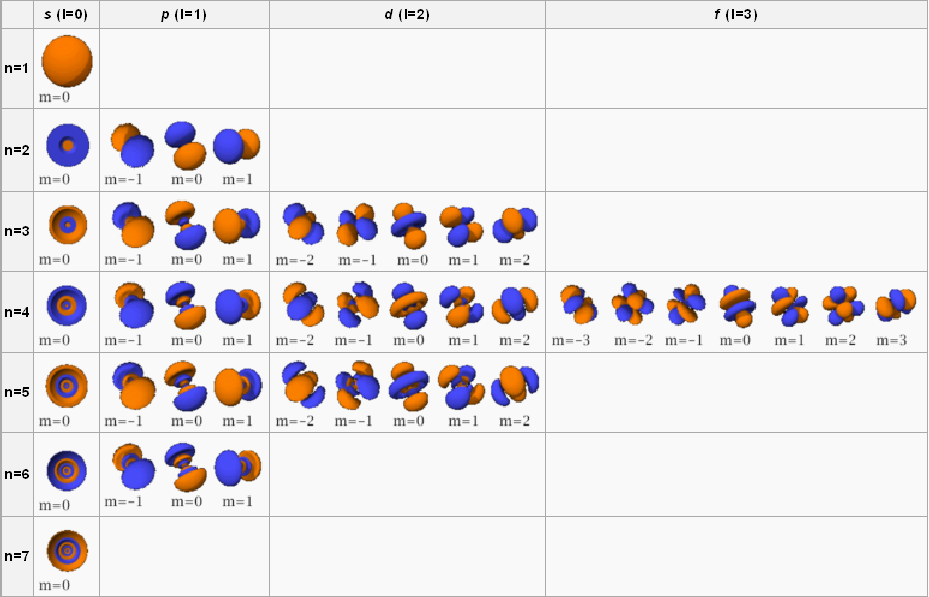
The Magnetic Quantum Number () specifies the orientation of the orbital in three-dimensional space. Its possible values are integers ranging from to . An s orbital () has only one possible orientation () because a sphere looks the same from any angle.
A p orbital (), however, has three possible values for : -1, 0, and +1. This corresponds to three p orbitals oriented along the x, y, and z axes (, , ). They have the same dumbbell shape but point in different directions. Similarly, d orbitals () have five possible orientations, and f orbitals () have seven.
Finally, the Spin Quantum Number () describes an intrinsic property of the electron called spin. It's a quantum mechanical property that doesn't have a true classical analog, but it can be visualized as the electron spinning on its axis, creating a tiny magnetic field. The spin can be in one of two directions: spin up () or spin down ().
The Heisenberg Uncertainty Principle states that it is impossible to simultaneously know which two properties of a particle with perfect accuracy?
Which quantum number primarily determines the energy level and the average distance of an electron from the nucleus?
These four numbers work together to define a specific orbital and the state of an electron within it. Understanding this framework is the key to predicting how electrons arrange themselves in atoms, which in turn determines an element's chemical properties.