Advanced Electromagnetic Wave Theory
Maxwell Equations
The Heart of Electromagnetism
At the core of classical electricity and magnetism lie four elegant equations. These are not just formulas; they are a complete description of how electric and magnetic fields are generated and how they interact with each other and with matter. Known collectively as Maxwell's Equations, they unify the work of predecessors like Gauss, Faraday, and Ampère into a single, cohesive theory.
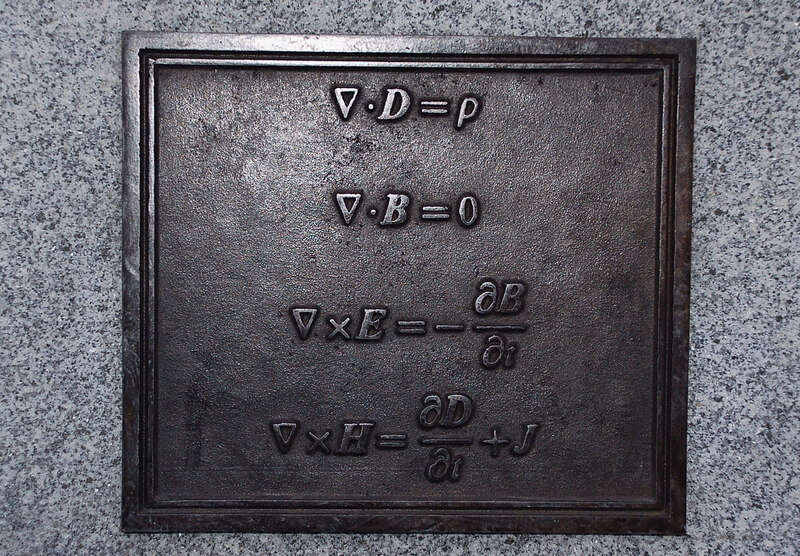
These equations come in two flavors: differential and integral. The differential forms describe the behavior of fields at a single point in space, giving a microscopic view. The integral forms describe the fields over a region of space or a surface, offering a macroscopic perspective. Let's look at each one.
The Four Laws
First is Gauss's Law for electricity. It states that an electric field is produced by electric charges. The total electric flux out of a closed surface is directly proportional to the charge enclosed within it. In simple terms, electric field lines originate from positive charges and terminate on negative charges.
Next is Gauss's Law for magnetism. This one is simpler. It tells us that there are no magnetic monopoles. Unlike electric charges, which can be isolated as positive or negative, magnetic poles always come in north-south pairs. As a result, magnetic field lines are always continuous loops; they never start or end at a point.
Third, we have Faraday's Law of Induction. This law reveals a crucial connection between electricity and magnetism. It states that a changing magnetic field creates a circulating electric field. This is the principle behind electric generators and transformers.
Finally, we have the Ampère-Maxwell Law. Originally, Ampère's Law related magnetic fields only to electric currents. However, noticed an inconsistency in the math when dealing with changing electric fields, such as in a charging capacitor. He added a new term, the , to fix it. This law now states that a magnetic field can be generated in two ways: by an electric current, or by a changing electric field.
Coupling and Waves
The true beauty of Maxwell's equations is revealed when you look at Faraday's Law and the Ampère-Maxwell Law together. One says a changing magnetic field creates an electric field. The other says a changing electric field creates a magnetic field. This creates a feedback loop.
Imagine you create a disturbance in an electric field. That changing E-field will induce a B-field. But that new B-field is also changing, so it induces a new E-field a little further away. This leapfrogging effect, where one field continuously generates the other, is an electromagnetic wave. Maxwell's equations predicted that these waves—which include radio waves, microwaves, and visible light—travel at a constant speed, the speed of light ().
The equations also define how fields behave at the boundary between two different materials. These boundary conditions are essential for understanding how electromagnetic waves reflect, refract, and are absorbed—forming the basis for optics and antenna design.
What is the primary implication of Gauss's Law for magnetism?
What crucial concept did James Clerk Maxwell add to Ampère's Law to account for changing electric fields?
Taken together, these four laws provide a complete, classical description of electromagnetism, forming the foundation for everything from circuit analysis to the theory of light.