Advanced Electrical Machines Principles and Applications
Advanced Electromagnetic Theory
Analyzing Magnetic Fields in Machines
To really understand electrical machines, we need to go beyond basic magnets and look at how magnetic fields behave in specific structures. Think of it like fluid dynamics, but for magnetism. We analyze a machine's magnetic field using the concept of a magnetic circuit.
A magnetic circuit is the path that magnetic flux follows. In a motor or transformer, this path is usually made of a high-permeability material like iron. Just as electrical resistance opposes the flow of current, a property called reluctance opposes the magnetic flux.
The total reluctance of the circuit determines how much flux is generated for a given magnetomotive force (MMF), which is created by the current flowing through the coil. The MMF is analogous to voltage in an electrical circuit.
Air has a much higher reluctance than iron. This means even a tiny air gap in a motor's magnetic circuit can significantly impact its performance, requiring more current to achieve the same magnetic flux. Analyzing these circuits is key to designing efficient machines.
The Governing Laws
Magnetic circuits are a practical tool, but the fundamental physics behind them, and all of electromagnetism, is described by a set of four elegant equations. These are Maxwell's Equations. They tie together electricity, magnetism, and light.
Let's look at them one by one in their integral form, which is useful for understanding the concepts in a physical space.
Fields That Travel
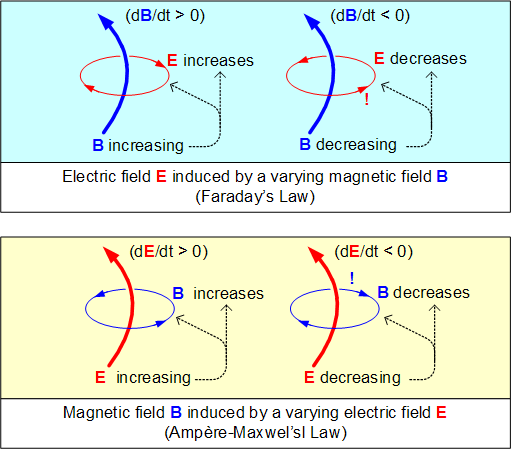
That final term in the Ampère-Maxwell law is revolutionary. It means a changing electric field creates a magnetic field, and Faraday's Law says a changing magnetic field creates an electric field. The two can sustain each other, creating a propagating wave that travels through space: an electromagnetic wave.
By combining the equations, you can derive the wave equation for the electric and magnetic fields.
While we often think of radio waves or light, this wave propagation is also relevant inside electrical machines. At high frequencies, the fields don't just stay put. They can radiate away energy or cause unexpected effects between components. Understanding wave propagation is critical for designing high-frequency transformers and motors, and for managing electromagnetic interference (EMI).
In the context of a magnetic circuit, which property is the direct analogue of electrical resistance in an electrical circuit?
What is the primary effect of introducing a small air gap into a magnetic circuit made primarily of a high-permeability material like iron?
This look at advanced concepts provides the theoretical foundation needed to analyze and design complex electrical machinery.