Advanced Dynamics of the Krebs Cycle
Pyruvate Decarboxylation Mechanism
The Gateway to the Krebs Cycle
Glycolysis breaks down glucose into two molecules of pyruvate right in the cell's cytoplasm. But the next stage of cellular respiration, the Krebs cycle, takes place inside the mitochondria. Before the cycle can begin, pyruvate must cross the inner mitochondrial membrane, which it does via a specific transport protein.
Once inside the mitochondrial matrix, pyruvate meets a massive molecular machine: the Pyruvate Dehydrogenase (PDH) complex. Think of it as a highly efficient assembly line. It's not just a single enzyme but a large, integrated complex made of three distinct enzymes—E1, E2, and E3—that work together to perform a critical conversion.
Pyruvate from aerobic glycolysis enters mitochondria, where it may be converted into acetyl-CoA (irreversible reaction) under the action of enzyme Pyruvate Dehydrogenase (PDH – inhibited by it’s product acetyl-CoA) for entry into:
This process, known as pyruvate decarboxylation, transforms the three-carbon pyruvate into a two-carbon acetyl group attached to Coenzyme A (CoA). The result is acetyl-CoA, the fuel for the Krebs cycle. During this conversion, one carbon atom is stripped from pyruvate and released as carbon dioxide, and a molecule of NADH is produced.
A Team of Five Coenzymes
The PDH complex relies on five different coenzymes to get the job done. Three of these—TPP, lipoate, and FAD—are tightly bound to the enzyme complex and act as catalytic cofactors. The other two, NAD⁺ and Coenzyme A, function as co-substrates.
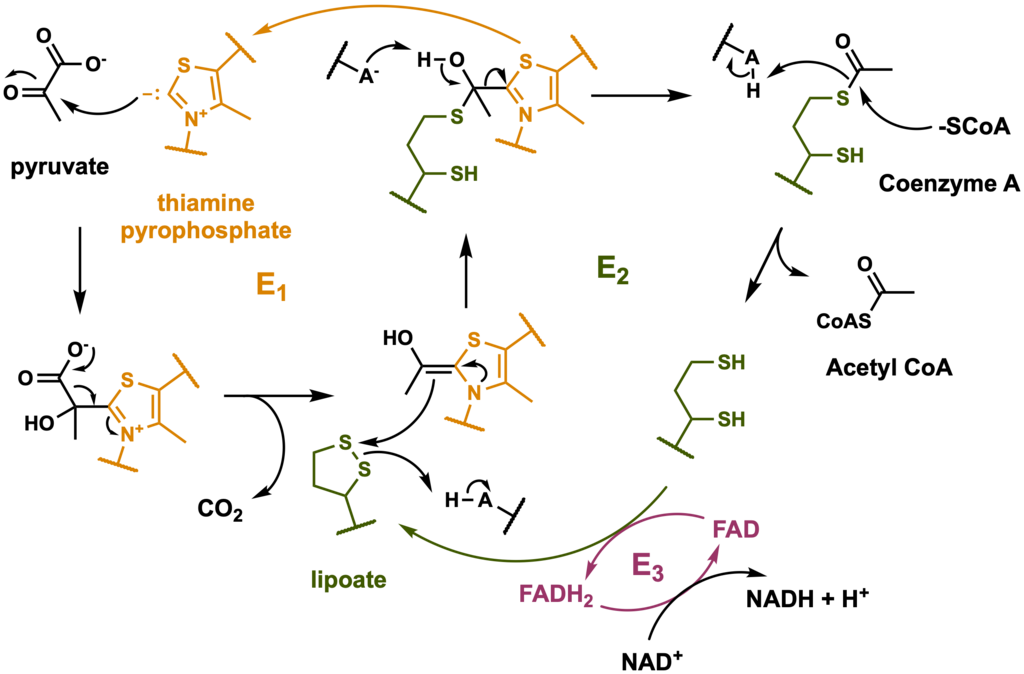
Here’s a breakdown of the team and their roles:
| Coenzyme | Full Name | Role in PDH Complex |
|---|---|---|
| TPP | Thiamine Pyrophosphate | Binds to pyruvate in E1, facilitating decarboxylation (removal of CO₂). |
| Lipoate | Lipoic Acid | Attached to E2, it accepts the two-carbon acetyl group from TPP and transfers it to Coenzyme A. |
| CoA-SH | Coenzyme A | Accepts the acetyl group from lipoate to form acetyl-CoA, the final product. |
| FAD | Flavin Adenine Dinucleotide | Accepts electrons from the reduced lipoate in E3, becoming FADH₂. |
| NAD⁺ | Nicotinamide Adenine Dinucleotide | Accepts electrons from FADH₂ in E3, forming NADH, an electron carrier for the respiratory chain. |
The three enzymes of the PDH complex hand off intermediates from one active site to the next. The E1 subunit first removes a carboxyl group from pyruvate as CO₂. The remaining two-carbon fragment is passed to the lipoate arm on the E2 subunit, which then transfers it to Coenzyme A, forming acetyl-CoA. Finally, the E3 subunit reoxidizes the lipoate arm using FAD and subsequently NAD⁺, generating NADH and resetting the complex for the next pyruvate molecule.
A Point of No Return
The conversion of pyruvate to acetyl-CoA is a highly exergonic reaction, meaning it releases a significant amount of free energy. This makes the step essentially irreversible in the cell. Unlike many steps in glycolysis, there is no direct metabolic pathway to convert acetyl-CoA back into pyruvate.
This irreversibility makes the PDH complex a critical point of metabolic regulation. Once pyruvate is converted to acetyl-CoA, the cell is committed to either sending it through the Krebs cycle for energy production or using it for fatty acid synthesis.
Because of this, the PDH complex is tightly controlled. High levels of its products, like acetyl-CoA and NADH, act as inhibitors, signaling that the cell has plenty of energy. Conversely, when energy is low, the complex is activated to produce more acetyl-CoA. This regulation ensures that the cell doesn't wastefully process glucose when its energy needs are already met.
Where in the cell does the conversion of pyruvate to acetyl-CoA occur?
Which of the following are all products of the reaction catalyzed by the Pyruvate Dehydrogenase (PDH) complex?
With acetyl-CoA now formed, the stage is set for the Krebs cycle to begin its work of extracting more energy.