Advanced Dynamics of the Human Cell
Membrane Dynamics
The Dynamic Membrane
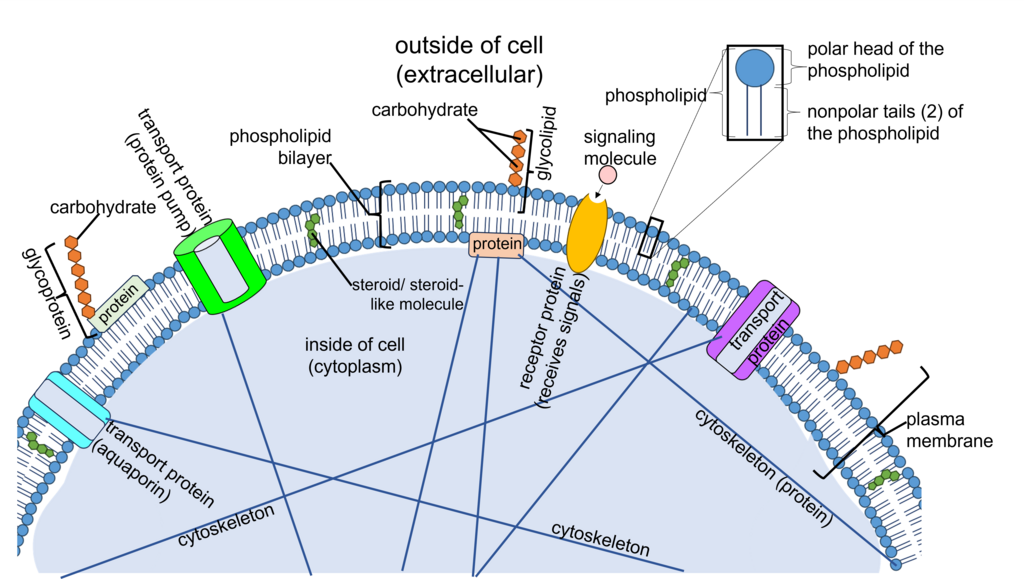
You already know the cell membrane is a phospholipid bilayer, but this description is too static. It's less like a solid wall and more like a bustling, fluid surface. The components—lipids, proteins, and carbohydrates—are constantly shifting and moving laterally, much like buoys bobbing in the ocean.
The fluid mosaic model describes the structure of the plasma membrane as a mosaic of components—including phospholipids, cholesterol, proteins, and carbohydrates—that gives the membrane a fluid character.
This fluidity allows the membrane to be flexible and self-sealing. However, the membrane isn't a completely uniform sea. It contains specialized areas called lipid rafts. These are small, highly organized domains floating within the larger membrane. They are thicker and less fluid than their surroundings because they're enriched with cholesterol and specific lipids called sphingolipids.
Lipid Raft
noun
A microdomain within a cell membrane that is enriched in cholesterol and sphingolipids and functions as a platform for organizing signaling proteins.
Think of lipid rafts as dedicated workbenches on the cell surface. By bringing specific proteins close together, they make cellular processes like signal transduction much more efficient. Instead of signaling molecules drifting aimlessly to find their partners, they are corralled into these rafts, ready for action.
Gradients and Potential
The membrane's primary job is to control what gets in and out, creating a difference between the intracellular and extracellular environments. This isn't just about chemical concentrations; it's also about electrical charge. Together, these two factors create the electrochemical gradient, the net driving force on an ion across the membrane.
The chemical part of the gradient is straightforward: ions naturally want to move from an area of high concentration to an area of low concentration. The electrical part is due to the membrane potential, a voltage difference across the membrane. The inside of most human cells is negatively charged relative to the outside, typically around -70 millivolts (mV). This charge difference attracts positive ions into the cell and repels negative ions.
The electrochemical gradient for sodium (), for example, is very strong. There's much more sodium outside the cell than inside (chemical gradient), and the negative charge inside the cell pulls the positive sodium ions inward (electrical gradient). For potassium (), the situation is more complex. Its chemical gradient pushes it out of the cell (high concentration inside), but the electrical gradient pulls it back in. The net movement depends on which force is stronger.
Powering the Pump
Maintaining these gradients requires constant work. The cell's primary tool for this is the sodium-potassium (/) pump, a classic example of primary active transport. This protein uses the energy from ATP hydrolysis to actively move ions against their electrochemical gradients.
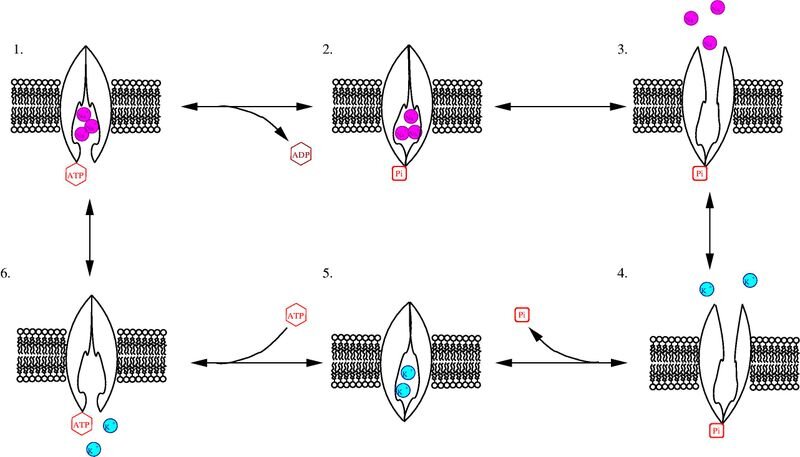
For every molecule of ATP it consumes, the pump performs a six-step cycle:
- Three ions from inside the cell bind to the pump.
- ATP phosphorylates the pump, causing it to change shape.
- The shape change releases the ions outside the cell.
- Two ions from outside the cell bind to the newly exposed sites.
- The binding of triggers the removal of the phosphate group.
- The pump returns to its original shape, releasing the ions inside the cell.
This process is not just about moving ions. By pushing three positive charges out for every two it brings in, the pump is electrogenic—it directly contributes to the negative membrane potential. This constant pumping is energetically expensive, consuming roughly 25% of a resting human's total energy.
Putting Gradients to Work
The steep sodium gradient created by the / pump is a powerful source of potential energy, like water held behind a dam. The cell harnesses this energy through secondary active transport to move other molecules against their own concentration gradients.
A key example is the sodium-glucose symporter (SGLT). This transport protein uses the energy released as flows down its electrochemical gradient to pull glucose into the cell, even when the glucose concentration inside is already high.
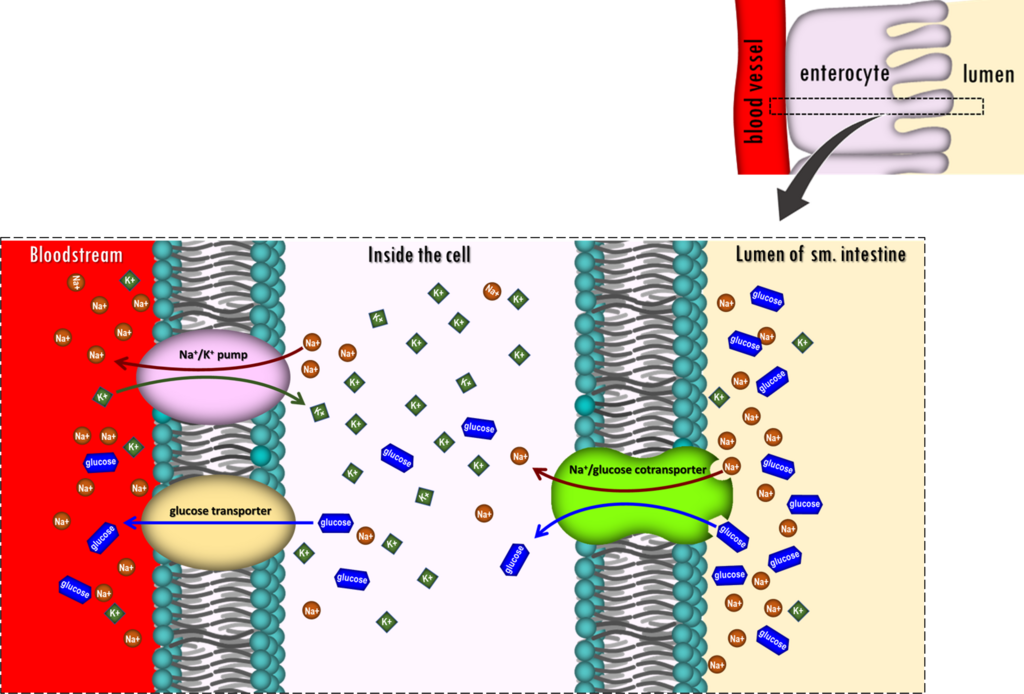
This mechanism is crucial in polarized epithelial cells, such as those lining your small intestine or renal tubules. These cells have distinct apical (facing the lumen) and basolateral (facing the bloodstream) membranes.
On the apical side, SGLT proteins use the sodium gradient to absorb glucose from digested food or filtered urine. On the basolateral side, a different transporter (a GLUT protein) allows this accumulated glucose to leave the cell and enter the bloodstream via facilitated diffusion, moving down its newly created concentration gradient. Meanwhile, the / pump, also located on the basolateral membrane, works tirelessly to pump sodium out, maintaining the gradient needed to power the whole system. This elegant division of labor allows for the efficient one-way transport of nutrients from the lumen into the body.
The cell membrane is often described as a "fluid mosaic." What are lipid rafts in the context of this model?
What two forces combine to create the electrochemical gradient that drives ion movement across the cell membrane?