Advanced Dynamics of the Continental Shelf
Crustal Transitions
Where Continent Meets Ocean
The edge of a continent isn't just a shoreline; it's a massive geological transition zone. This zone, the continental margin, marks where thick, buoyant continental crust gives way to thin, dense oceanic crust. The fundamental difference between these two lies in their rock composition, or petrology.
Continental crust is broadly granitic. It’s rich in silica and aluminum, making it relatively light. Think of it as the thick, frothy foam on a latte. Oceanic crust, in contrast, is basaltic. It's composed of denser minerals rich in magnesium and iron, like the dark, heavy coffee underneath. This density difference is not trivial; it dictates why continents ride high and ocean floors sit low.
| Feature | Continental Crust | Oceanic Crust |
|---|---|---|
| Primary Rock Type | Granite, Granodiorite | Basalt, Gabbro |
| Average Density | ~2.7 g/cm³ | ~3.0 g/cm³ |
| Average Thickness | 35–40 km (up to 70 km) | 7–10 km |
| Age | Up to 4 billion years | Generally < 200 million years |
The Great Thinning
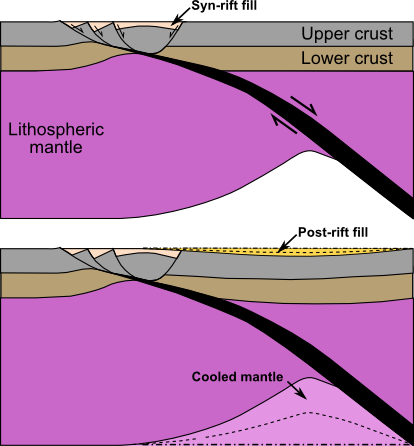
Continents don't just abruptly end. They are stretched and thinned over millions of years in a process called , which creates the continental margin. Imagine slowly pulling a piece of caramel taffy apart. It doesn't snap cleanly; it necks down in the middle, becoming progressively thinner before it separates. Continental lithosphere behaves similarly under tectonic tension.
As the light continental crust thins, the denser mantle material beneath it rises to take its place. This process triggers an important balancing act known as isostasy, where the lithosphere floats on the deeper, fluid-like asthenosphere at an elevation that depends on its thickness and density. The thinned, stretched continental edge, now weighed down by encroaching ocean water and sediments, subsides or sinks. This subsidence is what forms the submerged continental shelf and the steeper continental slope.
The Moho's Curve
Geologists can map the boundary between the crust and the mantle using seismic waves. This boundary is called the Mohorovičić discontinuity, or just the for short. Beneath the thick continents, the Moho can be 50-70 km deep. But as the crust thins across the continental margin, the Moho rises dramatically, sitting just 7-10 km below the seafloor under the oceanic crust. This sharp upward curve of the Moho is a defining feature of the continent-ocean transition.
Active vs. Passive Margins
Not all continental margins are the same. Their structure depends entirely on their tectonic setting.
A passive margin is one that is not on a plate boundary. It's the quiet, trailing edge of a continent that has moved away from a spreading center. The Atlantic coasts of North and South America are classic examples. They have wide continental shelves and a gradual transition to the deep ocean, the result of that successful rifting process millions of years ago.
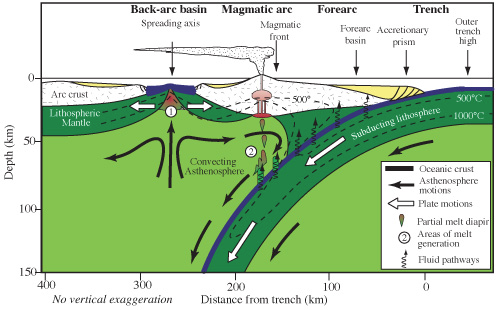
An active margin, however, is a hotbed of geologic activity. Here, the edge of a continent is also a tectonic plate boundary, typically where an oceanic plate is grinding against and sliding beneath a continental plate in a subduction zone. The Pacific coast of South America is a prime example. These margins are characterized by narrow shelves, deep-sea trenches, earthquakes, and a line of volcanoes just inland. The transition from continental to oceanic crust is abrupt and violent.
Understanding these transitions isn't just academic. It explains why coastlines look the way they do and helps predict where geological hazards are most likely to occur.
What is the primary difference in rock composition between continental crust and oceanic crust?
The geological process where continental lithosphere is stretched and thinned, eventually creating a continental margin, is called ________.