Advanced Dynamics of Human Psychology
Cognitive Architecture Dynamics
The Architecture of Thought
Your mind isn't a passive receiver of information. It's an active, dynamic system that constructs your reality. Think of it as a cognitive architecture, a framework that processes the world around you. This process starts with a flood of sensory data, but you don't experience it all. Attention acts as a gatekeeper, filtering what gets in.
What guides this filter? Your existing mental frameworks, or schemas. A schema is an organized pattern of thought or behavior, a mental shortcut built from past experience. If you're a chess master, you see a board not as 32 pieces but as patterns of force and opportunity. If you're a doctor, you see a patient's symptoms not as isolated facts but as potential signs of a known condition. Your schemas dictate what you perceive and how you encode new memories, integrating them into your existing knowledge.
The Mental Bottleneck
Your brain's processing power, specifically your working memory, is finite. The mental effort required to process information is called A simple task, like tying your shoes, imposes a low cognitive load. A complex one, like trying to understand a new scientific theory, imposes a high one.
When the total cognitive load exceeds your capacity, your ability to think clearly and make decisions suffers. It's like trying to run too many demanding programs on a computer at once, everything slows down and starts to crash. Effective decision-making isn't just about having the right information; it's about managing your mental bandwidth to process it effectively. This is why simplifying complex problems and eliminating distractions are critical skills in any high-stakes field.
Carefully manage the intrinsic load of concepts you are trying to internalize, and reduce extraneous sources of information and distraction hampering germane load (available mental effort).
Two Minds, One Brain
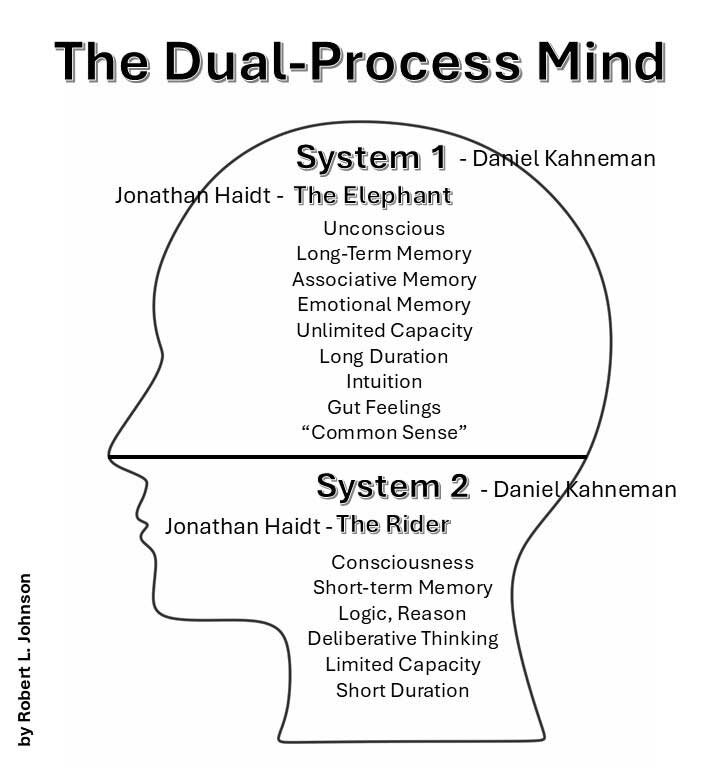
To cope with the limits of cognitive load, our minds operate on two different tracks. This idea is known as and it splits our thinking into two modes: System 1 and System 2.
System 1 is the Elephant. It’s fast, automatic, intuitive, and emotional. It operates effortlessly and is responsible for most of our day-to-day judgments. When you instantly recognize a friend's face or get a “gut feeling” about a situation, that's System 1 at work. It relies on mental shortcuts called heuristics.
System 2 is the Rider. It’s slow, deliberate, analytical, and logical. It requires conscious effort and attention. When you solve a complex math problem or weigh the pros and cons of a major life decision, you're engaging System 2. This mode is powerful but lazy; it takes a lot of energy, so we avoid using it unless we have to.
| Feature | System 1 (The Elephant) | System 2 (The Rider) |
|---|---|---|
| Speed | Fast, automatic | Slow, deliberate |
| Effort | Low, effortless | High, requires focus |
| Control | Unconscious | Conscious |
| Process | Intuitive, emotional | Analytical, logical |
| Example | Recognizing a face | Calculating a 17% tip |
Useful Shortcuts, Costly Errors
The heuristics used by System 1 are essential. They allow us to navigate a complex world without getting paralyzed by analysis. But these shortcuts are also the source of predictable, systematic errors in judgment known as
For example, an emergency room doctor might fall victim to confirmation bias, focusing on evidence that supports their initial diagnosis while ignoring signs that point to a different, less obvious condition. A financial trader might be swayed by the availability heuristic, overestimating the likelihood of a market crash because they recently read several news articles about one.
These biases aren't signs of intellectual weakness. They are features of our cognitive architecture, the trade-off for having a brain that can make fast, efficient judgments most of the time. The key to better professional judgment is not to eliminate System 1 thinking, but to recognize when it's likely to lead you astray and consciously engage the more effortful System 2.
Time for a quick check on these concepts.
What is the term for the mental effort required to process information?
A seasoned firefighter instantly assesses a burning building and knows the safest point of entry without consciously analyzing every detail. Which system of thinking is primarily at play?
Understanding these dynamics is the first step toward metacognition, or thinking about your thinking. By recognizing the interplay of attention, memory, and your two competing systems, you can begin to spot potential errors in your own judgment and make more deliberate, rational decisions when it truly counts.