Advanced Dynamics of Chemical Bonding
Lattice Energy Dynamics
Why Ionic Bonds Form
You know that metals tend to lose electrons and nonmetals tend to gain them, forming cations and anions that attract each other. But if it costs energy to remove an electron from an atom (ionization energy), why is the formation of an ionic compound like sodium chloride (NaCl) so favorable? The process releases a tremendous amount of energy, making the resulting solid incredibly stable. The secret isn't in forming the individual ions, but in arranging them into a crystal lattice.
The massive energy release that stabilizes an ionic solid comes from arranging gaseous ions into a highly ordered, three-dimensional crystal structure.
This energy is called lattice energy (). It's the enthalpy change that occurs when one mole of an ionic solid is formed from its constituent gaseous ions. A large, negative lattice energy signifies a very stable ionic compound. But how can we measure this? We can't easily combine gaseous sodium and chloride ions in a lab. Instead, we use an indirect method based on Hess's Law called the Born-Haber cycle to calculate it.
The Born-Haber Cycle
The Born-Haber cycle is a thermodynamic roadmap. It breaks down the formation of an ionic solid into a series of distinct, measurable steps. Since the total energy change of a reaction is the same regardless of the path taken, we can add up the energies of these individual steps to find the one we can't measure directly: the lattice energy.
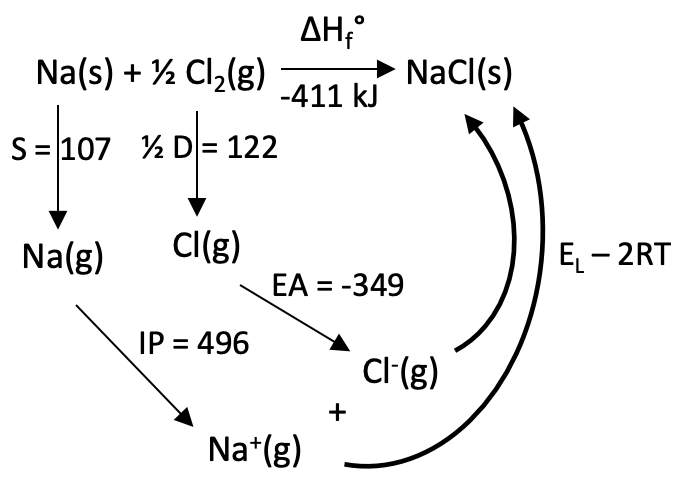
Let's walk through the cycle for NaCl. Our goal is to calculate the final step, the lattice energy.
- Atomization of Na: We start with solid sodium and turn it into gaseous sodium. This requires energy. , kJ/mol.
- Ionization of Na: We remove an electron from gaseous sodium. This is the first ionization energy. , kJ/mol.
- Atomization of Cl: We break the covalent bonds in chlorine gas to get individual chlorine atoms. , kJ/mol.
- Electron Affinity of Cl: A gaseous chlorine atom gains an electron. Energy is released. , kJ/mol.
- Formation of NaCl: The standard enthalpy of formation for NaCl is known from experiments. , kJ/mol.
By putting it all together, we can solve for the unknown lattice energy ().
The huge release of energy, -787 kJ/mol, confirms that forming the crystal lattice is the powerful driving force behind ionic bond formation. This energy overcomes the costs of creating the ions in the first place.
What Affects Lattice Energy
Lattice energy is fundamentally about the electrostatic force between ions. The strength of this force can be approximated by Coulomb's Law which tells us that the force is directly proportional to the product of the charges and inversely proportional to the distance between them. This gives us two key factors to consider: ionic charge and ionic radius.
1. Ionic Charge: Greater charges lead to stronger attraction and higher lattice energy. Magnesium oxide (MgO), with and ions, has a much higher lattice energy (-3795 kJ/mol) than NaCl (-787 kJ/mol) with its and ions. This explains MgO's incredibly high melting point of 2852°C compared to NaCl's 801°C.
2. Ionic Radius: Smaller ions can get closer together, increasing the electrostatic attraction. This leads to a higher lattice energy. Comparing sodium fluoride (NaF) and sodium iodide (NaI), the fluoride ion is much smaller than the iodide ion. This allows the ions in NaF to pack more tightly, giving it a higher lattice energy (-910 kJ/mol) than NaI (-682 kJ/mol).
Higher charges and smaller radii result in stronger ionic bonds and more stable crystals, leading to higher melting points and hardness.
When Ionic Bonds Aren't Perfect
The ionic model assumes electrons are completely transferred, creating perfect spheres of charge. But in reality, no bond is 100% ionic. Sometimes, the cation's positive charge is strong enough to pull the anion's electron cloud towards it, distorting its shape. This sharing of electron density introduces some covalent character into the bond. help predict when this will happen.
Covalent character is favored when:
- The cation is small and highly charged: A high charge density allows it to polarize the anion effectively. For example, is much better at this than .
- The anion is large and highly charged: A large electron cloud is more easily distorted or "squishy" (polarizable). For example, is more polarizable than .
Consider silver iodide (AgI). It has a small, charged cation () and a large, polarizable anion (). This results in significant covalent character, making it insoluble in water, unlike the more ionic NaCl.
Time to check your understanding of these energy dynamics.
What is the primary driving force for the formation of a stable ionic compound like sodium chloride (NaCl)?
The Born-Haber cycle allows for the calculation of which value that is not easily measured directly?
Understanding these energy calculations allows us to predict and explain the physical properties of ionic compounds, from their stability to their melting points.