Advanced Dynamics and Compression Engineering
Detection Algorithms and Topologies
Detector Response and Timing
The core of any dynamics processor is its detection circuit, which dictates how the device interprets and reacts to the input signal's amplitude. The two primary methods, Peak and RMS, are differentiated by their integration times and, consequently, their sonic character. Peak detection responds to instantaneous voltage levels, making it ideal for taming fast, high-amplitude transients without affecting the main body of the signal. Its near-zero integration time allows it to clamp down on percussive hits or sibilance with precision, preventing clipping and managing spiky material effectively.
In contrast, operates by averaging the signal level over a specific time window, typically around 10-30 milliseconds. This method more closely mirrors the human ear's perception of loudness, as our hearing naturally integrates sound over short periods. By responding to the average power rather than instantaneous peaks, RMS compression results in a smoother, more transparent form of gain reduction. It excels at increasing the density and sustain of a signal or managing the overall level of complex material like a full mix or subgroup without audibly pumping on every transient.
Peak detection is for controlling peaks. RMS detection is for controlling loudness.
Feed-Forward vs. Feedback Topologies
The placement of the detector circuit relative to the gain reduction element defines the compressor's topology. In a feed-forward design, the detector taps the input signal before it reaches the gain cell (typically a VCA). The control voltage generated is a direct function of the input level, resulting in precise, predictable, and often aggressive gain reduction. This topology allows for features like lookahead and perfect over-easy knees because the detector's decision is based on unaltered signal dynamics.
Conversely, a feedback topology places the detector after the gain cell. The detector analyzes a signal that has already been compressed. This creates a self-regulating loop: as gain reduction is applied, the level hitting the detector decreases, which in turn reduces the amount of gain reduction. This constant adjustment tends to produce a smoother, more program-dependent response that is often described as more 'musical' or 'gentle'. Classic compressors like the Teletronix LA-2A and Urei 1176 utilize feedback designs, contributing to their sought-after character.
Gain Cell Characteristics
The mechanism that actually reduces the signal's gain is the gain cell. Different types impart their own distinct sonic footprint. VCA (Voltage-Controlled Amplifier) based cells are known for their precision, speed, and clean, linear gain reduction. They respond to the control voltage with mathematical accuracy, making them highly versatile for both subtle and extreme dynamic shaping.
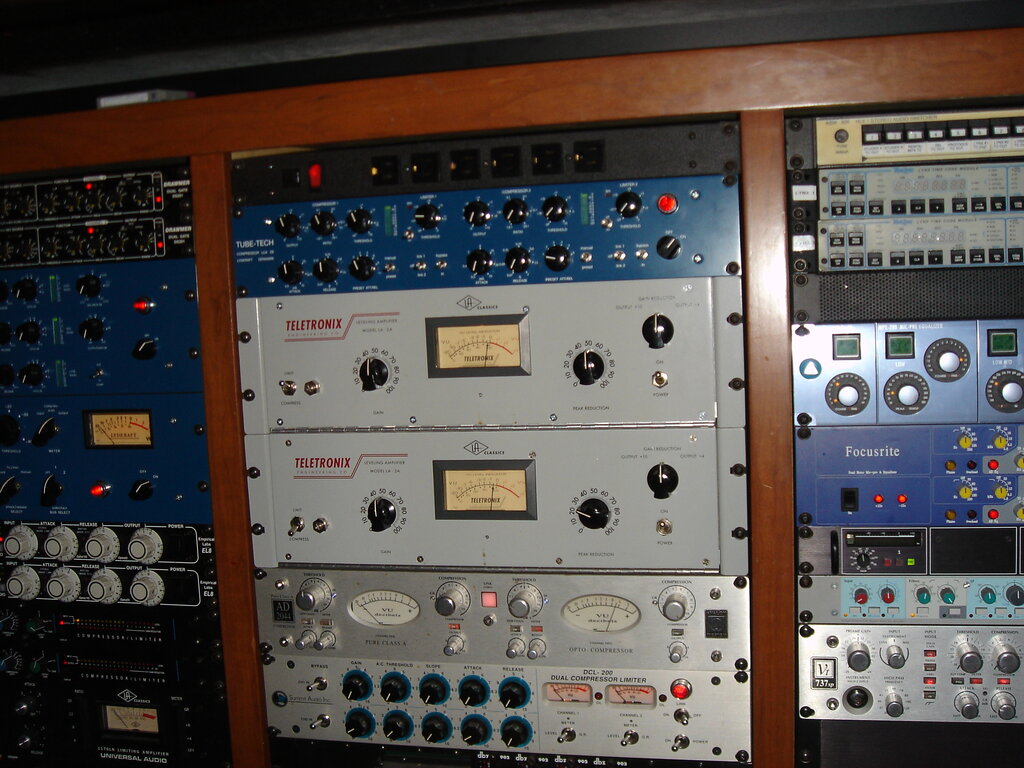
Optical compressors, or opto-compressors, use a completely different mechanism. The audio signal modulates the brightness of a light source (like an LED or electroluminescent panel), which in turn illuminates a photo-sensitive resistor. The resistance of this component controls the output level. This indirect process introduces non-linearities. The iconic [{
Ultimately, the choice between these detection methods and topologies is a choice between transparency and character. A feed-forward VCA compressor offers surgical control, while a feedback optical design provides program-dependent musicality. Understanding their internal workings allows an engineer to move beyond presets and select the precise tool to shape the micro-dynamics of a recording.
Which type of detection circuit is most effective for taming sharp, sudden transients like snare drum hits without affecting the overall body of the sound?
In a feed-forward compressor design, where is the detector circuit placed?