Advanced DNA Replication Mechanisms
Replication Initiation
The Starting Line
DNA replication doesn't just start anywhere. For a cell to copy its entire genome efficiently and without errors, the process must begin at specific, designated locations along the DNA molecule. These starting blocks are known as origins of replication.
Think of them as officially sanctioned starting points for a massive construction project. In prokaryotes like bacteria, there's typically a single origin called oriC, while eukaryotes, with their much larger genomes, have thousands. In yeast, these are called Autonomously Replicating Sequences (ARS). These regions are not random; they are defined by specific DNA sequences.
These locations, often called , are typically rich in adenine (A) and thymine (T) base pairs. This is a key structural feature. A-T pairs are held together by two hydrogen bonds, whereas guanine (G) and cytosine (C) pairs are held by three. The weaker A-T bonding makes these sections of the DNA double helix easier to pull apart, providing the initial opening needed for replication machinery to access the strands.
Assembling the Crew
Once an origin of replication is identified, a team of specialized proteins arrives to prepare the site. This is the initiation phase. In eukaryotes, the first to arrive is the Origin Recognition Complex (ORC), which binds directly to the ARS. The ORC acts as a landing pad, recruiting other proteins to form a larger assembly known as the pre-replication complex (pre-RC).
The crucial next step is loading the enzyme that will do the heavy lifting of unwinding the DNA: helicase. In prokaryotes, this enzyme is called DnaB, while in eukaryotes it is a group of proteins forming the MCM (Minichromosome Maintenance) complex. Helicase loaders place an inactive helicase ring around each of the two single DNA strands. Once activated, these enzymes will use energy from ATP to break the hydrogen bonds between the base pairs, unzipping the double helix in both directions and creating a 'replication bubble'.
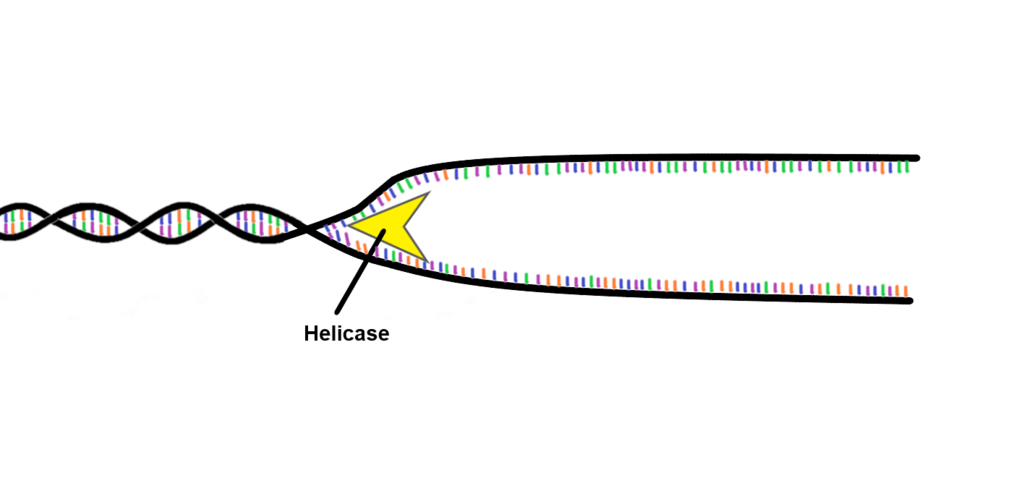
With the DNA strands separated, they become vulnerable. They could re-anneal by snapping back together, or they could be attacked by enzymes that degrade single-stranded DNA. To prevent this, a group of proteins called (SSBs) quickly coat the exposed strands. They act like placeholders, keeping the two strands separated and protected, ensuring they remain available as templates for copying.
Relieving the Tension
As helicase plows forward and unwinds the double helix, it creates a problem ahead of the replication fork. The DNA that is still wound becomes tighter and more twisted. This effect, called torsional strain or supercoiling, is similar to what happens when you try to quickly separate the two strands of a twisted rope: the rope ahead of your hands gets impossibly knotted. If left unchecked, this strain would halt replication entirely.
To solve this, a class of enzymes called topoisomerases comes to the rescue. In bacteria, a specific type called DNA gyrase is particularly important. These enzymes work ahead of the replication fork. They make temporary nicks in the DNA backbone, allowing the strands to swivel around each other and release the tension. Then, they reseal the break, leaving the DNA relaxed and ready for helicase to continue its work. This ensures the entire replication process can proceed smoothly from start to finish.