Advanced Digital Forensics Investigations
Advanced Digital Evidence Acquisition
Beyond the Hard Drive
In the early days of digital forensics, investigations often centered on a single, powered-down computer. The primary task was creating a perfect copy of a hard drive. But today, data is everywhere, and much of it is fleeting. The most critical evidence might not be in a file on a disk, but in a computer's active memory, a remote cloud server, or a locked smartphone.
This shift requires more advanced acquisition techniques. We're moving beyond static data to capture information that disappears the moment a device is turned off. This is the world of volatile data.
Capturing Data in Motion
Volatile memory, or RAM, is a treasure trove of evidence. It contains information about running programs, active network connections, logged-in users, and, crucially, encryption keys. If a suspect’s hard drive is encrypted, the key needed to unlock it might be sitting in RAM. Capturing this data before it vanishes is often the difference between a successful investigation and a dead end.
This process, known as memory acquisition or a RAM dump, involves using specialized tools to copy the entire contents of the system's memory to a file. This file can then be analyzed with tools like Volatility or Rekall to reconstruct the state of the machine at the time of seizure. It's like taking a snapshot of the computer’s brain while it was still thinking.
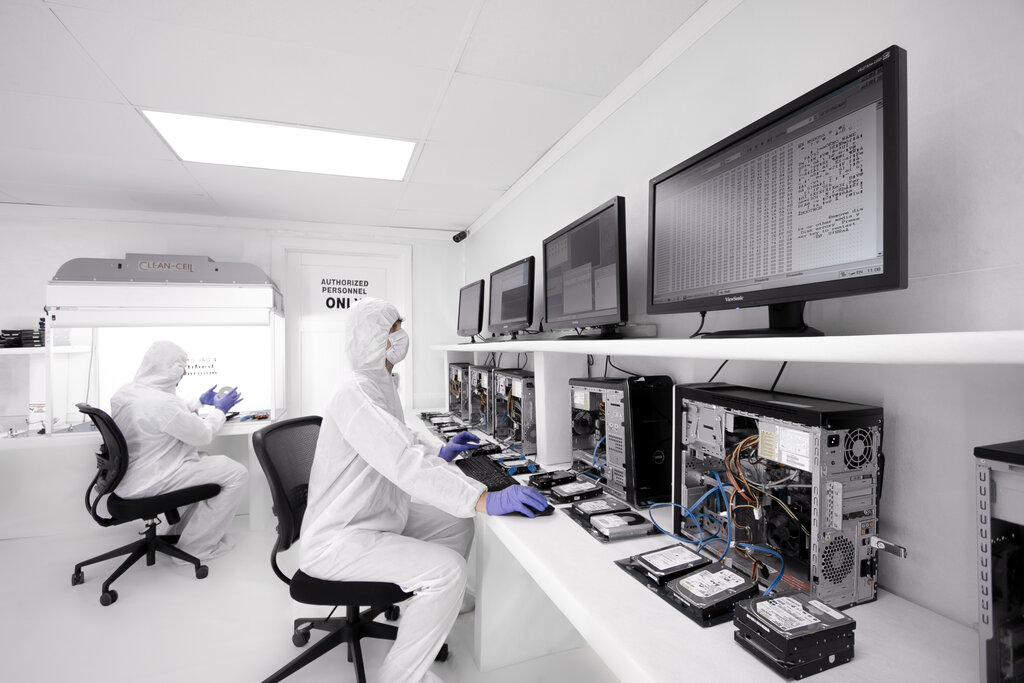
No matter where the data comes from, how it's preserved is critical. Every step must be meticulously documented to maintain the chain of custody, a chronological record of who handled the evidence. The goal is to create a forensically sound copy, an exact duplicate of the original data, verified by a mathematical process called hashing. This ensures that the evidence presented in court is the same as what was collected at the scene.
Maintaining the original evidence in its unaltered state is paramount as improper handling contributes to 20% of data breaches during investigations.
The Cloud and Mobile Maze
Investigating data in the cloud presents a unique set of hurdles. The information isn't on a single device you can hold; it's spread across servers that could be in different cities or even different countries. This distributed nature complicates everything, from legally obtaining the data to piecing together a coherent story.
Acquiring cloud data often involves working with service providers like Google, Amazon, or Microsoft. This requires legal orders and cooperation, which can be slow. Investigators must navigate a web of different laws and privacy regulations, a challenge that simply doesn't exist when you're dealing with a single physical hard drive.
Mobile devices are just as complex. Modern smartphones are designed to be secure fortresses, with strong encryption and sandboxed applications that keep data siloed. Getting evidence from an iOS or Android device requires specialized tools and techniques that can bypass these protections. There are different levels of data extraction:
The Cat-and-Mouse Game
As forensic techniques evolve, so do the methods used to thwart them. Anti-forensics involves actively trying to hide, alter, or destroy digital evidence. This can range from using strong, full-disk encryption to employing data-wiping software that overwrites files with random data, making them unrecoverable.
More sophisticated techniques include steganography, where data is hidden within an innocuous-looking file like an image or audio track, and timestamp manipulation, which alters the creation or modification dates of files to mislead investigators.
Countering these tactics is a constant challenge. It might involve cracking passwords, finding encryption keys in volatile memory, or using advanced algorithms to detect the statistical anomalies caused by steganography. Forensic specialists rely on a suite of both commercial tools, like EnCase and FTK, and powerful open-source alternatives like Autopsy and the SANS SIFT toolkit. These tools help automate the processing of massive datasets, carving out deleted files, indexing data, and creating timelines of activity. They are the essential instruments in the modern investigator's toolkit.
Why is capturing volatile memory (RAM) considered critical in many modern digital forensic investigations?
What mathematical process is used to create a unique digital fingerprint of a piece of evidence, verifying that a forensic copy is an exact duplicate of the original?
The field of digital forensics is constantly evolving, requiring investigators to adapt to new technologies and the clever ways people try to hide their tracks.