Advanced Digital Camera Mastery
Exposure Interplay
The Language of Light
You already know that aperture, shutter speed, and ISO control the brightness of an image. Now it's time to think about them as a system of creative trade-offs. The key to moving beyond automatic settings is understanding that for any given level of light, multiple combinations of these three settings will produce an identical exposure.
The language we use to measure these changes is universal: s. A "stop" is a doubling or halving of the amount of light reaching the sensor. Increasing exposure by one stop doubles the light; decreasing it by one stop halves the light. This applies to all three elements of the triangle.
Aperture: Halving the f-number (e.g., from f/4 to f/2.8) doubles the light (+1 stop). Shutter Speed: Halving the speed (e.g., from 1/125s to 1/60s) doubles the light (+1 stop). ISO: Doubling the number (e.g., from 200 to 400) doubles the sensor's sensitivity (+1 stop).
These relationships are proportional. If you decrease your aperture by one stop to increase your depth of field (e.g., going from f/2.8 to f/4), your image will be underexposed. To compensate, you must increase another setting by one stop. You could either slow your shutter speed to 1/60s or raise your ISO to 400. The choice depends entirely on your creative goal.
| Shutter Speed | Aperture | ISO | Exposure | Creative Effect |
|---|---|---|---|---|
| 1/125s | f/2.8 | 200 | Correct | Shallow depth of field, frozen motion. |
| 1/125s | f/4 | 400 | Correct | Deeper depth of field, frozen motion, more noise. |
| 1/60s | f/4 | 200 | Correct | Deeper depth of field, slight motion blur. |
This is the principle of equivalent exposures. The three settings in the table above all result in the same image brightness, but each tells a different visual story.
The Cost of Light
Every exposure decision has a consequence. When you adjust ISO, the trade-off is image quality. ISO isn't actually light; it's the amplification of the signal from the sensor. At low ISO values, the signal is clean. As you increase the ISO, you're essentially turning up the volume on the sensor's data. This amplification, or , introduces unwanted artifacts.
The most obvious artifact is luminance noise, which looks like a fine grain or sandiness, especially in the darker areas of your photo. More damaging is chrominance (or color) noise, which appears as random splotches of red, green, and blue. High ISOs can also reduce dynamic range and color depth, making tones look flat and less vibrant.
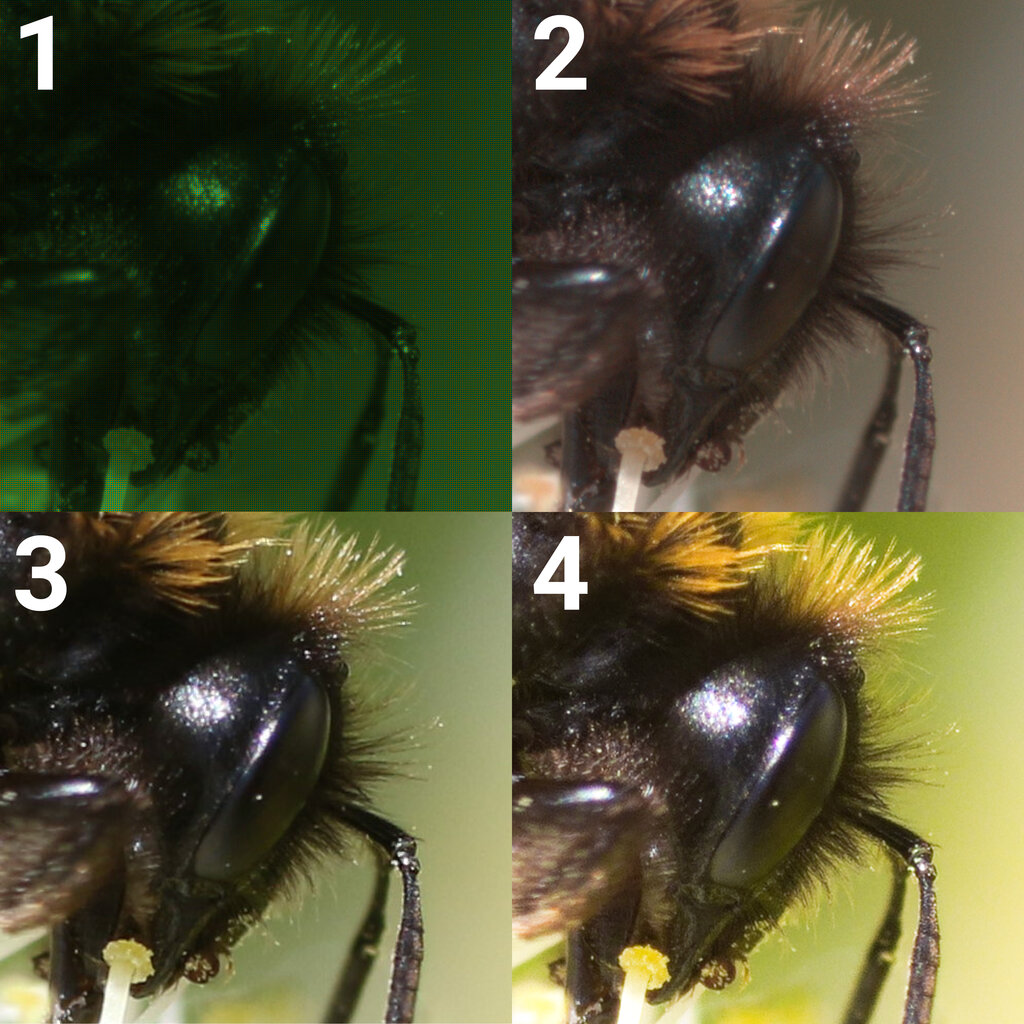
The goal in a low-light situation is to find a balance. Is a little grain acceptable to get a sharp, hand-held shot at a fast shutter speed? Or would a cleaner image from a tripod with a low ISO and slow shutter better serve your purpose? Your answer defines your technical approach.
Capturing Cinematic Motion
For videographers, the exposure triangle has a slightly different set of rules, largely dictated by the need for realistic motion blur. The is a guideline inherited from the days of rotary shutters in film cameras. It states that your shutter speed should be double your frame rate.
If you're shooting at 24 frames per second (fps), your shutter speed should be 1/48s (or 1/50s, the closest common setting). If shooting at 60 fps for slow motion, your shutter speed should be 1/120s (or 1/125s).
Following this rule produces a motion blur that looks natural and cinematic to the human eye. A much faster shutter speed (like 1/1000s) will make motion look jittery and stuttered, an effect used in action films like Saving Private Ryan to create a sense of chaos. A slower shutter speed will create a dreamy, smeared look.
Because the shutter speed is essentially locked to the frame rate, videographers primarily control exposure using aperture, ISO, and neutral density (ND) filters, which act like sunglasses for the lens to reduce light without affecting color.
Here's a quick check on what we've covered.
Ready to test your knowledge?
What does it mean to increase an image's exposure by one "stop of light"?
You are photographing a landscape and change your aperture from f/8 to f/16 to increase your depth of field. This darkens your image by two stops. If your original shutter speed was 1/125s and you want to keep your ISO at 100, what shutter speed is needed to achieve an equivalent exposure?
Mastering these trade-offs is what separates a technically proficient photographer from an artist. It's about making deliberate choices to shape how a viewer experiences your image, moving beyond just a "correct" exposure to find the right one.