Advanced Diffraction Principles and Applications
Huygens–Fresnel Principle
Ripples From Every Point
How does a wave move forward? It seems like a simple question. A ripple expands in a pond, a light beam travels from a lamp. But the underlying mechanism is surprisingly elegant. The Huygens–Fresnel principle provides a powerful way to visualize and calculate this propagation.
The core idea is this: every point on a wavefront can be considered a source of tiny, secondary spherical waves, called wavelets. The new position of the wavefront a moment later is the surface that is tangent to all of these wavelets. It's the combined effect, the sum, of all these tiny disturbances.
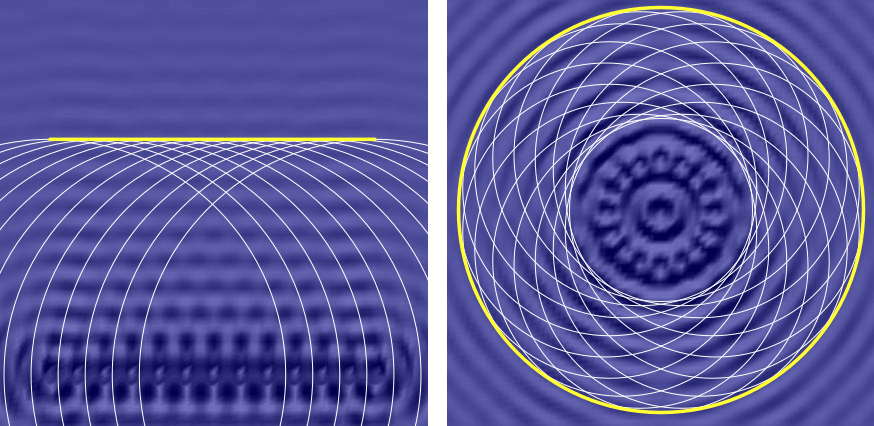
Imagine dropping a long, straight stick into a still pond all at once. The initial splash creates a straight wavefront. According to Huygens' principle, you can think of every single point along that line as creating its own tiny circular ripple. These ripples expand outwards. The new, forward-moving straight wave you see a second later is simply the leading edge formed by all these tiny circular ripples combining.
Adding Interference to the Mix
Christiaan Huygens proposed the initial idea in the 17th century, but it had a flaw: it couldn't explain why waves only travel forward. If each point creates a spherical wavelet, shouldn't the wave also travel backward? It also couldn't account for the light and dark fringes seen in diffraction patterns.
About a century later, Augustin-Jean Fresnel refined the principle by incorporating the idea of interference. He proposed that the secondary wavelets interfere with each other. The amplitude of the wave at any point is the superposition, or sum, of all the individual wavelets reaching that point.
Fresnel's key insight was that wavelets are not all created equal. They have an 'obliquity factor,' meaning they are strongest in the forward direction and have zero amplitude in the backward direction.
This refinement leads to a mathematical formulation. The complex amplitude of the wave at a point , denoted as , is found by integrating the contributions from all points on the original wavefront surface, .
Predicting Wave Behavior
The power of this principle lies in its ability to predict how waves behave when they encounter obstacles. It's the foundation for understanding diffraction. When a wavefront hits a barrier with an opening, like a slit, we can treat the points within the slit as the only sources of new wavelets.
These wavelets spread out beyond the slit. In the area behind the barrier, these wavelets interfere. At some points, they arrive in phase (constructive interference), creating a bright spot. At others, they arrive out of phase (destructive interference), creating a dark spot. By summing the contributions of all the wavelets from the slit, we can precisely calculate the resulting interference pattern.
This same logic applies to more complex situations, like the double-slit experiment. The pattern of light and dark bands seen on the screen is a direct result of the interference between the sets of wavelets originating from each of the two slits. The Huygens-Fresnel principle gives us the tools to move beyond simple ray optics and into the more complex, and more accurate, world of wave optics.
What is the core idea of the Huygens principle for wave propagation?
What crucial concept did Augustin-Jean Fresnel add to Huygens' original principle to better explain phenomena like diffraction?
The principle elegantly connects the idea of waves as continuous fronts with the concept of countless point sources, forming the basis for much of wave optics.