Advanced DevOps Engineering and Automation
CI/CD Pipeline Architecture
Architecting the Modern Pipeline
A simple script that runs tests and deploys code is a good start, but it's not a production-grade pipeline. A robust CI/CD pipeline is an automated workflow, defined as code, that handles complexity with grace. This is the core principle of (PaC): treating your CI/CD configuration with the same rigor as your application code. It lives in your Git repository, is version-controlled, and can be reviewed and audited just like any other file.
By defining the pipeline in a file like .gitlab-ci.yml or a GitHub Actions workflow, you create a repeatable, self-documenting process. This approach is the foundation for everything that follows.
# Example .github/workflows/ci.yml
name: Build and Test

on: [push, pull_request]

jobs:
  build:
    runs-on: ubuntu-latest
    steps:
    - uses: actions/checkout@v3
    - name: Set up Node.js
      uses: actions/setup-node@v3
      with:
        node-version: '18'
    - run: npm install
    - run: npm test
Branching and Building
How your team manages Git branches directly impacts your CI/CD architecture. The branching strategy dictates when and how pipelines run, and what they do. Two dominant strategies offer different trade-offs: GitFlow and Trunk-Based Development.
(TBD) is favored by teams practicing continuous deployment. All developers commit to a single main branch (the trunk). Feature work is done in short-lived branches that are merged into the trunk multiple times a day. This model relies heavily on feature flags and robust automated testing to keep the trunk stable and deployable at all times. The CI pipeline for TBD is simpler: it runs against every commit to main and on every pull request, with the goal of deploying to production upon a successful merge.
Choosing a strategy is a trade-off. GitFlow offers structure and is great for projects with distinct version releases. Trunk-Based Development offers speed and simplicity, but requires a disciplined team and a mature testing culture.
Efficient Execution
As a pipeline grows, it gets slower. A 30-minute build process is a major bottleneck. To combat this, we use parallel and matrix builds. Instead of running tests sequentially (unit, then integration, then end-to-end), we can run them simultaneously in parallel jobs. This dramatically cuts down feedback time.
A matrix build takes this further. It runs the same set of jobs against different configurations, like multiple versions of a programming language or different operating systems. This is essential for testing libraries and applications that need to support various environments.
# Example of a matrix build in GitHub Actions
jobs:
  test:
    runs-on: ubuntu-latest
    strategy:
      matrix:
        node-version: [16, 18, 20]
        os: [ubuntu-latest, windows-latest]
    steps:
    - uses: actions/checkout@v3
    - name: Use Node.js ${{ matrix.node-version }}
      uses: actions/setup-node@v3
      with:
        node-version: ${{ matrix.node-version }}
    # ... test steps continue here
These jobs run on "runners," the machines that execute the pipeline tasks. You can use shared runners provided by the CI platform (like GitHub or GitLab) or set up your own self-hosted runners. Shared runners are convenient and managed for you, but can be slower and have limitations. Self-hosted runners give you full control over the hardware, operating system, and software, which is crucial for specialized builds or security requirements.
Managing Artifacts and Secrets
A pipeline doesn't just run code; it produces things. These outputs, called artifacts, are the results of a build. They could be a compiled binary, a Docker image, or a code coverage report. A key part of pipeline architecture is managing these artifacts. Successful jobs should store their artifacts, making them available for subsequent stages (like deployment) or for developers to download.
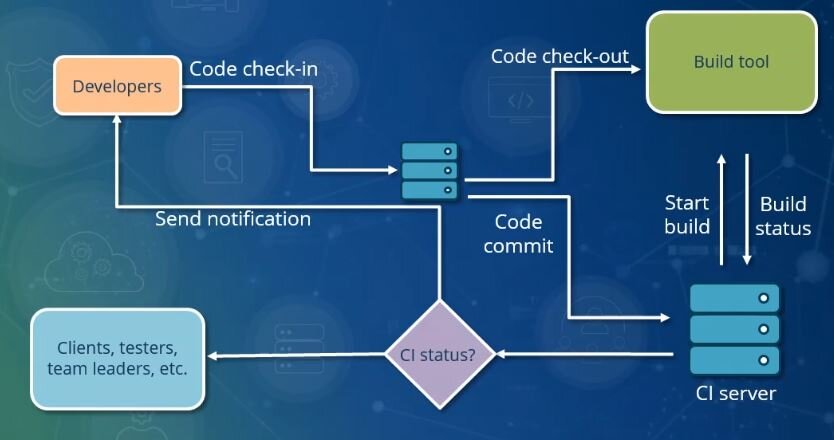
Just as important is managing what goes into the pipeline: secrets. API keys, database passwords, and other credentials should never be hardcoded in your pipeline configuration files. Instead, they are stored as environment variables within the CI/CD platform's settings. These are injected securely into the runner's environment only when a job is executing. For even higher security, many organizations integrate their pipelines with a dedicated secrets manager like HashiCorp Vault or AWS Secrets Manager.
Well-architected CI/CD pipelines are the engine of modern software development. They combine a clear Git workflow with efficient execution strategies and secure handling of artifacts and secrets to provide fast, reliable feedback.
What is the primary principle of "Pipeline-as-Code" (PaC)?
A team practicing Trunk-Based Development merges code into the main branch multiple times a day. To keep main stable and deployable, this team relies heavily on feature flags and robust automated testing.