Advanced Deep Learning for Vision and Multimodality
Convolutional Neural Networks
Seeing Like a Computer
How do you know a cat is a cat? You see its pointy ears, its whiskers, its furry tail. Your brain processes these features automatically. A Convolutional Neural Network, or CNN, is a type of deep learning model that learns to recognize patterns in a similar way, making it incredibly powerful for tasks involving images.
Unlike other neural networks that treat inputs as flat lists of numbers, CNNs are designed to understand the spatial structure of data, like the pixels in a picture. They are inspired by the human visual cortex, where different neurons respond to specific features in our field of vision, like edges or colors.
CNNs build a hierarchy of features. Simple layers might learn to spot edges and corners, while deeper layers combine these to recognize more complex shapes like eyes, noses, or entire objects.
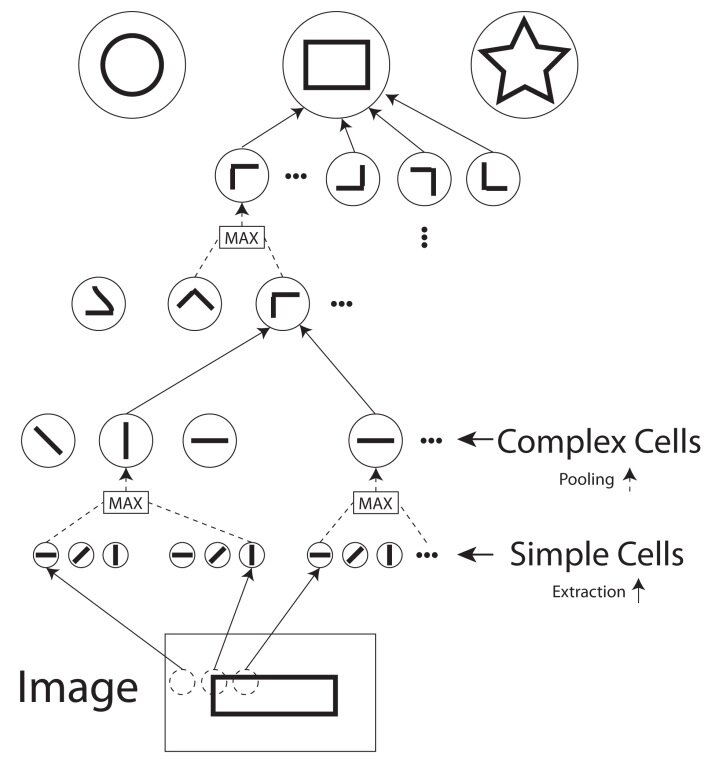
This is achieved through three main types of layers: convolutional, pooling, and fully connected.
The Core Components
The magic of a CNN happens in its specialized layers.
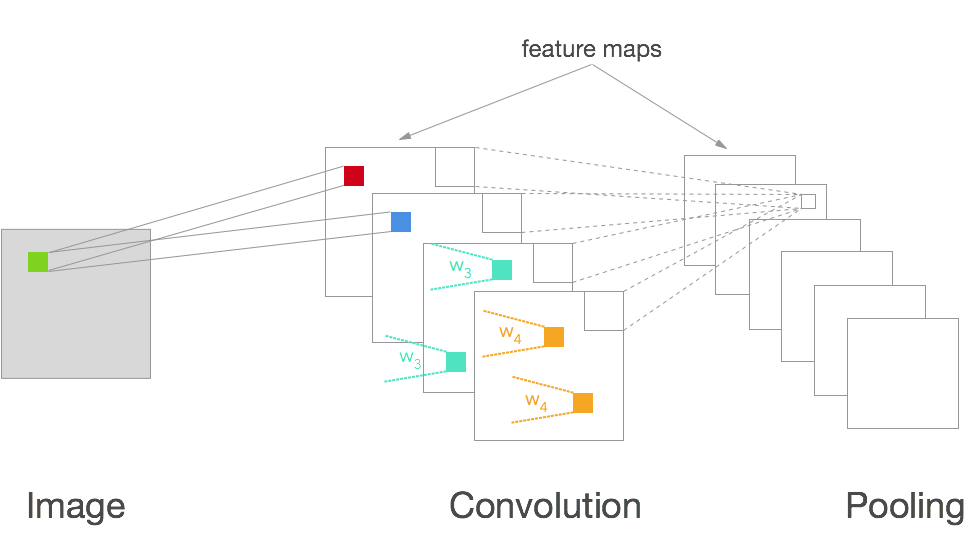
Convolutional Layers are the heart of the network. They use filters, also known as kernels, which are small matrices of weights. The network slides these filters across the input image, one patch at a time, to look for specific patterns. For example, one filter might be tuned to detect vertical edges, while another looks for a certain color or texture.
As the filter moves, it performs a mathematical operation (a dot product) between its own values and the pixel values of the image patch it's currently over. This produces a single number for each position, creating a new grid called a feature map. This map highlights where in the image the filter's specific feature was found.
After a convolutional layer comes a Pooling Layer. Its job is to downsample, or shrink, the feature maps. This reduces the amount of computation needed and helps the network generalize better, making it less sensitive to the exact location of features in the image.
A common technique is max pooling. The network looks at a small window of the feature map (say, a 2x2 area) and takes only the largest value. It then slides this window across the entire feature map, creating a new, smaller map that retains the most important information.
Finally, after several rounds of convolution and pooling, the processed data reaches the Fully Connected Layers. These layers are the same as those in a standard neural network. They take the high-level features extracted by the previous layers, flatten them into a one-dimensional vector, and use this information to make a final prediction, such as classifying the image as 'cat', 'dog', or 'bird'.
Advanced Architectures
As researchers pushed for deeper and more powerful networks, they ran into problems. Stacking too many layers could actually make a network perform worse due to an issue called the vanishing gradient problem. Two groundbreaking architectures, ResNet and U-Net, offered clever solutions.
ResNet introduced a simple but powerful idea: what if a layer could just pass its input directly to the next layer if that's the best option? This insight allowed for networks with hundreds or even thousands of layers.
ResNet, short for Residual Network, tackles the challenge of training very deep networks. Its core innovation is the "residual block," which features a skip connection. This connection creates a shortcut, allowing the input of a block to bypass a couple of layers and be added to their output directly. This makes it easier for the network to learn an identity function—essentially, to do nothing—if a layer isn't needed. This simple trick helps gradients flow through the network during training, enabling the creation of extremely deep and accurate models.
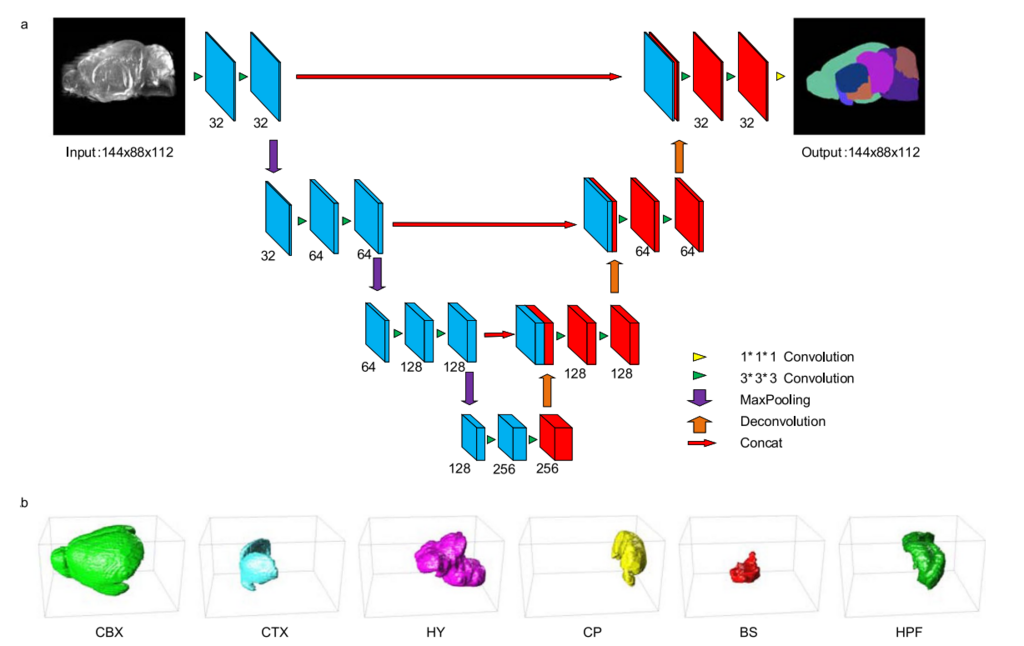
U-Net was designed for a different task: biomedical image segmentation. The goal of segmentation is not just to classify an image, but to label every single pixel. For example, in a medical scan, a U-Net could identify the exact boundaries of a tumor.
Its architecture is famously symmetric, resembling the letter 'U'. The first half is an encoder (or contracting path) that uses convolutions and pooling to capture the context of the image. The second half is a decoder (or expansive path) that gradually upsamples the feature maps to reconstruct a full-resolution output. The key feature is the use of skip connections that link the encoder and decoder. These connections feed feature maps from the encoder directly to corresponding layers in the decoder, combining high-level context with precise spatial information. This allows U-Net to produce highly accurate segmentations.
CNNs in Action
The power and flexibility of CNNs have made them essential tools across many fields.
- Image Classification: This is the classic CNN task. Is this a picture of a car or a truck? ResNet, for example, achieved superhuman performance on the famous ImageNet classification challenge.
- Image Segmentation: As we saw with U-Net, these models can outline specific objects within an image. This is crucial for medical imaging, autonomous driving (identifying roads, pedestrians, and other vehicles), and satellite imagery analysis.
- Object Detection: This is a step beyond classification. It involves not only identifying what objects are in an image but also drawing a bounding box around each one. This is the technology behind facial recognition on your phone and automated checkout systems in stores.
Ready to check your understanding of these powerful networks?
What is the primary function of a convolutional layer in a CNN?
The key innovation of the ResNet architecture, which allows for the training of extremely deep networks, is its use of ________.
From recognizing simple edges to enabling self-driving cars, CNNs are a cornerstone of modern computer vision. By learning features in a hierarchical way, they provide a powerful framework for understanding the visual world.