Advanced Deep Learning Architectures and Applications
Convolutional Neural Networks
How Machines Learn to See
While standard neural networks are powerful, they have a major limitation when it comes to images. If you feed a 1000x1000 pixel image into a standard network, the input layer would need one million neurons. This isn't just computationally expensive; it also ignores a crucial aspect of images: spatial hierarchy. Pixels that are close to each other are related, forming edges, textures, and shapes. A standard network flattens the image, losing this valuable information.
Convolutional Neural Networks (CNNs) are designed specifically for this kind of data. Inspired by the human visual cortex, they process images in a way that preserves the relationship between pixels, allowing them to learn features at different levels of complexity.
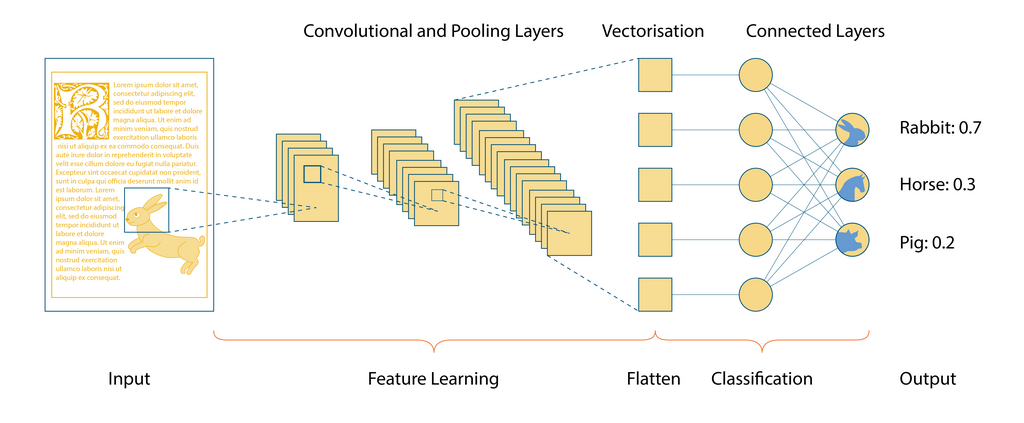
Instead of treating every pixel as an independent input, CNNs use special layers to recognize patterns locally and then combine those patterns to understand the bigger picture. It’s like starting with lines and curves, then recognizing eyes and a nose, and finally seeing a face.
The Core Components
A CNN's power comes from three main types of layers: convolutional, pooling, and fully connected.
Convolutional Layers: The Feature Detectors The main job of a convolutional layer is to detect features in the input image. It does this by sliding a small filter, also called a kernel, over the image. This filter is a small matrix of weights. As it moves across the image, it performs a mathematical operation (a convolution) that produces a “feature map.”
Each feature map highlights where a specific feature—like a vertical edge, a certain color, or a simple texture—appears in the image. A single convolutional layer can apply dozens of different filters, each one searching for a different pattern.
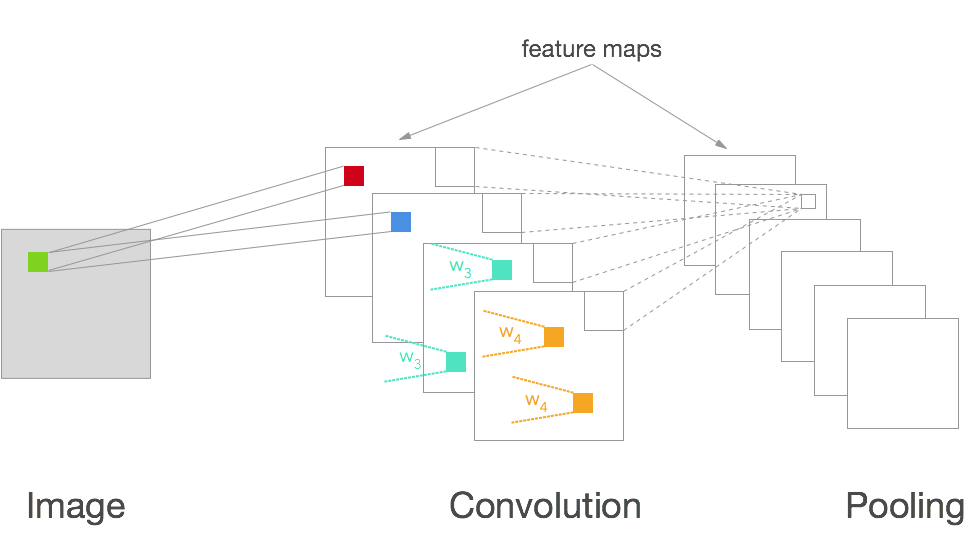
Pooling Layers: Making it Manageable After a convolutional layer identifies features, a pooling layer steps in to simplify the information. Its main goal is to reduce the size of the feature map. This reduces the number of parameters and the amount of computation the network needs to perform.
A common technique is “max pooling.” The feature map is divided into small grids, and for each grid, only the maximum value is kept. This process makes the network more efficient and helps it recognize a feature regardless of its exact location in the image.
Fully Connected Layers: The Decision Maker After several rounds of convolution and pooling, the network has a rich set of high-level features. The final step is to use this information to make a decision, like classifying an image. This is where fully connected layers come in. These are the same kind of layers you'd find in a standard neural network.
The feature maps, which are still in a grid format, are flattened into a single vector of numbers. This vector is then fed into one or more fully connected layers, which learn to weigh the features and produce a final output, such as the probability that the image contains a cat, a dog, or a rabbit.
Building a Vision System
A complete CNN is a stack of these layers. It typically starts with multiple convolutional and pooling layers to perform feature extraction. The early layers learn to detect simple features like edges and corners. As the data passes deeper into the network, the layers learn to combine these simple patterns into more complex ones, like eyes, wheels, or leaves.
This hierarchical feature extraction is what makes CNNs so effective for tasks like image classification and object detection. By the time the data reaches the final fully connected layers, the network is no longer looking at raw pixels but at abstract, meaningful concepts within the image.
This entire process, from low-level edge detection to high-level object classification, is learned automatically during training. The network adjusts the weights in its filters and layers to get better at its assigned task.
Implementing these models is more accessible than ever, thanks to powerful deep learning frameworks. Libraries like PyTorch and TensorFlow provide pre-built modules for convolutional, pooling, and fully connected layers, allowing developers to construct and train sophisticated CNNs with just a few lines of code.
# A simple CNN structure in PyTorch
import torch
import torch.nn as nn

class SimpleCNN(nn.Module):
    def __init__(self):
        super(SimpleCNN, self).__init__()
        # Convolutional Layer 1
        self.conv1 = nn.Conv2d(in_channels=3, out_channels=16, kernel_size=3, padding=1)
        self.relu1 = nn.ReLU()
        self.pool1 = nn.MaxPool2d(kernel_size=2, stride=2)

        # Convolutional Layer 2
        self.conv2 = nn.Conv2d(in_channels=16, out_channels=32, kernel_size=3, padding=1)
        self.relu2 = nn.ReLU()
        self.pool2 = nn.MaxPool2d(kernel_size=2, stride=2)

        # Fully Connected Layer
        self.fc1 = nn.Linear(32 * 8 * 8, 10) # Assuming 32x32 input image

    def forward(self, x):
        out = self.pool1(self.relu1(self.conv1(x)))
        out = self.pool2(self.relu2(self.conv2(out)))
        out = out.view(-1, 32 * 8 * 8) # Flatten the features
        out = self.fc1(out)
        return out
This ability to automatically learn relevant features from raw pixel data has made CNNs the foundation of modern computer vision.
What is the primary reason standard neural networks are not ideal for image processing tasks?
What is the main function of a pooling layer in a Convolutional Neural Network?