Advanced De La Riva Sweeps and Transitions
Dynamic Offbalancing Mechanics
Beyond the Hook
You've established your De La Riva guard. The hook is in, your grips are set. Now what? Many practitioners treat the DLR as a static holding position, waiting for the opponent to make a mistake. The key to advancing your DLR game is to shift from a passive to an active mindset. Instead of just holding, you need to actively unbalance your opponent. This concept is known in Japanese martial arts as —the art of breaking balance.
In the context of the De La Riva guard, Kuzushi isn't just a single move; it's a constant, dynamic process. You'll use your hook, your free leg, your grips, and your hips in concert to manipulate your opponent's base and posture. The goal is to force them into a reactive state, where they are too busy trying to regain balance to mount an effective guard pass. This constant off-balancing creates the openings you need to launch your attacks.
Grips, Hips, and Posture
Your primary tools for breaking posture are your grips and your hips. A standard, effective combination is a collar grip and a sleeve grip on the same side as your DLR hook. These grips are not just for holding on; they are levers to control your opponent's upper body.
Pull the collar down toward your chest while pushing the sleeve across your body. This dual-action creates a powerful turning force on your opponent's torso, forcing their shoulder to dip and their posture to break.
This action is amplified significantly by your hips. Don't lie flat on your back. Elevate your hips off the mat, driving your weight into your opponent through your hook and grips. This hip elevation makes your push-pull action much more powerful and makes it harder for your opponent to stand straight up. Think of your hips as the engine and your grips as the steering wheel. Together, they direct your opponent's posture where you want it to go.
Forcing the Light Leg
The ultimate goal of your Kuzushi is to make one of your opponent's legs light and easy to sweep. This is achieved through a dynamic push-and-pull with your legs. While you're breaking their posture with your grips and hips, your DLR hook actively pulls their leg in, while your free foot pushes against their other leg (often on the thigh or hip).
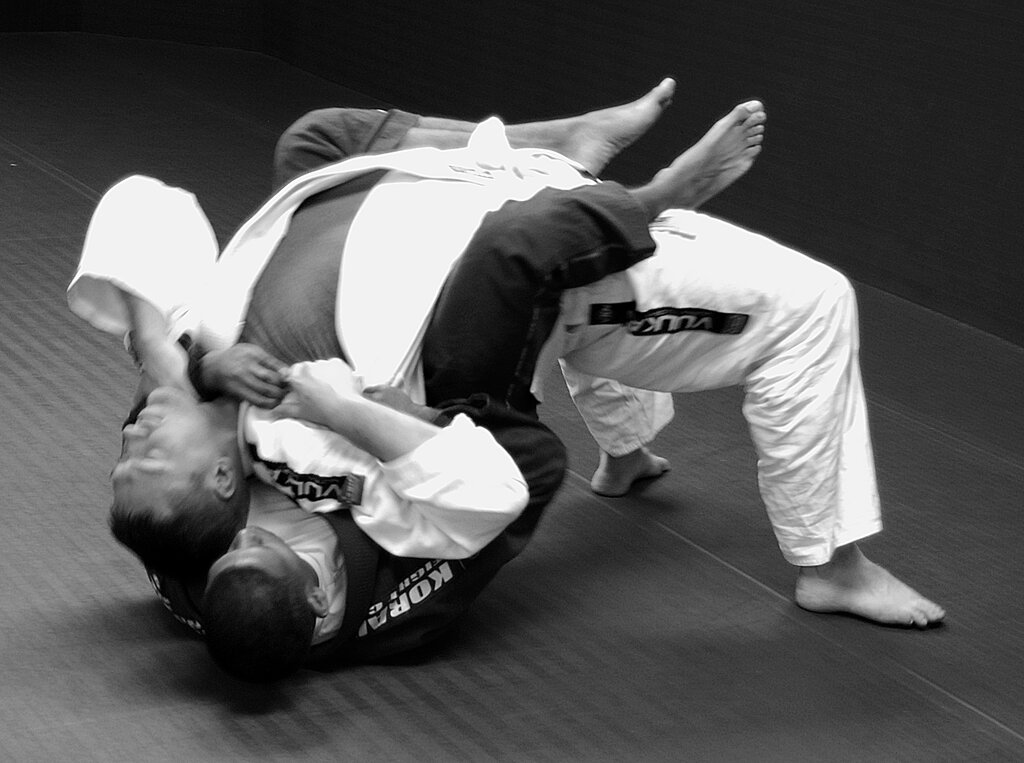
Leverage over strength – The beauty of grappling is that a smaller person can overcome a bigger opponent with the right technique
This leg work creates a dilemma. As you pull their hooked leg, they must shift their weight to the other leg to maintain balance. This is the 'light leg' response you want. The hooked leg, now carrying less weight, becomes vulnerable to classic DLR sweeps like the balloon sweep or baby bolo. Your free leg's push is crucial; it prevents them from simply squaring up and helps direct their weight onto that far leg.
Troubleshooting Resistance
Your opponent won't just stand there. They will actively fight your attempts to off-balance them. Two common reactions are turning their knee out and squaring their hips.
| Opponent's Action | Your Counter-Action |
|---|---|
| Turns Knee Out | This weakens your DLR hook. Immediately transition your free foot to their hip or bicep to manage distance. Use your sleeve grip to pull them back into position, or switch to a different guard like Reverse De La Riva. |
| Squares Hips | When they square up, they are trying to neutralize the angle. Use this moment to elevate your hips aggressively and use your free leg to push their far knee, forcing them to pivot and re-exposing the DLR angle. This often sets up an overhead or tripod sweep. |
The key is to treat their resistance not as a failure, but as new information. Their reaction tells you which attack to try next. If they defend the pull, you push. If they defend the angle, you create a new one. Your DLR guard should feel like a web, where every movement by your opponent triggers a counter-movement from you.
Ready to test your understanding of these dynamic concepts?
What is the primary principle for transitioning the De La Riva guard from a passive holding position to an active, attacking one?
When playing De La Riva, what is the main purpose of elevating your hips off the mat?
By actively pursuing Kuzushi, you transform your De La Riva guard from a defensive position into a powerful launching pad for your offense. It's a game of constant motion and reaction, where you lead the dance.