Advanced Data Modeling and Database Architecture
Advanced Normalization Strategies
Beyond Third Normal Form
Most databases are designed to reach the Third Normal Form (3NF). It provides a solid defense against data redundancy and anomalies. But in complex systems, especially those with multiple overlapping candidate keys, 3NF can sometimes fall short. This is where stronger normalization rules become necessary to ensure absolute data integrity.
When designing high-concurrency applications, subtle data dependencies can lead to significant consistency issues if not properly addressed.
Let's consider a practical example. Imagine a multi-tenant application for university course scheduling. Instructors can teach multiple courses, and each course can be taught by multiple instructors. To keep things simple, let's say an instructor is an expert in only one subject.
Here's a table to track this:
| InstructorID | CourseID | Subject |
|---|---|---|
| 101 | CS101 | Computer Science |
| 101 | CS205 | Computer Science |
| 202 | MTH150 | Mathematics |
| 305 | CS101 | Computer Science |
This table is in 3NF. There are no partial dependencies (it has a composite primary key of InstructorID and CourseID) and no transitive dependencies. However, there's a hidden problem. The Subject depends on the InstructorID. If Instructor 101's subject is updated in one row but not the other, the data becomes inconsistent. This subtle issue is exactly what is designed to fix.
Resolving with BCNF
BCNF addresses functional dependencies that 3NF might miss. A table is in BCNF if, for every functional dependency X → Y, X is a superkey. In our example, InstructorID → Subject is a functional dependency, but InstructorID by itself is not a superkey for the whole table. This violates BCNF.
To resolve this, we use decomposition. We split the original table into two smaller, well-structured tables that preserve the original information without the redundancy.
Decomposition is the process of breaking down a large, problematic table into smaller, normalized tables.
By splitting the table, we eliminate the redundancy. Each instructor's subject is stored only once. This decomposition is "lossless," meaning we can join the two new tables on InstructorID to reconstruct the original data without creating any spurious rows.
Handling Multi-valued Dependencies
Sometimes, the relationships in our data are more complex than simple functional dependencies. Consider a system for tracking employee skills and the projects they are assigned to. An employee can have multiple skills and be on multiple projects. Crucially, their skills and projects are independent of each other.
This leads to a multi-valued dependency (MVD). An MVD exists when a single key value determines a set of values for two or more independent attributes. For example, EmployeeID →→ Skill and EmployeeID →→ Project.
| EmployeeID | Skill | Project |
|---|---|---|
| 550 | Python | Project A |
| 550 | Python | Project B |
| 550 | SQL | Project A |
| 550 | SQL | Project B |
This table is in BCNF because there are no non-trivial functional dependencies. However, it's highly redundant. To add a new skill for employee 550, we have to add multiple rows, one for each project they're on. This is a classic update anomaly. Fourth Normal Form (4NF) exists to solve this exact problem.
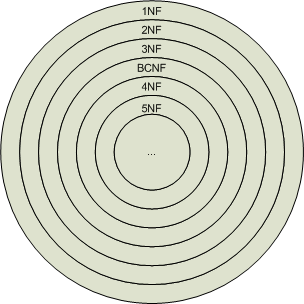
A table is in 4NF if it is in BCNF and has no non-trivial multi-valued dependencies. The solution, once again, is decomposition. We break the table apart to isolate the independent relationships.
Decompose to isolate independent facts. An employee's skills are a fact. Their project assignments are another fact. Don't mix them in one table.
| EmployeeID | Skill |
|---|---|
| 550 | Python |
| 550 | SQL |
| EmployeeID | Project |
|---|---|
| 550 | Project A |
| 550 | Project B |
With these two tables, we can add a new skill or a new project assignment with a single, simple insertion. The data is clean, and the risk of anomalies is gone.
The Performance Trade-Off
So, should every database be normalized to 4NF or BCNF? Not necessarily. While higher normal forms reduce redundancy and improve data integrity for write operations (inserts, updates, deletes), they can harm read performance. Every decomposition creates another table that must be joined during queries. For a database that is read from far more often than it is written to, such as in data warehousing or analytics, these joins can become a significant performance bottleneck.
This is why some systems use denormalization deliberately. They intentionally violate normalization rules to pre-join data, reducing query complexity and speeding up read access at the cost of increased storage and more complex write logic.
Denormalization
noun
The process of intentionally adding redundant data to one or more tables to improve query performance. It's a strategic trade-off, sacrificing storage efficiency and write simplicity for faster data retrieval.
In most cases, denormalization isn’t about rejecting best practices—it’s about making deliberate trade-offs when query performance, latency, and system responsiveness take precedence over perfect structure.
The key is to understand the trade-offs. For online transaction processing (OLTP) systems with frequent writes and a high need for consistency, striving for BCNF and 4NF is often the right choice. For online analytical processing (OLAP) systems, a more denormalized approach is usually better. Professional schema design involves analyzing the application's access patterns and choosing the level of normalization that best fits its needs.
Time to check your understanding of these advanced concepts.
A table is in Boyce-Codd Normal Form (BCNF) if, for every non-trivial functional dependency X → Y, what condition must X satisfy?
In the university course example, the table with (InstructorID, CourseID, Subject) was in 3NF but violated BCNF. Why?
Mastering these forms allows you to design robust, scalable, and consistent database schemas for even the most demanding applications.