Advanced Cybersecurity Strategies
Threat Landscape Overview
The Persistent Adversary
In cybersecurity, some attackers are sprinters, aiming for a quick score. Others are marathon runners. These are the Advanced Persistent Threats, or APTs. An isn't a piece of malware; it's a well-funded, patient, and highly skilled group, often backed by a nation-state. Their goal isn't a smash-and-grab. They aim for long-term infiltration to conduct espionage, steal intellectual property, or quietly disrupt critical systems over months or even years.
APTs operate with stealth and precision, often using custom-built tools that evade standard antivirus software. They meticulously research their targets, looking for the path of least resistance. To understand their methodical approach, security professionals often use a model called the Intrusion Kill Chain. It breaks down an attack into a sequence of phases, from initial reconnaissance to the final objective.
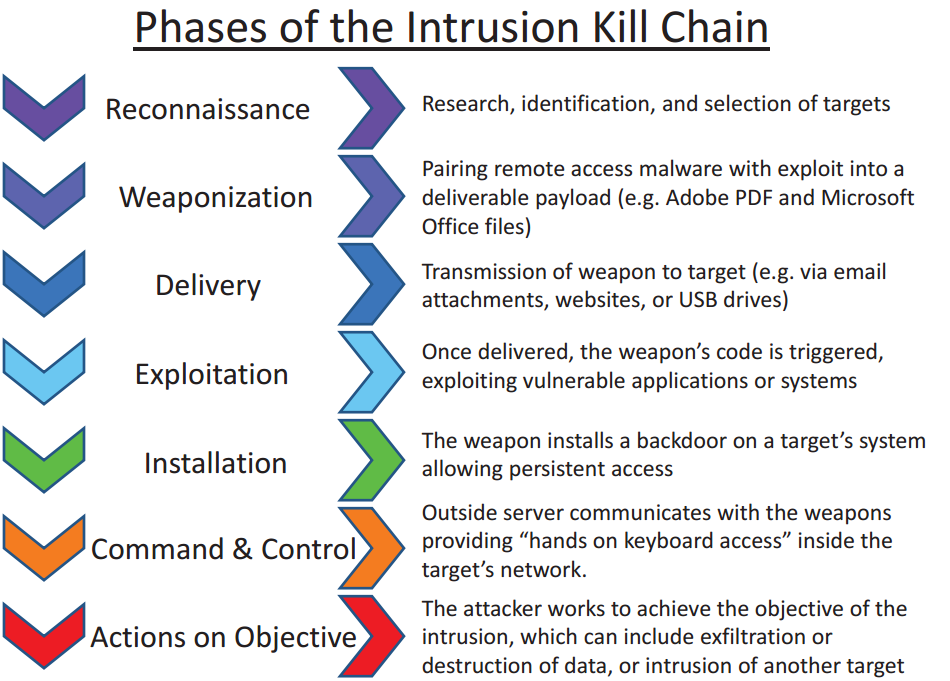
By understanding these phases, defenders can identify and disrupt an attack at various points along the chain. For instance, blocking a phishing email disrupts the 'Delivery' phase, while detecting unusual network traffic might stop the 'Command & Control' phase before major damage is done.
The Ransomware Economy
Ransomware has morphed from a digital nuisance into a full-fledged criminal economy. Early versions were simple, locking a user's screen and demanding a small payment. Today's ransomware is far more menacing. Attackers now practice "double extortion": they don't just encrypt your files; they steal sensitive data first and threaten to leak it publicly if the ransom isn't paid. This puts immense pressure on organizations, as a data breach can be more damaging than downtime.
This evolution is powered by the Ransomware-as-a-Service (RaaS) model. Think of it like a franchise. A core group of developers creates the ransomware and infrastructure. They then recruit "affiliates" who carry out the actual attacks. The affiliates use the provided tools to infiltrate networks, deploy the ransomware, and negotiate with victims. The profits are then split between the developers and the affiliate, typically with the affiliate keeping the larger share. This model lowers the barrier to entry, allowing less skilled criminals to launch devastating attacks.
Defending against modern ransomware requires more than just good backups. Strategies now include network segmentation to limit an attacker's movement and proactive threat hunting to find intruders before they can deploy their payload.
Attacking the Chain
Why break down a fortress door when you can be invited in? That's the logic behind a supply chain attack. Instead of targeting a well-defended organization directly, attackers compromise one of its trusted software vendors. By injecting malicious code into a legitimate software update, they can distribute their malware to thousands of the vendor's customers in a single stroke.
The most infamous example is the SolarWinds attack. In 2020, attackers believed to be associated with a Russian APT compromised the build process for SolarWinds' Orion Platform, a popular network management software. They inserted a tiny backdoor into a software update file. When SolarWinds customers, including US government agencies and Fortune 500 companies, installed the trusted update, they unknowingly installed the backdoor. The attackers then used this access to move deeper into the most sensitive networks in the world.
This type of attack is incredibly difficult to defend against because it exploits trust. Organizations rely on their software vendors and have security measures in place to validate official updates. The SolarWinds incident forced the entire industry to rethink how software is built, distributed, and trusted.
New Frontiers of Risk
The threat landscape is constantly expanding, with new technologies introducing new vulnerabilities. The Internet of Things (IoT) has connected everything from coffee makers to industrial control systems to the internet. Unfortunately, security is often an afterthought. Many IoT devices ship with default passwords, rarely receive software updates, and transmit data without encryption. This makes them easy targets for attackers, who can corral them into massive botnets to launch Distributed Denial-of-Service (DDoS) attacks or use them as a foothold to pivot into a more secure corporate network.
The move to the cloud presents another set of challenges. While cloud providers like Amazon and Google offer powerful security tools, the ultimate responsibility for securing data in the cloud often lies with the customer. A simple misconfiguration, like leaving a storage bucket open to the public, can expose massive amounts of sensitive data. These misconfigurations are one of the most common causes of major data breaches today.
Amidst all this technology, the human element remains a primary target. Social engineering has evolved far beyond generic phishing emails. Attackers now use —highly targeted emails that use personal information gathered from social media or previous breaches to appear legitimate. An even more focused variant is "whaling," which specifically targets high-level executives. By impersonating a CEO or CFO, an attacker can trick an employee into making unauthorized wire transfers or divulging confidential company strategy.
To stay ahead, organizations rely on threat intelligence—a constant stream of data about new attack tools, threat actor TTPs, and active campaigns. By understanding who the attackers are and how they operate, defenders can move from a reactive posture to a proactive one, hunting for threats before they cause damage.
What is the primary characteristic that distinguishes an Advanced Persistent Threat (APT) from a typical cybercriminal?
How does the Ransomware-as-a-Service (RaaS) model empower less skilled cybercriminals?