Advanced Curriculum Design for Teacher Development
Advanced Pedagogical Strategies
Beyond the Basics
Effective teaching is more than just delivering information. It's about creating environments where students actively build their own understanding. Two powerful theories that guide this modern approach are constructivism and connectivism. They shift the focus from the teacher as a source of knowledge to the teacher as a facilitator of learning.
Constructivism
noun
A learning theory suggesting that people construct their own understanding and knowledge through experiences and by reflecting on those experiences.
Constructivism views learners as builders. Instead of passively receiving facts, they are given the raw materials — experiences, problems, and resources — to construct their own mental models of the world. A history lesson might involve analyzing primary source documents rather than just memorizing dates from a textbook. The goal is for the student to build a durable, personal understanding.
Connectivism updates this idea for the digital age. It proposes that learning happens across networks. Knowledge isn't just inside our heads; it's distributed across connections we form with people, databases, and online resources. The most important skill is the ability to find, navigate, and nurture these connections.
Connectivism
noun
A learning theory for the digital age that emphasizes the role of social and cultural networks in how we learn.
| Feature | Constructivism | Connectivism |
|---|---|---|
| Learning Locus | Inside the learner's mind | Distributed across a network |
| Core Process | Building personal meaning | Making connections |
| Teacher's Role | Facilitator | Network guide |
| Key Skill | Critical thinking | Ability to find & filter information |
Tailoring the Lesson
If learners build knowledge differently and through diverse networks, it follows that a one-size-fits-all lesson plan will fail many of them. This is where differentiated instruction comes in. It's a proactive approach to teaching that acknowledges students have varied readiness levels, interests, and learning profiles.
Instead of making every student complete the same task in the same way, a teacher can differentiate one of four elements:
- Content: What the student needs to learn. Some students might get foundational texts, while others work with more complex sources.
- Process: The activities used to master the content. This could mean working in small groups, individually, or through hands-on projects.
- Product: How students demonstrate what they've learned. Options might include an essay, a podcast, a presentation, or a diagram.
- Learning Environment: The way the classroom works and feels. This includes flexible seating and a mix of quiet zones and collaborative spaces.
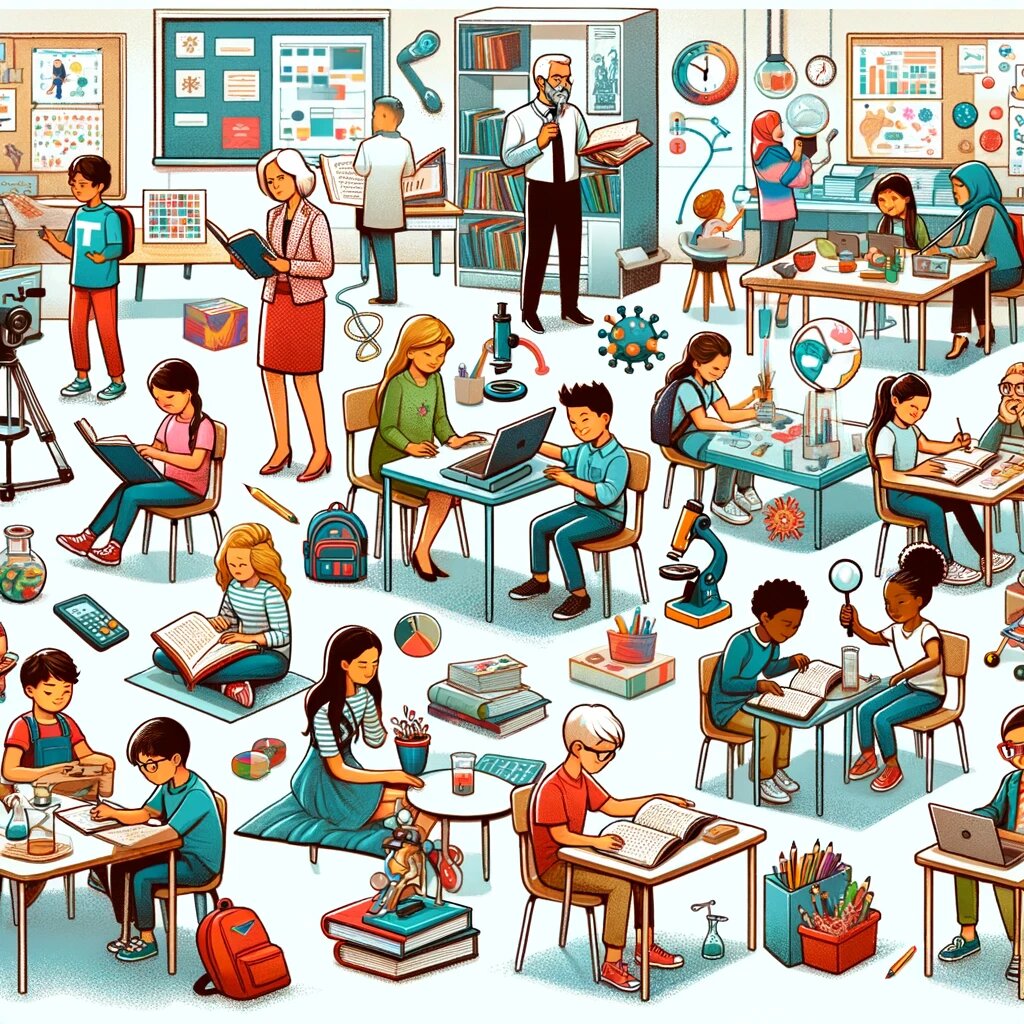
Closely related is the practice of culturally responsive teaching. This isn't just about celebrating holidays from around the world. It's about making learning more meaningful by connecting the curriculum to students' cultural backgrounds, lived experiences, and prior knowledge.
When a math teacher uses word problems that reflect the students' communities, or a literature teacher includes authors who share their students' identities, the material becomes more relevant and engaging. This approach builds a bridge between the student's home life and school life, creating a more inclusive and effective learning environment.
When students see themselves and their communities in their lessons, learning becomes personal and powerful.
Building Bridges to Understanding
To help students tackle complex new topics, educators can use instructional scaffolding. Just as scaffolding supports a building during construction, instructional scaffolding provides temporary support for students until they can handle the task on their own. This support is gradually removed as their competence grows.
Scaffolding
noun
A teaching method that involves providing temporary support to a student who is learning a new skill or concept. The support is gradually withdrawn as the student becomes more proficient.
Examples of scaffolding include:
- Modeling: The teacher demonstrates how to complete a task.
- Think-Alouds: The teacher verbalizes their thought process while solving a problem.
- Providing Examples: Showing students completed examples of the final product.
- Using Graphic Organizers: Supplying charts or diagrams to help students organize their thoughts.
A broader framework for supporting all learners is Universal Design for Learning (UDL). This approach comes from architecture, where the goal is to design buildings that are accessible to everyone from the start, rather than adding ramps or elevators as an afterthought.
In education, UDL means creating lessons that are flexible enough to meet the needs of all students. It focuses on providing multiple means of:
- Engagement (the “why” of learning): Sparking interest and motivation by offering choices and making learning relevant.
- Representation (the “what” of learning): Presenting information in different formats, like text, audio, video, and hands-on activities.
- Action & Expression (the “how” of learning): Giving students various ways to show what they know, such as writing, speaking, or drawing.
UDL isn't about giving some students special help; it's about designing better lessons for everyone.
By integrating these advanced strategies, educators move beyond simple instruction. They become architects of rich learning experiences that are adaptive, inclusive, and deeply effective.