Advanced CRISPR Gene Editing
Biochemical Site Recognition
The Guide and the Gatekeeper
The precision of CRISPR-Cas9 hinges on a molecular partnership between two key components. Think of it as a highly specific search-and-cut mission inside the cell's nucleus. The success of this mission depends entirely on the system's ability to recognize a unique address within the vast expanse of the genome. This recognition is not a single event, but a carefully choreographed sequence of molecular handshakes.
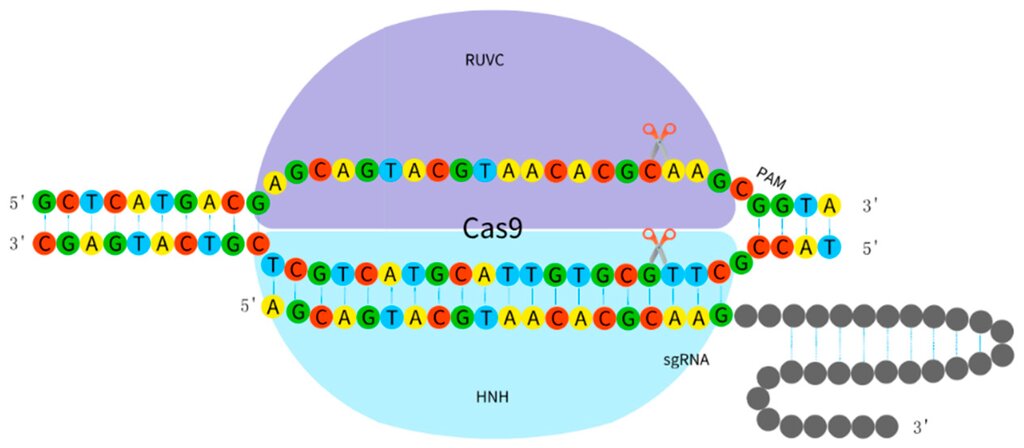
The first player is the , or sgRNA. This engineered molecule is the system's GPS. It consists of two distinct parts. The first is a 20-nucleotide 'spacer' region. This is the customizable sequence that scientists design to be perfectly complementary to the target DNA sequence they want to edit. It's the 'search' query for our genomic find-and-replace function. The second part is the 'scaffold,' a constant RNA structure that folds into a specific shape. This scaffold acts as a handle, securely docking into the Cas9 protein and holding it in an active, ready-to-scan conformation.
Finding the 'NGG' Landmark
Even with a precise guide, the Cas9 protein doesn't just bind anywhere the sgRNA matches. It needs a second checkpoint: the Protospacer Adjacent Motif, or PAM. For the most commonly used Cas9 from Streptococcus pyogenes, this motif is a simple three-nucleotide sequence: 'NGG,' where 'N' can be any DNA base. This PAM sequence must be present on the target DNA strand, immediately following the sequence that the guide RNA's spacer recognizes.
Once in the cell's nucleus, the Crispr-Cas9 complex bumps along the genome, attaching every time it comes across a small sequence called PAM.
Cas9 first scans the DNA for this PAM sequence. Only when it finds an 'NGG' does it pause and attempt to unwind the DNA double helix. This allows the sgRNA's spacer region to test for a match with the adjacent DNA sequence. This PAM-first recognition is a critical safety measure. It prevents the CRISPR system from targeting its own CRISPR locus within the bacterial genome, which contains the spacer sequences but lacks the PAM sites. It also dramatically narrows down the search space, ensuring Cas9 doesn't waste energy trying to bind to countless non-target sites.
Conformational Changes and the Cut
Once the PAM is verified and the sgRNA begins to form a stable duplex with the target DNA strand, the Cas9 protein undergoes a dramatic conformational change. It shifts from a flexible, open state to a rigid, locked conformation, fully encircling the DNA. This binding is energetically favorable. The formation of the stable DNA-RNA hybrid helix releases energy, which helps to lock the complex in place and ensure the edit happens at the right location.
This structural shift is what activates the enzyme's cutting machinery. Cas9 has two separate nuclease domains, , that act as molecular scissors. The conformational change brings these domains into position. The HNH domain moves to cleave the DNA strand that is paired with the guide RNA (the target strand). Simultaneously, the RuvC domain cleaves the opposite, non-target strand. The result is a clean, double-strand break (DSB) at a precise location, typically 3-4 bases upstream of the PAM sequence. This break is the starting point for all subsequent gene editing events.
The entire process, from initial scanning to the final cut, is a masterclass in biochemical precision. Each step, from the sgRNA's design to the PAM requirement and the final conformational change, serves as a checkpoint to ensure the powerful gene-cutting machinery is deployed only at the intended genomic address.
What are the two main functional parts of the single guide RNA (sgRNA)?
In the CRISPR-Cas9 editing process, what is the first thing the Cas9 protein recognizes on the target DNA?